House Arryn Map The Eyrie, Vale of Arryn, Gulltown & Mountain Power
The Eyrie · Vale of Arryn · Gates of the Moon · Gulltown · Mountains of the Moon
Explore the complete House Arryn map through the mountain geography that makes the Vale nearly untouchable: the Eyrie, the Gates of the Moon, Gulltown, the High Road, the Bloody Gate, the Mountains of the Moon, and the political routes of Jon Arryn, Lysa, Robin, Sansa, and Littlefinger.
House Arryn rules the Vale of Arryn in eastern Westeros from the Eyrie — a high mountain fortress considered one of the most defensible seats in the known world. The House Arryn map covers the Eyrie, Gates of the Moon, Gulltown, the High Road, the Bloody Gate, and the Mountains of the Moon. House Arryn’s sigil is a white falcon and crescent moon on sky blue; its words are “As High as Honor.” The Vale’s power comes from mountain geography, political isolation, old Andal prestige, and strategic control of the only roads into the region.
House Arryn at a Glance
Eight fast facts connecting the Eyrie to mountain defense, Gulltown trade, old Andal honor, and the guarded entrances that define Arryn territory.
A high mountain castle famed for isolation, near-impossible assault, and the Moon Door.
A protected eastern valley ringed by the Mountains of the Moon, hard to enter by force.
White falcon and crescent moon on sky blue — sky, height, old nobility, watchfulness.
A motto of elevation and aristocratic prestige that mirrors both castle and character.
The narrow, heavily defended mountain passage that makes Vale invasion almost impossible.
The Vale’s major harbor; a sea connection to trade, news, and wider Westerosi politics.
The perilous mountain road into the Vale, controlled by terrain and mountain clans.
The Vale becomes a hidden stage for survival, manipulation, and political education.
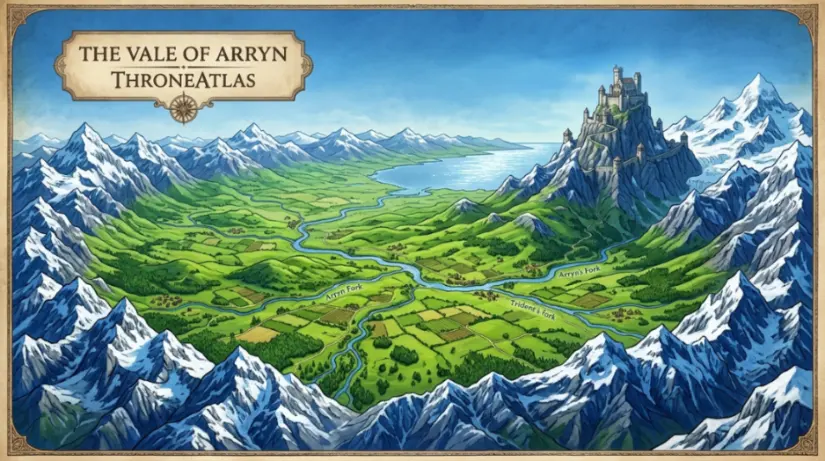
House Arryn Territory and Mountain Defense Map
A stylized ThroneAtlas view of the Vale of Arryn, showing the Eyrie, Gates of the Moon, Gulltown, the Bloody Gate, the High Road, and the mountain barriers that define Arryn power.
Explore House Arryn by Mountain Power Center
Select any Arryn location to understand how height, roads, gates, ports, and isolation shape the Vale’s role in the wider game of thrones.
The Eyrie
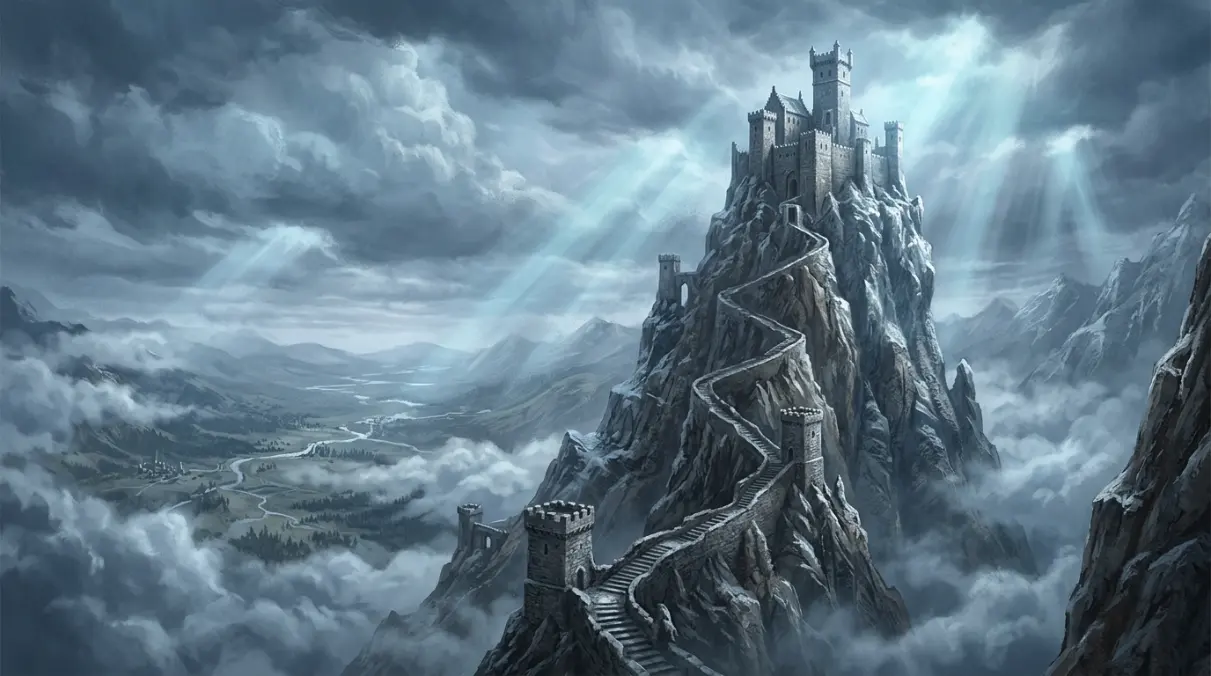
The Eyrie is the seat of House Arryn and one of the most celebrated mountain castles in Westeros. Its altitude makes assault nearly impossible, and it transforms Arryn power into a symbol of isolation, noble prestige, and cold judgment.
What the House Arryn Map Actually Shows
The House Arryn map is, at its core, a map of elevation and patience. The Eyrie, the Bloody Gate, the High Road, Gulltown, and the Mountains of the Moon form a defensible system that allows the Arryns to choose when — or whether — to involve themselves in the wider conflicts of Westeros.
That’s different from almost every other great house. The Lannisters have gold. The Starks have cold and loyalty. The Tyrells have bread and roses. House Arryn has position — and they’ve used it brilliantly for generations. Their strength doesn’t announce itself with dragon fire or golden banners. It just waits, behind stone and sky, until waiting becomes the most powerful move on the board.
What makes the Arryn map genuinely interesting is what it doesn’t include. There’s no river of conquest, no trade empire, no legendary sword. The Vale simply sits there, ringed by mountains, and dares the rest of the realm to come take it.
The Eyrie: Westeros’s Most Famous Sky Fortress
The Eyrie is the seat of House Arryn and one of the most extraordinary castles in all of Westeros. It’s not the largest castle, and it’s not the most comfortable — in winter it becomes so cold and inaccessible that the Arryn household descends to the Gates of the Moon below. But it doesn’t need to be the biggest. It needs to be the hardest to reach, and on that metric it has no competition.
The Eyrie’s location matters for another reason. In symbolic terms, it’s almost too perfect for the Arryns: noble, distant, dangerous to reach, and very easy to fall from. That last part is literal. The Moon Door — a trapdoor that opens above a thousand-foot drop — turns the Eyrie from merely a fortress into something closer to a throne of judgment.
Why the Eyrie Is Nearly Impossible to Assault
There’s no realistic siege of the Eyrie. You’d need to fight your way up a mountain path through multiple waycastles — Sky, Stone, and Snow — while defenders rain arrows from above. Even if you somehow managed all of that, you’d arrive at walls that sit on a natural rock platform with sheer drops on every side. Armies that could crack the Eyrie would already have lost half their force on the mountain. That’s not a castle. That’s a geography lesson.

The Vale of Arryn: A Kingdom Protected by Mountains
The Vale of Arryn is one of the most naturally protected regions in Westeros. The Mountains of the Moon form a near-complete ring around the valley, making it nearly impossible to enter with an organized army. That geographic fact has defined Arryn politics for centuries — and explains why the Vale emerged from the War of the Five Kings with its strength largely intact while other regions were devastated.
The Vale also carries a specific kind of cultural weight. It’s strongly associated with Andal heritage and the old nobility that crossed the Narrow Sea thousands of years before the main story begins. That history gives Arryn rule a sense of deep legitimacy — they aren’t new money or recent conquerors. They’ve been here, at this height, for a very long time.
That combination of geography and prestige creates a region with an unusual personality: proud, formal, somewhat insular, and quietly confident that the rest of the realm should be grateful it’s not currently being invaded from the east.
The Bloody Gate: Where Geography Becomes Military Architecture
The Bloody Gate is arguably the single most strategically important point on the House Arryn map. It’s the narrow fortified passage that controls land access into the Vale through the Mountains of the Moon, and it’s named — unsurprisingly — after how many armies have tried and failed to force it.
Think of the Bloody Gate as the lock on the Vale’s door. A rich valley surrounded by mountains is only as defensible as its entrances, and the Arryn lords understood this early. The Gate was built not just to stop armies, but to make the idea of invading the Vale feel futile before the first sword is even drawn.
During the War of the Five Kings, this is exactly what happens. While the Riverlands burn and the Stormlands mobilize, the Vale sits quietly behind the Bloody Gate and watches. That silence isn’t cowardice. It’s geography weaponized over generations.
The High Road and the Mountain Clans of the Vale
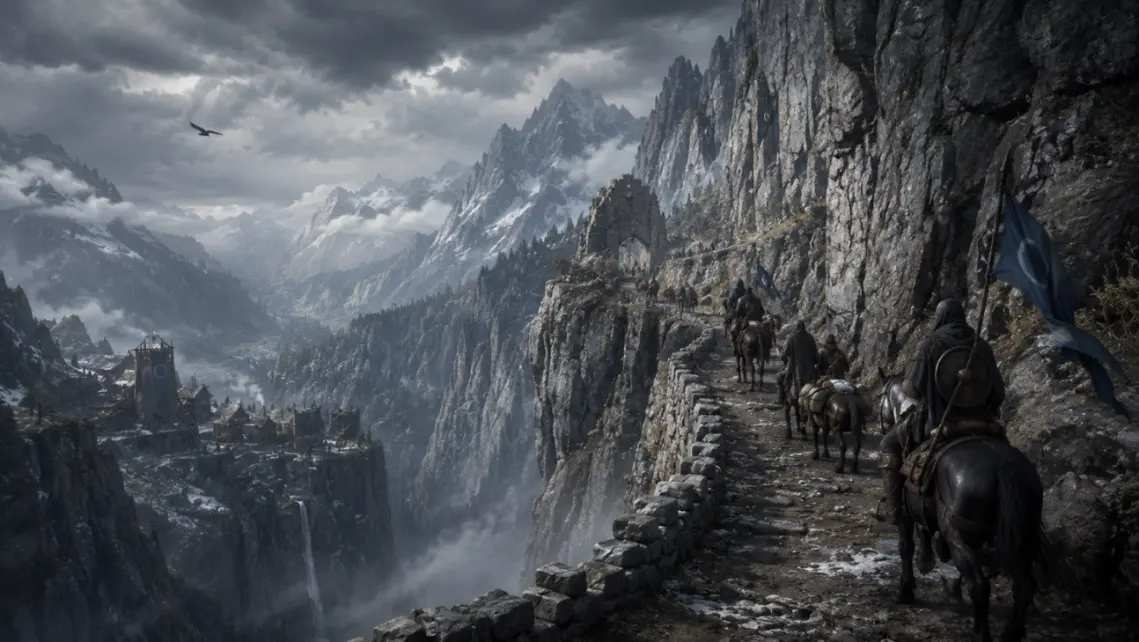
The High Road is the dangerous overland route that connects the Vale to the rest of Westeros through the Mountains of the Moon. It’s the path that travelers must take when they can’t arrive by sea, and it’s rarely comfortable.
Mountain clans — tribal groups who live in the mountains and have long raided travelers and lowland settlements — make the High Road genuinely hazardous. The Clans of the Mountains of the Moon include the Stone Crows, Moon Brothers, Painted Dogs, and Black Ears, among others. They’re not a unified army, but they’re persistent, and they know the terrain far better than any southern knight ever will.
Tyrion Lannister’s passage through this region in the first book is one of the story’s more underappreciated geography moments. His decision to arm the mountain clans — and their subsequent impact on the broader conflict — shows exactly how important the High Road’s instability is to the wider map.
Gulltown: The Vale’s Sea Gate and Trade Hub
Gulltown is the major port city of the Vale and an essential counterweight to the Eyrie on the House Arryn map. The Eyrie represents height, isolation, and old prestige. Gulltown represents access, movement, and commerce. Together, they show that the Vale isn’t sealed from the world — it just controls how the world gets in.
Located on the eastern coast, Gulltown faces the Narrow Sea and handles the Vale’s maritime trade routes. Ships from across the known world can dock there, which means news, merchants, and political information all flow through Gulltown before they reach the mountain roads. For a region that is often described as isolated, that’s a significant window to the outside.
In fan discussions, Gulltown is sometimes overlooked because it doesn’t get much direct screen time. But it matters enormously on the map level. Without Gulltown, the Vale would truly be a sealed fortress. With it, the Vale is a protected region with selective engagement — which is considerably more powerful.
Jon Arryn: The Hand Whose Death Begins Everything
Jon Arryn is one of the most consequential characters in the entire story despite dying before the first scene of Game of Thrones. As Hand of the King under Robert Baratheon, Jon Arryn was the primary political manager of the realm — the man holding the court together while Robert hunted and drank.
His death — poisoned by his own wife at Littlefinger’s instigation, as we eventually learn — sets every main storyline in motion. It draws Ned Stark south to King’s Landing. It sends the letter that warns Catelyn. It triggers the investigation into royal legitimacy that underpins the entire conflict between the Lannisters and the Baratheons.
Geographically, Jon Arryn’s story connects the Vale to King’s Landing, Winterfell, and the Iron Throne in ways that make House Arryn far more central than its mountain location might suggest. The Vale is distant, but Jon Arryn’s career placed Arryn influence at the absolute center of the realm for nearly two decades.
Lysa Arryn, Robin Arryn, and the Politics of Withdrawal
Lysa Arryn takes over the Vale after Jon’s death, and her leadership turns the region’s natural defensiveness into something more personal — and more dangerous. She withdraws from the war, barricades herself in the Eyrie, and tries to protect her son Robin from a realm she believes wants to destroy what’s hers.
That decision to stay out of the War of the Five Kings is politically significant. The Vale has the soldiers, the resources, and the strategic position to tip the war. Its neutrality isn’t weakness — but it’s also not deliberate strategy. It’s grief, paranoia, and possessiveness shaped into policy.
Robin Arryn — young, frail, still nursing at an age that raises eyebrows across the realm — inherits the symbolic height of his house without the strength those words imply. He’s not cruel, exactly. He’s been raised in a fortress above the world and has never had to reckon with it. The Moon Door becomes almost a metaphor: power to cast people out, in the hands of a child who doesn’t fully understand what that means.
Sansa Stark in the Vale: A Hidden Stage for Political Education
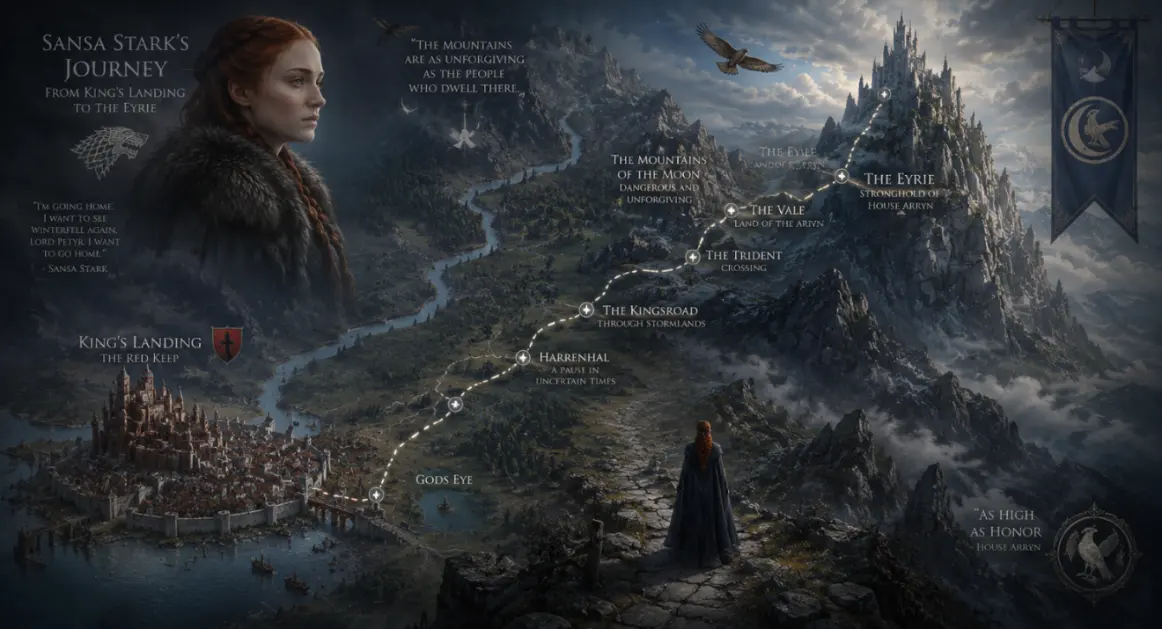
Sansa Stark gives the Vale one of its most important character routes on the House Arryn map. After escaping King’s Landing following Joffrey’s death, she’s brought to the Eyrie by Littlefinger — disguised as his bastard niece “Alayne Stone.”
That period in the Vale is undervalued in fan discussions because it doesn’t have the dramatic set-pieces of King’s Landing or Winterfell. But it’s where Sansa goes from a political hostage to someone who begins to understand how power actually works. She watches Littlefinger manipulate Lysa. She manages Robin’s moods. She starts to see that the game is played in whispers and positioning, not just in battles.
For ThroneAtlas, the Sansa route through the Vale is valuable precisely because it shows how geography can shape character. The Eyrie’s isolation removes her from the noise of the capital and forces her to pay attention to the person beside her. The Vale isn’t her home — but it’s where she starts becoming someone who might survive.
Littlefinger and the Map of Opportunity
Petyr Baelish — Littlefinger — sees the Vale more clearly than almost anyone else in the story. He recognizes that it’s strong, protected, underused, and vulnerable through exactly one channel: personal relationships. Stone gates are impenetrable. Hearts are not.
By leveraging his history with Lysa, his manipulation of Robin, and his careful management of Sansa, Littlefinger converts one of Westeros’s most defensible regions into a personal power base. He becomes Lord Protector of the Vale without ever winning a battle. He doesn’t need armies. He has access to the person who controls the armies.
That’s the real lesson of the House Arryn map. The Bloody Gate can stop an invasion. It can’t stop someone Lysa invites through the Moon Gate for love. The fortress is as strong as its most vulnerable occupant — and in this case, that’s very vulnerable indeed.
The Falcon-and-Moon Sigil and What It Actually Means
House Arryn’s sigil — a white falcon and crescent moon on sky blue — is one of the most spatially honest symbols in Westeros. Every element earns its place.
The falcon belongs to height, wide vision, and the kind of watchful patience that comes from surveying everything from above. Falcons are noble hunting birds, yes — but they’re also animals that see what others can’t, from a vantage point others can’t reach. That’s exactly what the Eyrie provides politically.
The crescent moon adds cold light, night-watch symbolism, and a sense of old mystery. It’s not the full, assertive circle of a sun — it’s a partial light, suggesting restraint and something held in reserve.
The words, “As High as Honor,” complete the picture. Honor as elevation. Nobility as altitude. It’s a beautiful phrase — but it also contains the Arryn weakness. When you’re that high, you can lose touch with the ground. And the ground is where history actually happens.
Explore More: Arryn Locations, Routes & Lore
This House Arryn map guide connects to the broader ThroneAtlas cluster covering Vale of Arryn geography, the Eyrie in detail, the Bloody Gate’s military role, Sansa Stark’s full journey map, Jon Arryn’s death and its consequences, and the complete Westeros map.
For anyone studying the wider political geography of Westeros, House Arryn is essential. The Vale shows that a region can shape the story through its absence as much as its actions. Mountains don’t need to march to matter.
Where to Go Next: The Complete Arryn Guide Path
Follow these six steps through House Arryn to explore the full Vale, mountain defense, court mystery, and the Sansa–Littlefinger storyline in order.
Regional guide — Start here for the full geographic picture: the Eyrie, Gulltown, Bloody Gate, mountain clans, High Road, and Vale isolation explained in detail.
Location guide — Deep-dive into the Eyrie’s layout, waycastles, Moon Door, symbolic meaning, and its role for Lysa, Robin, Sansa, and Littlefinger.
Character route — Tracks Sansa from Winterfell through King’s Landing to the Vale, covering disguise, political education, and her eventual northern return.
Defense guide — The strategic case for the Vale’s invincibility: mountain access, invasion difficulty, waycastle positions, and guarded road control.
Lore guide — How Jon Arryn’s murder connects the Vale to King’s Landing, Ned Stark, royal legitimacy, and the chain of events that breaks the realm.
Trade guide — The Vale’s sea access, eastern economy, Narrow Sea trade routes, and the commercial contrast with the highland Eyrie.
Places, Characters & Events Tied to House Arryn
The Arryn map connects the Vale’s mountain-route geography, political withdrawal, Sansa’s survival arc, Littlefinger’s schemes, and the King’s Landing mystery cluster.
Key Places
The Eyrie, Vale of Arryn, Bloody Gate, Gates of the Moon, Gulltown, High Road, Mountains of the Moon, King’s Landing, and Winterfell — all connected through Arryn alliances, character routes, and political consequence.
Key Characters
Jon Arryn, Lysa Tully Arryn, Robin Arryn, Sansa Stark, Petyr “Littlefinger” Baelish, Catelyn Tully, Tyrion Lannister, Ned Stark, Robert Baratheon, and Varys — each shaped by or shaping the Vale’s hidden influence.
Key Events & Lore
Jon Arryn’s murder, Lysa’s poisoning, the Moon Door trial, Andal settlement of the Vale, War of the Five Kings (Vale neutrality), mountain clan destabilization, and Littlefinger’s rise to Lord Protector of the Vale.
House Arryn Map — Frequently Asked Questions
Common questions about the House Arryn map, the Eyrie, the Vale of Arryn, Gulltown, the Bloody Gate, and Arryn lore answered directly.
House Arryn is located in the Vale of Arryn in eastern Westeros, directly east of the Riverlands and north of the Crownlands. The family rules from the Eyrie, a high mountain fortress in the Mountains of the Moon. The Vale’s eastern border faces the Narrow Sea, where Gulltown serves as the region’s major port city.
The seat of House Arryn is the Eyrie — a small but extraordinarily defensible castle built high in the Mountains of the Moon atop the Giant’s Lance peak. It is reached by ascending a dangerous mountain path through three waycastles (Stone, Snow, and Sky). During winter, when the Eyrie becomes too cold and isolated, the Arryn household descends to the Gates of the Moon at the mountain’s base.
House Arryn’s words are “As High as Honor” — a motto reflecting elevation, prestige, and old aristocratic identity. Their sigil is a white falcon and crescent moon on a sky-blue field. The falcon symbolizes height, watchfulness, and noble bearing; the crescent moon adds cold light, restraint, and old mystery. Together, sigil and words position House Arryn as a house defined by altitude — both literal and moral.
The Vale of Arryn is one of Westeros’s most defensible regions because the Mountains of the Moon form a near-complete natural barrier around the valley. The main land entrance is controlled by the Bloody Gate — a narrow fortified pass where defenders hold overwhelming advantage over attackers. The High Road through the mountains is treacherous, exposed to mountain clan raids, and offers almost no tactical advantage to an advancing army. Only Gulltown provides sea access, but a naval assault would face its own challenges.
Gulltown is the Vale’s major port city and the region’s connection to maritime trade, Narrow Sea shipping routes, and the outside world. It prevents the Vale from being completely isolated, giving House Arryn access to news, merchants, and political information from across Westeros and beyond. Without Gulltown, the Vale would be a sealed fortress. With it, the Vale is a strategically protected region that selectively engages with the wider economy and politics of the realm.
The Vale’s neutrality during the War of the Five Kings was primarily the result of Lysa Arryn’s decision as Lady Regent. After Jon Arryn’s death, Lysa retreated to the Eyrie and refused to commit Vale forces to any faction — partly out of grief and paranoia, partly out of a desire to protect her son Robin. The geography reinforced this: behind the Bloody Gate, the Vale could simply watch the rest of the realm tear itself apart. That neutrality preserved the Vale’s fighting strength, but it also meant the Arryns exercised no real influence during one of the realm’s most consequential conflicts.
The Moon Door is a trapdoor set in the floor of the High Hall of the Eyrie that opens onto a sheer drop of several hundred feet into the valley below. It is used as a method of execution — condemned prisoners are cast through the Moon Door rather than hanged. In the story, it becomes symbolically important: Robin Arryn is fascinated by it in a way that reflects his sheltered, somewhat disturbed upbringing. Tyrion is nearly cast through it. The Moon Door turns the Eyrie’s height from a geographic fact into a moral statement.
Related Arryn Maps, Routes, Lore & Locations
ThroneAtlas is an independent fan-made map and lore reference guide. It is not affiliated with, endorsed by, or connected to HBO, Warner Bros. Discovery, George R. R. Martin, or any official Game of Thrones, House of the Dragon, or A Song of Ice and Fire property. All character names, locations, and trademarks are the property of their respective owners. Last reviewed: May 2026.