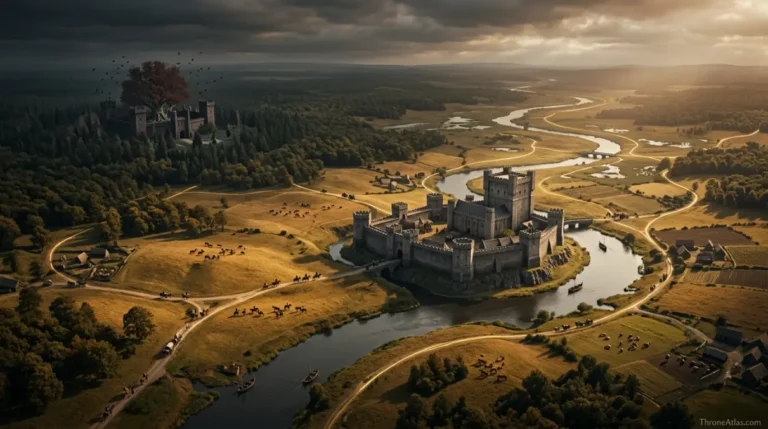
Battle of Winterfell Map Living Army, Trenches, Dragons, Crypts, Godswood & Night King Battlefield
A tactical reading of Winterfell’s defenses, the dead’s pressure line and the Godswood trap
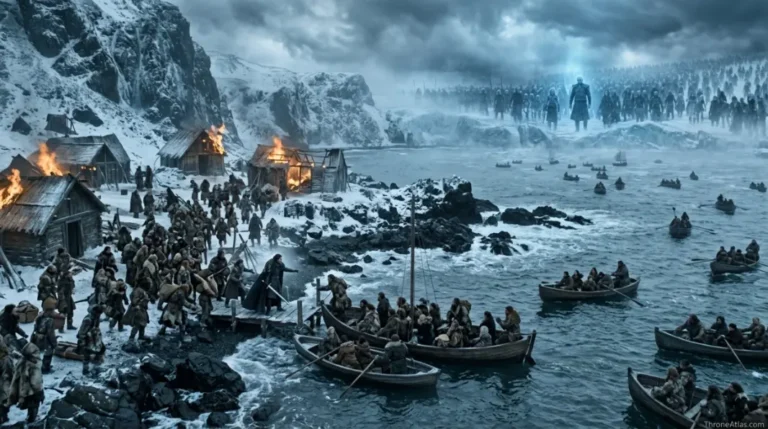
The Battle of Winterfell map is a defensive collapse and bait map. It tracks how the living place cavalry, infantry, trenches, dragons, crypts and Bran around one objective: survive long enough for the Night King to enter the Godswood.
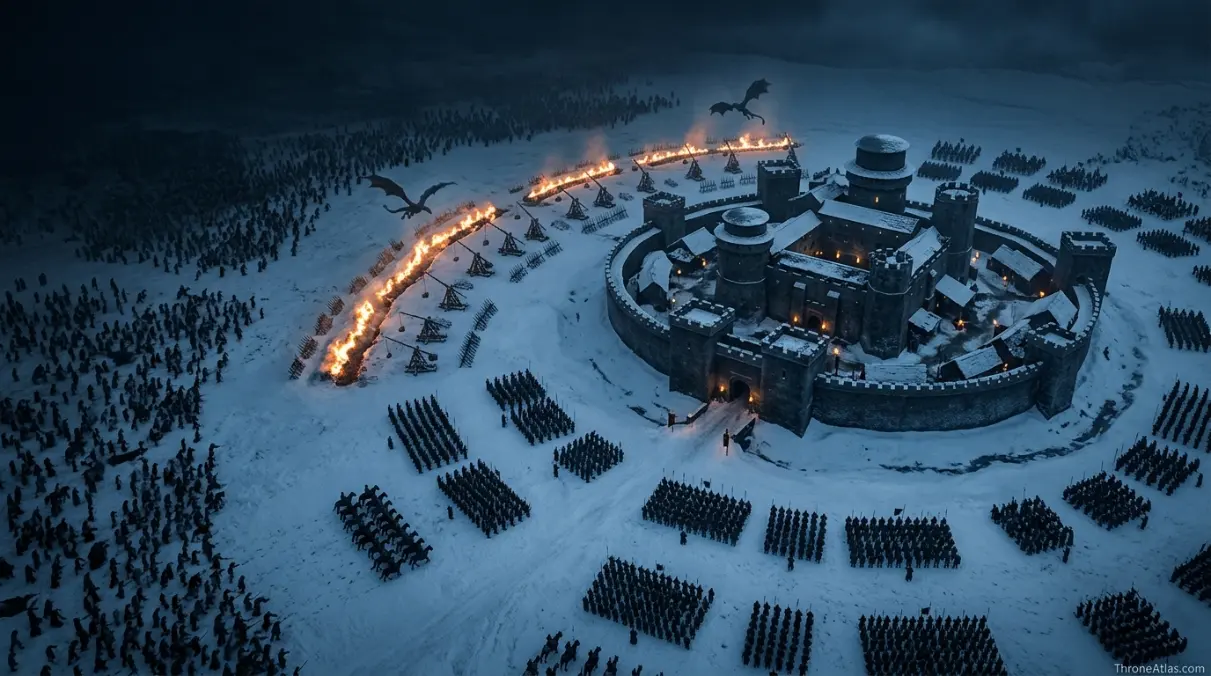
The Battle of Winterfell map centers on the castle exterior, the Dothraki forward charge, Unsullied and northern infantry lines, the trench system, dragon airspace, the crypts, the inner castle, and the Godswood where Bran waits for the Night King. The battlefield is best read as a compression map: the dead push the living from open field to trench, from trench to walls, from walls to interior survival, and finally to the Godswood kill zone where Arya ends the threat.
What this Battle of Winterfell Map explains
The fast cards below give the two-minute answer before the deeper route, table and FAQ sections.
Main stops on the Battle of Winterfell Map
This simplified route graphic is designed for reading flow, not exact geographic scale. Use it to understand order, pressure and consequence.
The cavalry opens the battle but vanishes quickly, showing the scale of the dead.
Unsullied, northerners and allies form the first real shield before the castle.
Jon and Daenerys use dragons for fire support and Night King pursuit.
The trench delays the dead and buys time for retreat into Winterfell.
The dead climb and overwhelm fixed defenses through sheer numbers.
The crypts become dangerous when the dead inside rise.
The battle becomes fragmented fighting room by room and yard by yard.
The Night King reaches Bran before Arya’s strike ends the invasion.
Complete Battle of Winterfell Map Guide
A thin map page only lists names. A strong ThroneAtlas page explains how places create pressure, change decisions and connect to the wider atlas. This guide is built to help readers follow the route, understand the stakes at each stop, and continue into connected maps without losing context.
How to read the Battle of Winterfell battlefield
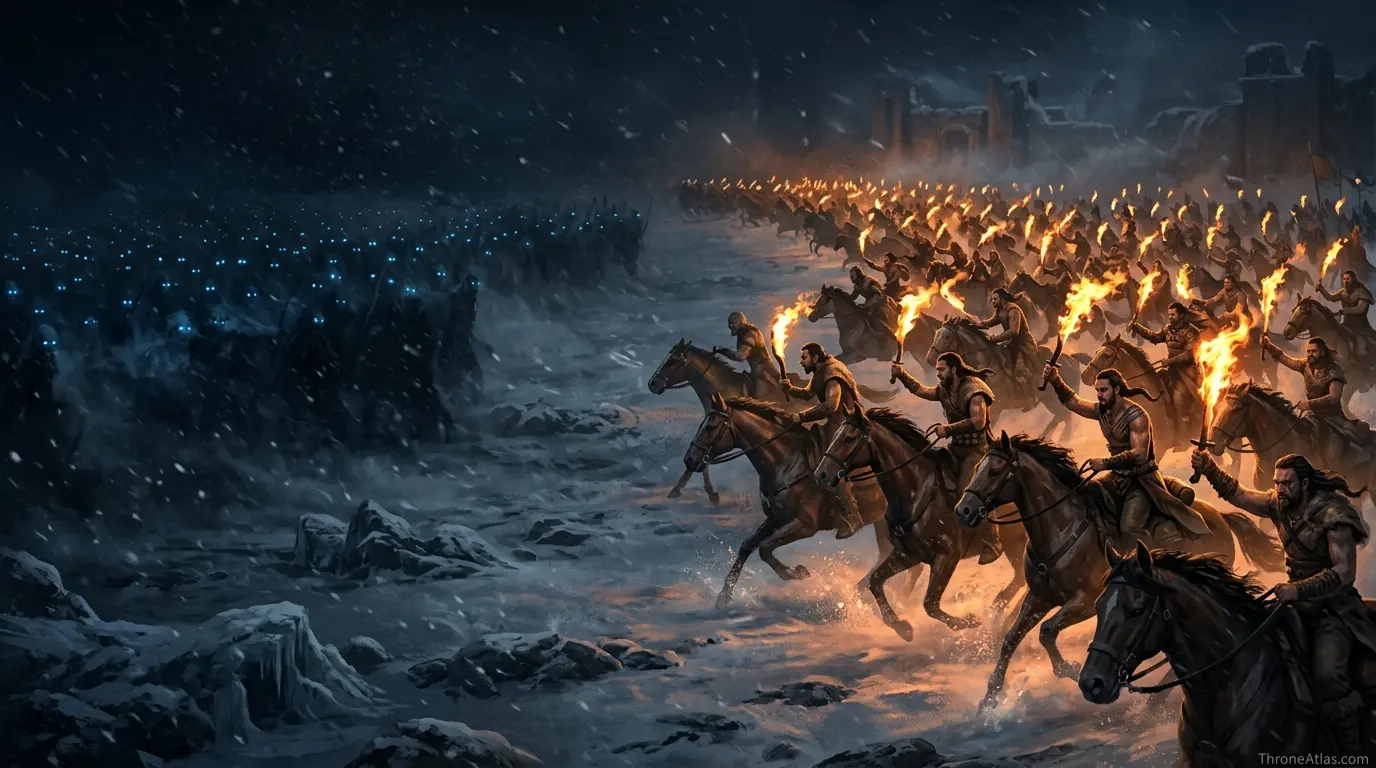
The Battle of Winterfell is easiest to understand as an inward compression map. The living begin outside the castle with cavalry, infantry and dragons. As the dead advance, the fight moves to trenches, walls, interior spaces and finally the Godswood.
This structure matters because many viewers remember individual moments but lose the spatial logic. The battle is not random chaos. It is a sequence of defensive layers failing one after another until the plan depends entirely on Bran’s bait position and Arya’s movement.
For search intent, the page should answer where each force starts, why the Dothraki charge fails, what the trenches do, why the crypts are unsafe, and where the Night King dies.
Dothraki charge, infantry line and the first collapse
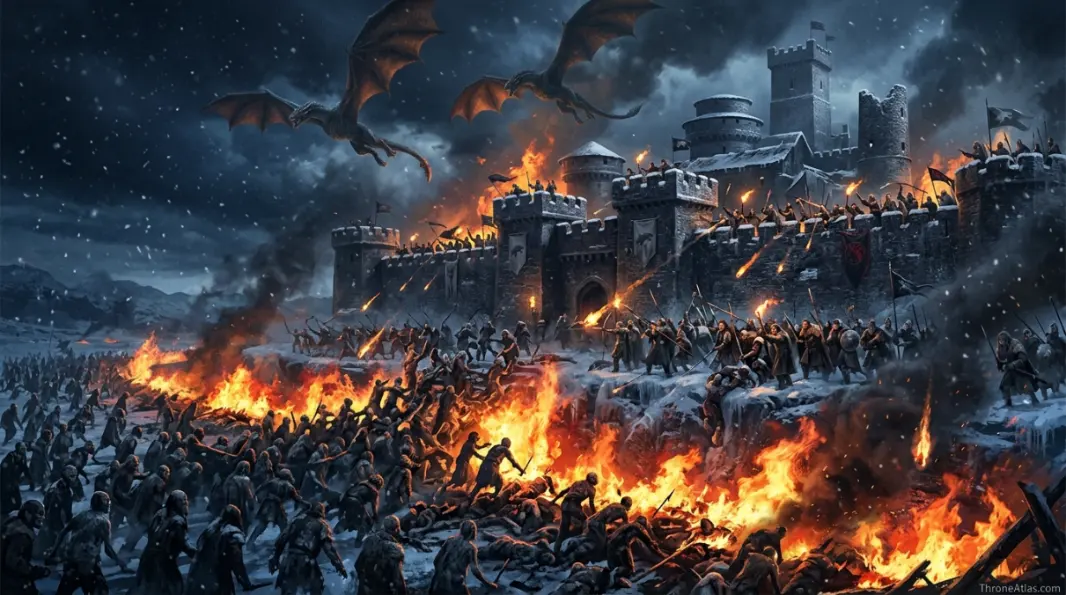
The Dothraki charge is the most debated opening decision because it sends cavalry into darkness against an enemy that does not fear morale shock. On the map, the charge serves a dramatic and tactical purpose: it reveals the dead’s scale and removes the possibility of a clean open-field victory.
The main infantry line then becomes the true first defense. Unsullied discipline, northern fighters and allied forces absorb the pressure long enough for retreat and trench ignition. This part of the map should be explained as a delaying action, not a winning position.
The emotional visual is simple: the living begin with fire moving outward and quickly learn that the battle will be fought by contraction.
Trenches, walls and the failure of static defense
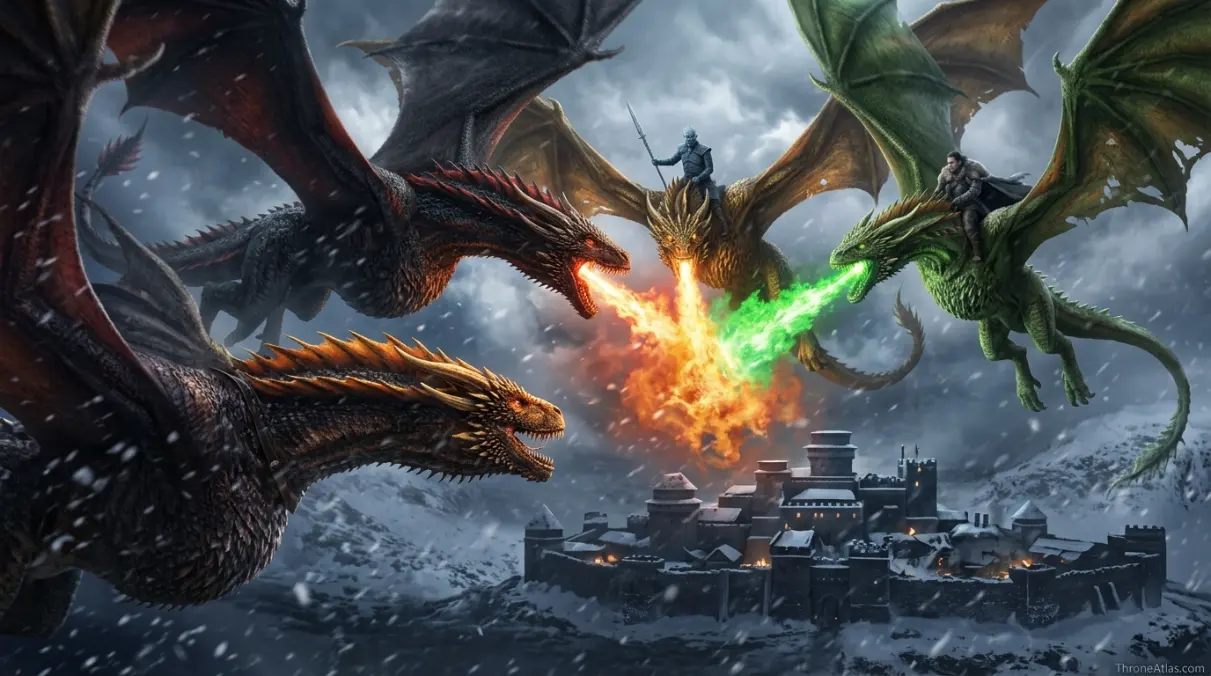
The trench ring is Winterfell’s strongest prepared barrier, but it is not permanent defense. It buys time. Once the dead bridge, smother or cross it, the castle walls become the next line.
This matters for map clarity because the trenches divide the battle into phases. Outside the trench is field battle. At the trench is retreat and fire control. Inside the trench is siege survival. The viewer can track the battle by watching which ring has failed.
For internal linking, this section connects to Winterfell Map, White Walker Map, Night King Route Map and Long Night Map. It is where location, enemy mechanics and battle planning meet.
Godswood endpoint and Arya’s route through the battlefield
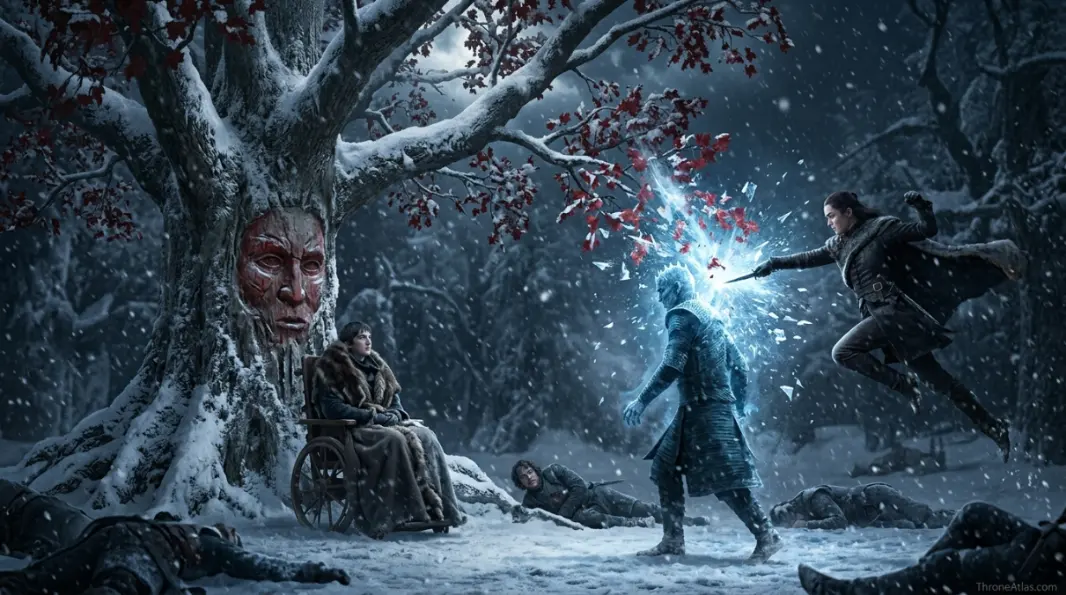
The Godswood is the correct endpoint because the battle’s objective is never simply to kill every wight. The objective is to draw the Night King to Bran. That makes Bran’s position the center of the map even when most fighting happens elsewhere.
Arya’s final strike works because the map has narrowed. The dead are inside. Theon has fallen. The Night King believes the target is isolated. The heart tree turns the battle from mass warfare into one instant of movement.
This is why the Battle of Winterfell Map should link to Arya Stark Journey Map, Bran Stark, Theon Greyjoy Journey Map, Night King Route Map and Long Night Map.
Detailed map reading for Battle of Winterfell Map
The quick route above gives the order, but the deeper value of this battle map is in the transition between points. A thin page says what happened; a true ThroneAtlas page explains why a location changes the next decision, danger, alliance, or battlefield condition.
For Battle of Winterfell Map, each stop should be read as a pressure point. The map does not exist only to decorate the story. It reveals distance, leverage, timing, memory, fear, terrain and political consequence. That is what makes the page useful for readers who want more than a recap.
1. Forward Field — Dothraki charge
The cavalry opens the battle but vanishes quickly, showing the scale of the dead. On the atlas, this point belongs to Outside Winterfell. Its job is to change what can happen next: movement becomes harder, trust becomes weaker, defense becomes narrower, or a hidden truth becomes impossible to contain. From this stop, the page naturally moves toward Main Line, carrying the consequence forward instead of treating the event as isolated.
2. Main Line — Infantry defense
Unsullied, northerners and allies form the first real shield before the castle. On the atlas, this point belongs to Winterfell approach. Its job is to change what can happen next: movement becomes harder, trust becomes weaker, defense becomes narrower, or a hidden truth becomes impossible to contain. From this stop, the page naturally moves toward Dragon Airspace, carrying the consequence forward instead of treating the event as isolated.
3. Dragon Airspace — Aerial fight
Jon and Daenerys use dragons for fire support and Night King pursuit. On the atlas, this point belongs to Above Winterfell. Its job is to change what can happen next: movement becomes harder, trust becomes weaker, defense becomes narrower, or a hidden truth becomes impossible to contain. From this stop, the page naturally moves toward Trench Ring, carrying the consequence forward instead of treating the event as isolated.
4. Trench Ring — Fire barrier
The trench delays the dead and buys time for retreat into Winterfell. On the atlas, this point belongs to Outer defense. Its job is to change what can happen next: movement becomes harder, trust becomes weaker, defense becomes narrower, or a hidden truth becomes impossible to contain. From this stop, the page naturally moves toward Castle Walls, carrying the consequence forward instead of treating the event as isolated.
5. Castle Walls — Siege pressure
The dead climb and overwhelm fixed defenses through sheer numbers. On the atlas, this point belongs to Winterfell. Its job is to change what can happen next: movement becomes harder, trust becomes weaker, defense becomes narrower, or a hidden truth becomes impossible to contain. From this stop, the page naturally moves toward Crypts, carrying the consequence forward instead of treating the event as isolated.
6. Crypts — False refuge
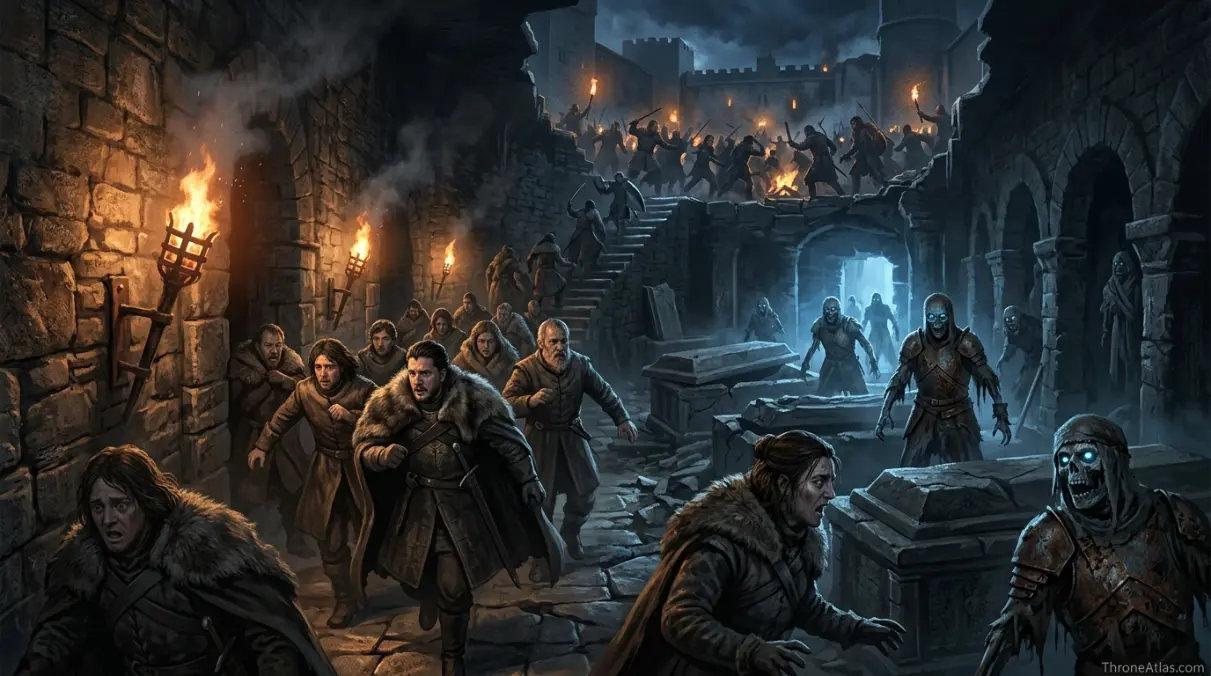
The crypts become dangerous when the dead inside rise. On the atlas, this point belongs to Winterfell interior. Its job is to change what can happen next: movement becomes harder, trust becomes weaker, defense becomes narrower, or a hidden truth becomes impossible to contain. From this stop, the page naturally moves toward Courtyard, carrying the consequence forward instead of treating the event as isolated.
7. Courtyard — Close survival
The battle becomes fragmented fighting room by room and yard by yard. On the atlas, this point belongs to Winterfell interior. Its job is to change what can happen next: movement becomes harder, trust becomes weaker, defense becomes narrower, or a hidden truth becomes impossible to contain. From this stop, the page naturally moves toward Godswood, carrying the consequence forward instead of treating the event as isolated.
8. Godswood — Final trap
The Night King reaches Bran before Arya’s strike ends the invasion. On the atlas, this point belongs to Winterfell heart tree. Its job is to change what can happen next: movement becomes harder, trust becomes weaker, defense becomes narrower, or a hidden truth becomes impossible to contain. From this stop, the page naturally moves toward Forward Field, carrying the consequence forward instead of treating the event as isolated.
How this page should win search intent
Visitors searching for Battle of Winterfell Map usually want fast orientation first: the main locations, the correct order, the central turning point, and the ending. After that, they want context that a normal wiki-style paragraph does not provide. This page is built with a quick answer, route schematic, map-point cards, deeper analysis, a scanner table and FAQs so both casual fans and lore readers can find the right level quickly.
The strongest SEO angle is not keyword stuffing. It is topical completeness. Each page should answer map order, character or lore function, region names, battle/lore connections, and follow-up links. That creates a useful internal hub that can support related pages across Winterfell, the Wall, Riverlands, Iron Islands, King’s Landing, White Walkers, Stark routes and battle maps.
For publishing, keep anchor text descriptive and natural. Use names like “Winterfell battlefield map,” “Night King route,” “Riverlands road,” “Pyke and Winterfell route,” “Long Night lore map,” and “Battle of the Bastards field layout.” These anchors tell users and search engines exactly why the next page matters.
10/10 publishing angle for Battle of Winterfell Map
The reason this page can compete as a stronger SERP result is that it does not treat the map as decoration. It answers the obvious query first, then gives the reader a framework for why the route matters. A visitor can scan the quick answer, jump to the schematic, check the route cards, read the deeper analysis, or use the FAQ without needing another tab open.
The unique angle is the relationship between Forward Field, Castle Walls, and Godswood. The first point gives the map its original identity. The middle point creates pressure and changes the stakes. The endpoint shows what the route has finally become. This beginning-middle-ending structure is what turns a list of places into a memorable atlas page.
For topical authority, this page should be internally linked from every related character, house, location, battle and lore article. It should also link outward with exact context rather than generic read-more anchors. Strong examples include the specific location name, the regional map, the battle title, the connected house, and the nearest lore page. That makes the page useful to readers and also helps search engines understand where it sits inside the ThroneAtlas knowledge graph.
For image SEO, the WebP images are placed as real <img> elements with descriptive alt text instead of CSS-only backgrounds. That means the visuals support accessibility, image indexing and page experience at the same time. The hero establishes mood, the compass preserves the locked ThroneAtlas brand system, and the in-body images divide the article into readable map stages.
For human readability, the page balances quick answers with deeper interpretation. Short sections help mobile users, while the longer analysis gives serious fans enough context to stay, click related maps and understand how this page belongs inside the wider ThroneAtlas atlas rather than standing alone as a thin article.
The final result is designed for publication as a complete map hub: readable, visually branded, internally connected, accessible through alt text, and strong enough to support future clusters around houses, routes, battles and ancient lore.
Location order and story function
The table below condenses the map into a scanner-friendly format for readers who want quick orientation before moving into related maps.
| Location | Map role | Region / route | Story function |
|---|---|---|---|
| Forward Field | Dothraki charge | Outside Winterfell | The cavalry opens the battle but vanishes quickly, showing the scale of the dead. |
| Main Line | Infantry defense | Winterfell approach | Unsullied, northerners and allies form the first real shield before the castle. |
| Dragon Airspace | Aerial fight | Above Winterfell | Jon and Daenerys use dragons for fire support and Night King pursuit. |
| Trench Ring | Fire barrier | Outer defense | The trench delays the dead and buys time for retreat into Winterfell. |
| Castle Walls | Siege pressure | Winterfell | The dead climb and overwhelm fixed defenses through sheer numbers. |
| Crypts | False refuge | Winterfell interior | The crypts become dangerous when the dead inside rise. |
| Courtyard | Close survival | Winterfell interior | The battle becomes fragmented fighting room by room and yard by yard. |
| Godswood | Final trap | Winterfell heart tree | The Night King reaches Bran before Arya’s strike ends the invasion. |
Battle of Winterfell Map Questions
It takes place at Winterfell and the surrounding battlefield in the North.
The main areas are the forward field, infantry line, trenches, walls, crypts, courtyard and Godswood.
The trenches create a fire barrier that delays the army of the dead and helps the living retreat.
The Night King dies in the Winterfell Godswood near Bran and the heart tree.
Arya Stark kills the Night King during the Battle of Winterfell.
Related maps, houses, battles and lore routes
Characters
ThroneAtlas is an independent fan-made atlas. Game of Thrones, House of the Dragon and related names belong to their respective rights holders. This page is for educational, lore-navigation and fan-reference purposes.