Map of Game of Thrones Season 1: Westeros, Essos, Routes & Key Locations
Season 1 is the foundation map of Game of Thrones. Before the realm shatters into the War of the Five Kings, the story carefully lays out the geography of power: the long Kingsroad that pulls the Starks into danger, the ancient Wall that guards against a forgotten threat, and the vast eastern lands where Daenerys begins her transformation.
Map Guide
Quick AnswerSeason 1 Full MapWhy the Map MattersCharacter RoutesKey LocationsPolitical ControlBattle GeographyEpisode TimelineFAQQuick Answer
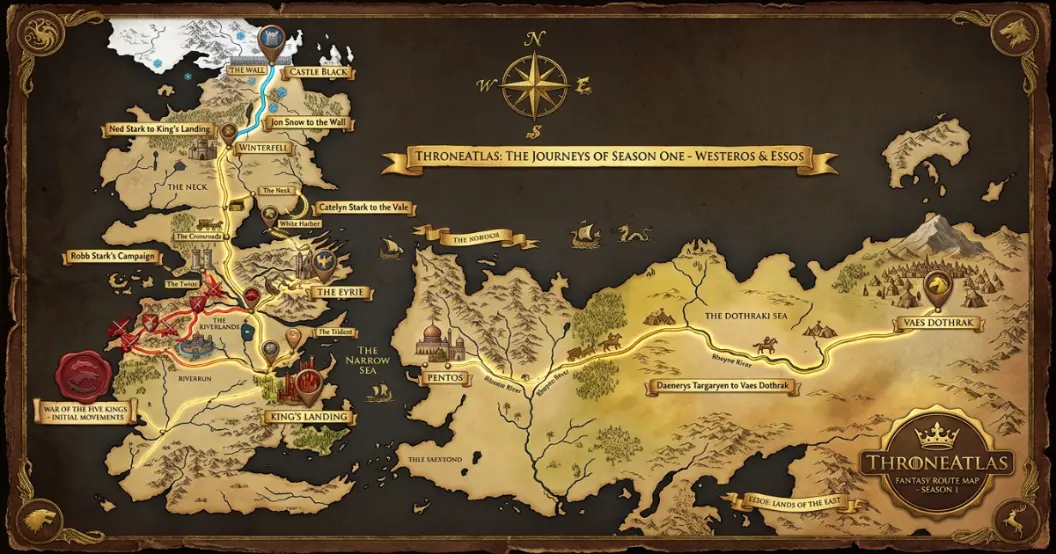
The Game of Thrones Season 1 map establishes the foundational geography of the entire series. It follows three parallel stories: the Starks traveling south from Winterfell to King’s Landing, Jon Snow heading north to Castle Black, and Daenerys beginning her journey in Essos from Pentos toward Vaes Dothrak. By the end of the season the realm is already fracturing — setting the stage for the War of the Five Kings.
For a complete site-wide map library, start from the Game of Thrones Maps hub, then continue to the already published Season 2 map to see how the War of the Five Kings expands after this foundation season.
Why the Game of Thrones Season 1 Map Matters
The first season does more than introduce characters. It builds the mental atlas required to understand the entire series. Winterfell is not simply a castle in the North; it is the northern anchor of Stark identity, a cold seat placed far from the intrigues of the southern court. King’s Landing is not simply a capital; it is the center of royal legitimacy, debt, corruption and spectacle. The Wall is not simply a border; it is a map line separating political blindness from existential danger.
Season 1 works because the map itself creates tension. Ned Stark’s journey south is a geographic mistake before it is a political one. In Winterfell, he has distance, loyalty, terrain and ancestral authority. In King’s Landing, he is surrounded by Lannister influence, royal debt, hidden succession questions and courtly traps. The map slowly removes his protection. Every mile away from the North makes him more honorable and less powerful.
At the same time, Jon Snow’s northern route gives the audience a second scale of danger. While the court fights over titles, Jon reaches Castle Black, where the map stretches into the haunted forest beyond the Wall. This creates one of the most important contrasts in the series: the South plays for thrones, while the North begins to notice that the board is much larger than politics.
Daenerys’s Season 1 route is equally important because it begins outside Westeros. Pentos, the Dothraki Sea and Vaes Dothrak expand the show from a civil conflict into a transcontinental story. On the map, Daenerys starts as a displaced heir with no army, no land and no court. By the finale, her exact location is less politically important than what has changed there: dragons have returned to the world, and Essos becomes the ignition point for a future invasion of Westeros.
Season 1 Character Routes and Map Consequences
The strongest way to read the Season 1 map is through character movement. Every major route changes a political relationship. The Stark party’s movement south opens the capital to northern honor. Jon’s movement north removes him from the succession conflicts of Winterfell and places him in the Night’s Watch. Catelyn’s sudden eastward movement to the Vale turns suspicion into armed conflict. Daenerys’s eastern movement turns exile into transformation.
| Route | Key Episodes | Geographic Importance | Political Consequence |
|---|---|---|---|
| Ned Stark: Winterfell → King’s Landing | S1E1–S1E8 | The Kingsroad links northern authority to the royal court. Ned leaves a loyal northern power base and enters a capital dominated by Lannister money, court secrets and royal weakness. | The movement places Stark honor inside a court designed for manipulation, leading directly to the succession crisis after Robert’s death. |
| Jon Snow: Winterfell → Castle Black | S1E1–S1E10 | Jon’s route runs north instead of south, separating his story from court politics and placing him at the only border that truly matters to the long future of Westeros. | His vows remove him from Stark inheritance but begin the Night’s Watch arc that later connects the North, wildlings and White Walker threat. |
| Catelyn Stark: Winterfell → King’s Landing → Vale | S1E2–S1E6 | Catelyn crosses major political zones quickly: the North, the capital, the Riverlands and the Vale. Her movement turns private suspicion into a public conflict. | Her capture of Tyrion Lannister ignites Lannister retaliation and helps turn local tension into the opening stage of war. |
| Tyrion Lannister: Winterfell → Wall → Vale → Riverlands | S1E1–S1E8 | Tyrion’s route gives viewers one of the widest Westeros journeys in the season, connecting Winterfell, Castle Black, the high roads of the Vale and the war roads of the Riverlands. | His arrest and trial by combat deepen the Stark-Lannister conflict and expose the Vale as politically isolated but strategically difficult to attack. |
| Daenerys Targaryen: Pentos → Dothraki Sea → Vaes Dothrak | S1E1–S1E10 | Daenerys moves through eastern Essos rather than Westeros, building a separate power story far from the Iron Throne’s immediate reach. | The route transforms her from a marriage pawn into a claimant with dragons, making the distant eastern map essential to the future of the Seven Kingdoms. |
| Robb Stark: Winterfell → Riverlands Campaign | S1E8–S1E10 | Robb’s march south turns Winterfell from a family home into a military command center. The Riverlands become the first major war corridor. | His victories lead to the northern lords naming him King in the North, changing the political map from one kingdom under Robert to rebellion and regional sovereignty. |
Key Locations on the Game of Thrones Season 1 Map
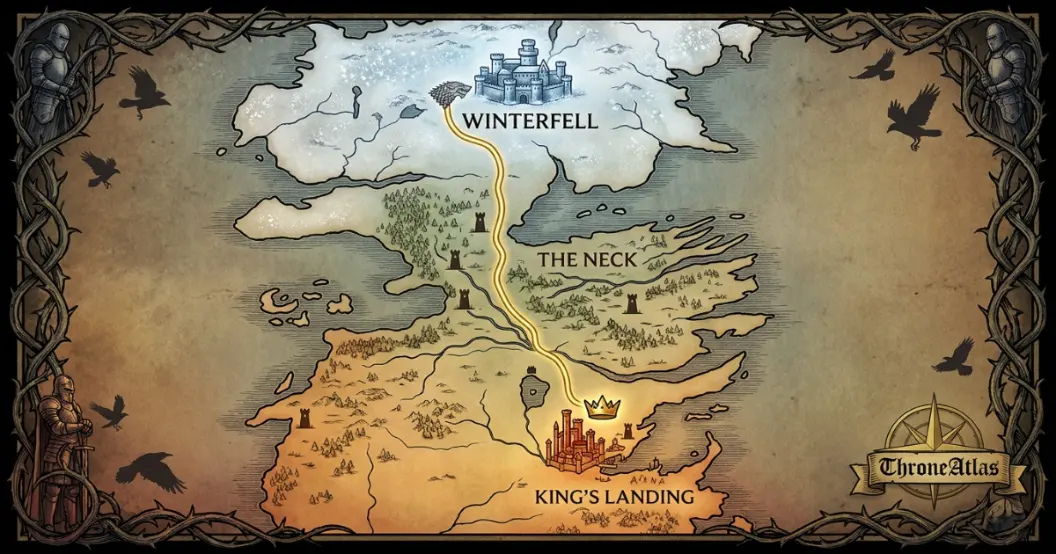
Season 1 introduces locations as living power centers. Each place has a function: Winterfell gives identity, King’s Landing gives legitimacy, the Wall gives warning, the Riverlands give war corridors, and Essos gives Daenerys the distance she needs to become something other than a pawn.
Winterfell
Winterfell is the emotional and political heart of the North, and Season 1 uses it as the viewer’s first true anchor on the Westeros map. The castle stands far from King’s Landing, which explains the Stark family’s colder manners, local loyalties and suspicion of southern court life. Robert’s arrival at Winterfell turns a northern stronghold into the starting point of the realm’s collapse. By the finale, Winterfell is no longer only a home; it is the seat Robb leaves behind when the North answers war.
King’s Landing
King’s Landing is the furnace of Season 1 politics. The Red Keep concentrates royal power, Lannister influence, council secrecy and succession danger into one crowded capital. Its southern position matters because Ned enters a world where distance from the North weakens his protection and court procedure moves faster than northern honor. The capital controls ravens, royal commands, public executions and the official story of succession. Whoever controls King’s Landing controls the language of law, even when the truth says otherwise.
The Wall and Castle Black
The Wall and Castle Black mark the true northern border of the realm. While the South obsesses over thrones, titles and inheritance, Castle Black introduces the Night’s Watch — a brotherhood of exiles guarding against threats the rest of Westeros has forgotten. Jon’s arrival creates the series’ most important narrative contrast: southern politics versus existential northern danger. On the Season 1 map, the Wall is not a side location; it is the warning line that the kingdoms fail to read.
The Riverlands
The Riverlands become the first true conflict corridor of the series. Their central position between northern marches, Lannister retaliation and the roads toward King’s Landing makes them impossible to ignore once armies begin moving. Villages, woods, river crossings and open roads all become part of the conflict system. Season 1 uses the Riverlands to show how quickly a private arrest and a royal scandal can turn neutral-looking land into the first battlefield of a continent-wide war.
The Eyrie and the Vale
The Vale is defensive geography turned into politics. Its mountain roads, narrow approaches and near-unreachable seat at the Eyrie make House Arryn difficult to threaten but also difficult to mobilize. Catelyn’s decision to take Tyrion there pulls the map away from the Kingsroad and into a region where isolation shapes judgment. The Vale’s height protects Lysa Arryn, yet that same isolation makes her court suspicious, theatrical and dangerously detached from the war forming below.
Pentos and the Dothraki Sea
Pentos begins Daenerys’s exile story as a place of bargaining, arranged marriage and Targaryen desperation. The Dothraki Sea then changes the map from merchant-city intrigue to open grassland movement, horse culture, caravan routes and survival. This eastern geography matters because Daenerys is not shaped by castles or councils; she is shaped by distance, exposure and a people who value movement over walls. By the finale, Essos has become the birthplace of the dragons rather than a mere place of exile.
Political Control Snapshot: Start vs End of Season 1
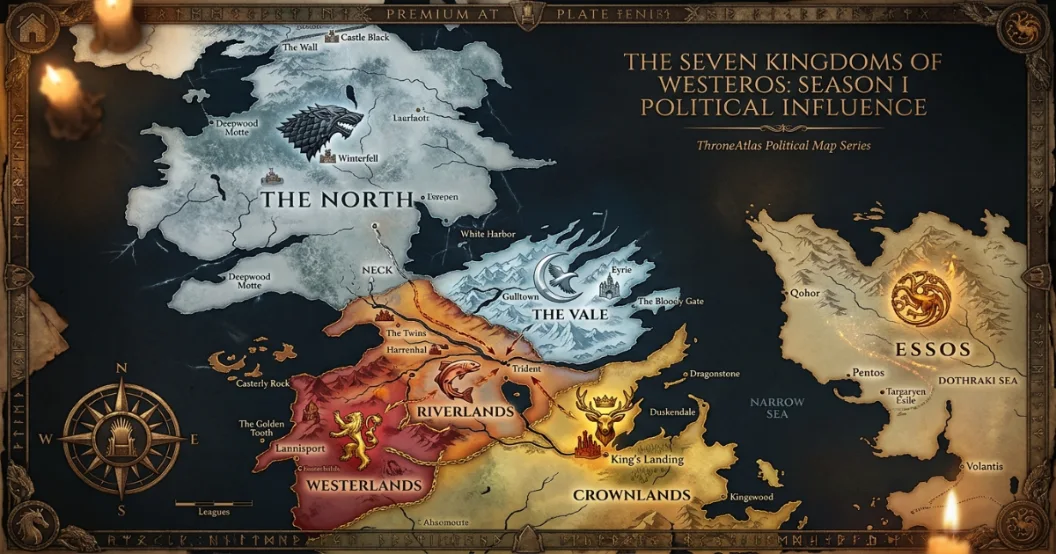
At the beginning of Season 1, the map appears stable. Robert Baratheon sits the Iron Throne, the Starks hold the North, the Lannisters appear loyal through royal marriage, and the Targaryens survive only as exiles. By the finale, the same map has fractured. Robert is dead, Joffrey sits the throne, Ned is executed, Robb commands a northern army, and Daenerys has dragons in the east.
| Region | Start of Season | End of Season | Map Meaning |
|---|---|---|---|
| North | Stark loyalty under Eddard Stark | Robb Stark leads the northern host | The North shifts from regional loyalty to open resistance after Ned’s execution. |
| King’s Landing | Robert Baratheon’s court | Joffrey Baratheon’s contested rule | The capital keeps legal control but loses moral legitimacy. |
| Westerlands | Lannister strength behind the crown | Lannister military response begins | Lannister wealth becomes battlefield force after Tyrion’s capture. |
| Riverlands | Tully territory under pressure | War corridor between Stark and Lannister forces | The central map becomes the first open theater of the War of the Five Kings. |
| Essos | Targaryen exile under Viserys’s ambition | Daenerys survives with three dragons | The eastern map becomes the source of a future world-changing military power. |
Battle and Conflict Geography in Season 1
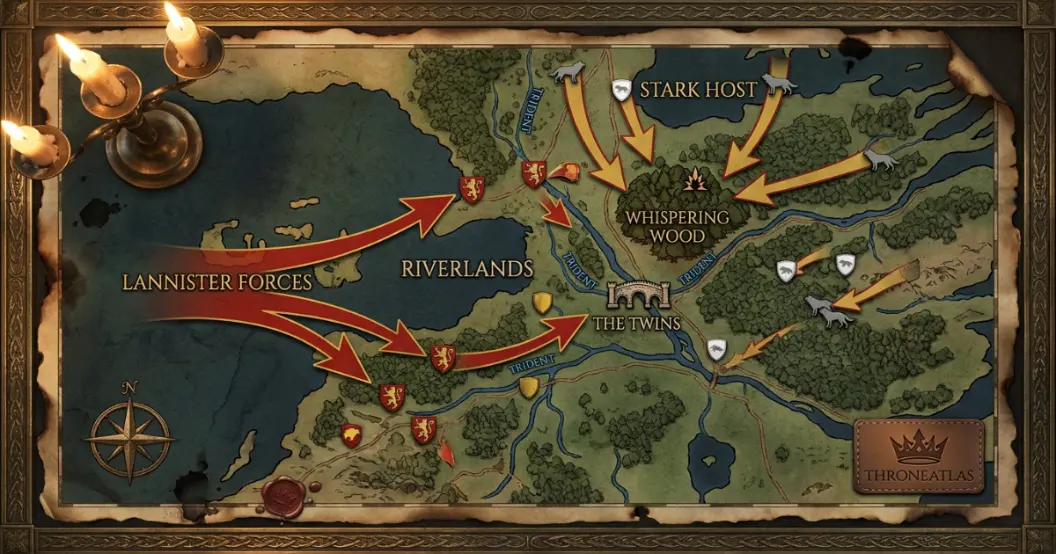
Season 1 is not yet the full war atlas of later seasons, but it creates the routes that make war unavoidable. The most important conflict geography appears in the Riverlands, where Stark and Lannister movement begins to turn roads, woods and crossings into military assets.
The Riverlands as the First War Corridor
The Riverlands sit in one of the most exposed positions in Westeros. Armies moving from the North toward the south often pass through or near the region, while Lannister power from the west can strike across its borders. This geography explains why the Riverlands suffer early. They are not protected by the North’s distance, the Vale’s mountains or the capital’s walls. They are central, fertile and vulnerable.
Whispering Wood and the Value of Ambush Terrain
The Whispering Wood matters because it shows Robb Stark understanding terrain faster than his enemies expect. Forested ground reduces the advantage of a larger or more confident force. Ambush geography lets Robb convert local knowledge, speed and secrecy into a victory that changes the war’s momentum. On a Season 1 battle map, this area represents the first moment where northern movement becomes strategic rather than reactive.
The Twins and River Crossing Logic
The crossing at the Twins introduces one of the series’ most important strategic lessons: bridges can be more powerful than castles. Walder Frey’s seat controls passage, and Robb’s army cannot treat geography as empty space. He must negotiate with the man who controls the route. This moment foreshadows how movement, marriage alliances and river crossings will shape later seasons far beyond the first campaign.
The Importance of River Crossings
Control of bridges and fords in the Riverlands becomes one of the earliest strategic lessons of the war. Rivers do not simply divide land; they divide armies, delay reinforcements and create natural choke points that clever commanders can exploit. Robb Stark’s first campaign succeeds because he understands that movement is not just speed across a map. It is access, timing, secrecy and the ability to force an enemy to react from the wrong side of the water.
Episode-by-Episode Season 1 Map Timeline
This timeline shows how Season 1 expands from a family visit at Winterfell into a multi-region crisis. The map begins with royal travel, splits into northern and southern routes, then ends with separate power centers preparing for war.
| Episode | Main Map Movement | Why It Matters |
|---|---|---|
| S1E1 | Robert Baratheon arrives at Winterfell; Daenerys is in Pentos. | The story connects the North, the capital and Essos from the beginning. |
| S1E2 | The royal party travels south; Jon travels north toward the Wall. | The Stark family divides into opposite map directions. |
| S1E3–S1E4 | Ned enters King’s Landing; Jon reaches Castle Black; Daenerys adapts to Dothraki movement. | Three separate worlds take shape: court, Wall and eastern exile. |
| S1E5–S1E6 | Catelyn takes Tyrion to the Vale; tensions spread through the Riverlands. | A private investigation becomes a regional crisis. |
| S1E7–S1E8 | Robert dies; Ned is arrested; Robb calls the banners. | The capital loses stability while the North becomes militarized. |
| S1E9 | Robb maneuvers through the Riverlands; Ned is executed in King’s Landing. | The map breaks emotionally and politically at the same time. |
| S1E10 | Robb is declared King in the North; Daenerys emerges with dragons. | The season ends with two new power centers outside direct control of the Iron Throne. |
Where Major Characters End Season 1
The final positions are crucial because they set the Season 2 map in motion. The story no longer belongs to one royal court. Power is divided between a northern rebellion, a contested capital, a dangerous frontier and a reborn Targaryen force in the east.
| Character | Final Season 1 Location | Map Setup for Season 2 |
|---|---|---|
| Robb Stark | Riverlands campaign camp | Leads the northern war effort as King in the North. |
| Catelyn Stark | With Robb’s host | Acts inside the northern alliance and Riverlands conflict zone. |
| Arya Stark | Escaping King’s Landing | Begins a road survival arc through war-torn territory. |
| Sansa Stark | King’s Landing | Becomes a political hostage inside the capital. |
| Jon Snow | Castle Black | Moves deeper into the Night’s Watch storyline beyond court politics. |
| Tyrion Lannister | Returning toward Lannister power | His next role shifts toward King’s Landing strategy. |
| Daenerys Targaryen | Eastern Essos after Drogo’s funeral pyre | Begins the dragon era and the long road back to Westeros. |
Map Evolution: What Changes from Season 1 to Season 2?
Season 1 ends by destroying the idea that Westeros is a single obedient realm. Season 2 begins with multiple claimants, exposed borders and active armies. The Season 1 map is therefore the “before” image: one king, one capital, one official realm. The Season 2 map becomes the “after” image: rival kings, moving fleets, siege routes and visible war fronts.
The biggest change is not simply that characters move. It is that locations change meaning. Winterfell moves from home to vulnerable northern seat. King’s Landing moves from royal center to threatened prize. The Riverlands move from middle ground to battlefield. Dragonstone, barely central in Season 1, becomes crucial when Stannis enters the larger war map. Essos, once a place of exile, becomes the cradle of dragon power.
Continue with the Map of Game of Thrones Season 2 to follow the War of the Five Kings, Stannis at Dragonstone, the Blackwater campaign and the wider military expansion across Westeros.
Game of Thrones Season 1 Map FAQ
Where does Season 1 mostly take place?
Season 1 mostly moves between Winterfell, King’s Landing, Castle Black, the Riverlands, the Vale and Daenerys’s route across Essos. The season uses these locations to introduce the political and geographic structure of the series.
What is the main route on the Season 1 map?
The main route is Ned Stark’s journey from Winterfell to King’s Landing along the Kingsroad. It connects northern loyalty to southern politics and drives the season’s central conflict.
Why is the Wall important in Season 1?
The Wall shows that Westeros has a danger beyond noble politics. Jon Snow’s arrival at Castle Black introduces the Night’s Watch, wildling pressure and the first signs of a deeper northern threat.
Where is Daenerys on the Season 1 map?
Daenerys begins in Pentos, travels through the Dothraki Sea, reaches Vaes Dothrak and ends the season in eastern Essos after the birth of her dragons.
Which region becomes the first war zone?
The Riverlands become the first major war zone because Stark and Lannister forces move through the region after Tyrion’s arrest and Ned’s fall in King’s Landing.
What is the most important battle in Season 1?
The Whispering Wood is the most important Season 1 battle because Robb Stark captures Jaime Lannister and proves that the northern campaign can defeat a stronger southern power through terrain, timing and surprise.
How does the Season 1 map set up the War of the Five Kings?
Season 1 divides the Stark family, weakens King’s Landing, activates the Riverlands, isolates the Wall storyline and ends with Robb declared King in the North. Those map changes create the war fronts that expand in Season 2.
How accurate is the Game of Thrones Season 1 map to the books?
The show’s Season 1 geography closely follows George R.R. Martin’s A Game of Thrones, with some compression for television pacing, especially around travel time, road distance and the exact placement of smaller Riverlands clashes.
Continue the Seasonal Atlas
Season 1 explains the board. Season 2 breaks it into war fronts. Use the full maps hub to follow every route, castle, battlefield and political shift across the series.
Game of Thrones Maps Hub Next: Season 2 Map