Map of Game of Thrones Season 3: Red Wedding, Riverlands & Routes
Season 3 is the year the map becomes a weapon. Roads, river crossings, guest halls, mountain passes and foreign slave cities no longer serve as simple backdrops; they become traps, tests and turning points. Robb Stark rides through the Riverlands toward a marriage alliance that will destroy his war. Jon Snow crosses deep into the wildling world beyond the Wall. Daenerys moves across Slaver’s Bay and turns geography into liberation. By the end of the season, Westeros has not merely changed rulers — it has changed shape.
Quick Answer
The Map of Game of Thrones Season 3 centers on three decisive geographic fronts: the Riverlands trap that ends Robb Stark’s campaign at The Twins, the northern wilderness beyond the Wall where Jon Snow learns how large the wildling threat really is, and Slaver’s Bay where Daenerys begins taking cities instead of fleeing between them.
Unlike Season 1, which introduces the world, or Season 2, which spreads the War of the Five Kings across Westeros, Season 3 narrows the map into pressure points. The most important location is The Twins because it controls movement across the Green Fork and becomes the setting for the Red Wedding. The season’s core map lesson is brutal: geography becomes a trap when safe passage depends on broken loyalty. The Freys control a crossing, the Boltons control betrayal from within, and the Lannisters gain power without needing to win a conventional battlefield victory.
Full Game of Thrones Season 3 Map
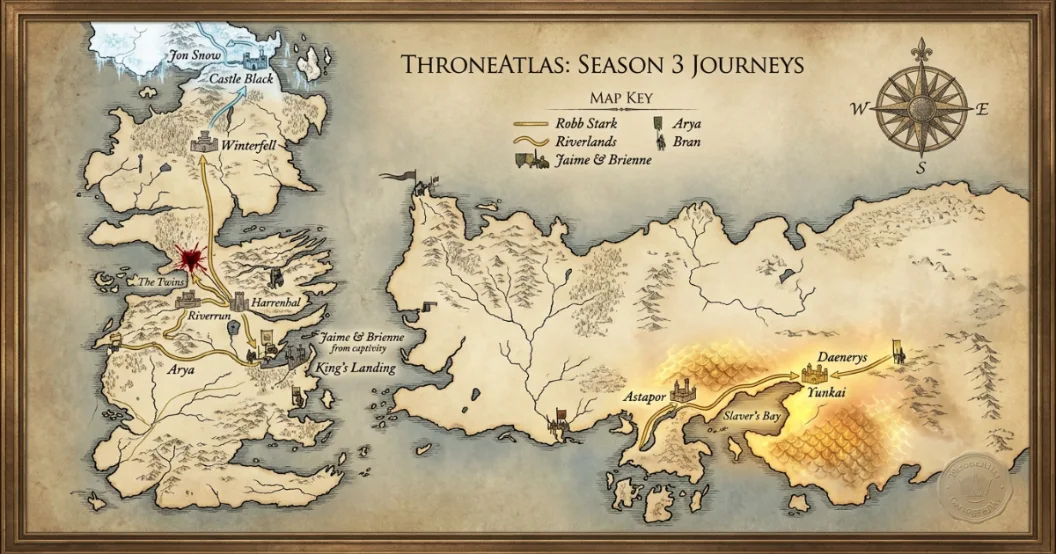
The complete Season 3 map should be read as a split atlas: Westeros collapses inward while Essos expands outward. In the west, the Riverlands act as the bleeding center of the war, connecting northern ambitions, Lannister resistance and Frey leverage. In the far north, the land beyond the Wall becomes more than a rumor. In the east, Astapor and Yunkai mark the beginning of Daenerys’s first real territorial campaign.
Why the Season 3 Map Matters
Season 3 is often remembered emotionally for the Red Wedding, but geographically it is remembered for something even colder: the discovery that movement through the realm is never neutral. Robb Stark’s army does not lose because it lacks courage. It loses because its campaign depends on access, crossings, marriages and safe passage through territory controlled by men whose loyalty is already breaking. The Riverlands become a chessboard where a single bridge-fortress can outweigh thousands of swords.
The map also sharpens the difference between northern and southern danger. While the great houses continue to fight for castles, titles and river roads, Jon Snow’s story reveals a much older frontier. Beyond the Wall is not empty wilderness. It is a living geography of clans, caves, frozen valleys, ancient paths and a people gathering under Mance Rayder. That northern route shows the audience that Westeros is arguing over crowns while a different kind of war is assembling in the cold.
Across the Narrow Sea, Daenerys’s Season 3 map changes her from a wandering claimant into a city-taking force. Astapor is not just another Essos location. It is the first place where she uses terrain, language, military discipline and local oppression to reverse power. By the time she moves toward Yunkai, her route has become a campaign line rather than an exile’s journey.
This is why Season 3 deserves a dedicated map page. It is the season where the world’s geography begins punishing characters for misunderstanding it. A wedding hall becomes a battlefield. A slave city becomes the seed of a revolution. A frozen frontier becomes the warning the southern kingdoms refuse to read.
Major Character Routes in Season 3
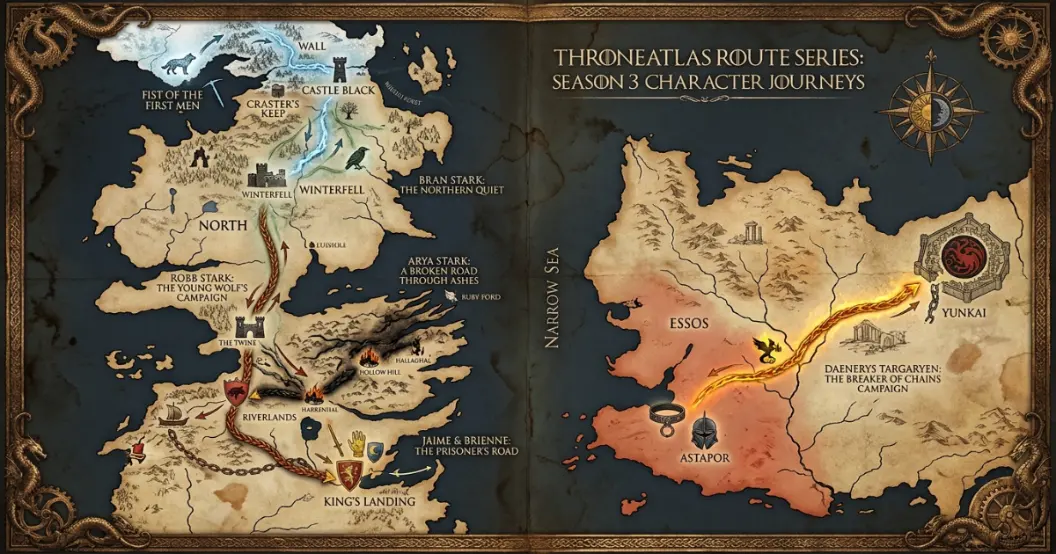
The strongest Season 3 route map tracks movement by consequence, not only distance. Every major route either tightens a trap, reveals a hidden world, or transfers power from one region to another.
| Character / Force | Route | Key Episodes | Geographic Importance | Political Consequence |
|---|---|---|---|---|
| Robb Stark | Riverrun → Riverlands roads → The Twins | S3E1–S3E9 | Robb’s campaign depends on moving through Frey-controlled territory and reconnecting northern strength with Riverlands alliances. | The Red Wedding destroys the Stark field army and ends the northern rebellion as a serious conventional threat. |
| Catelyn Stark | Riverrun → The Twins | S3E2–S3E9 | Her route follows the diplomacy of desperation: repairing a broken Frey alliance by returning to the crossing Robb once needed. | Her death removes the Stark family’s most experienced political conscience and deepens the northern catastrophe. |
| Arya Stark | Riverlands villages → Brotherhood territory → near The Twins | S3E1–S3E10 | Arya’s route shows the civilian underside of the war: burned villages, ransom roads, outlaw camps and broken supply lines. | Arriving too late to reunite with her family hardens Arya’s path from survivor into avenger. |
| Jon Snow | Frostfangs / wildling lands → south toward Castle Black | S3E1–S3E10 | Jon’s movement beyond the Wall reveals the wildling world as a political and military geography rather than a blank northern void. | He returns with knowledge that the Night’s Watch desperately needs, setting up the Wall conflict to come. |
| Daenerys Targaryen | Astapor → Slaver’s Bay roads → Yunkai | S3E1–S3E10 | Her eastward campaign follows the slave-city corridor, converting urban geography into military and moral leverage. | Daenerys gains the Unsullied, liberates enslaved populations and becomes a regional force instead of an exiled claimant. |
| Jaime Lannister & Brienne | Riverlands captivity route → Harrenhal → King’s Landing | S3E1–S3E10 | Their road crosses the battered center of Westeros and shows how war turns noble travel into imprisonment, ransom and exposure. | Jaime’s return changes his political value in King’s Landing while his journey with Brienne reshapes his identity. |
| Bran Stark | Winterfell ruins → northern road → Gift / Wall approach | S3E1–S3E10 | Bran’s movement shifts the Stark story away from castles and toward mystical northern geography. | His route begins separating the magical threat from ordinary political warfare. |
Key Locations on the Season 3 Map
Season 3’s locations matter because each place carries leverage. The Twins controls a crossing. Riverrun anchors the Riverlands. Castle Black stands against a growing northern migration. Astapor gives Daenerys an army. Yunkai tests whether liberation can become policy. King’s Landing remains the center where distant betrayals become formal power.
The Twins
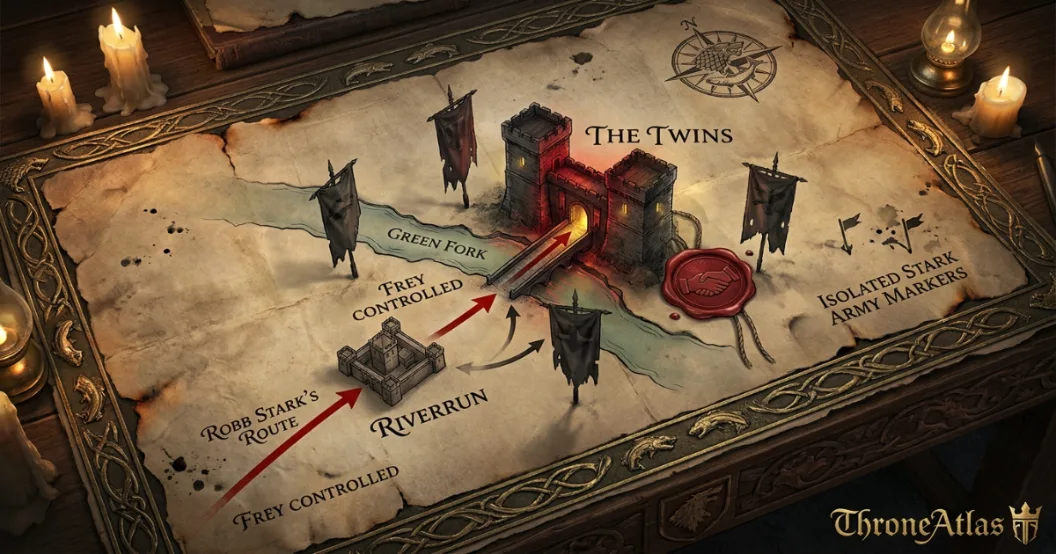
The Twins is the geographic heart of Season 3’s tragedy. House Frey’s fortress straddles the Green Fork, turning a bridge into political power and making Walder Frey more dangerous than his banners alone suggest. Robb Stark returns here because his campaign still needs passage, legitimacy and repaired alliance lines through the Riverlands. The Red Wedding works because The Twins is both a private hall and a controlled military choke point: once Robb enters Frey territory, his army is vulnerable inside and outside the walls.
Riverrun
Riverrun remains the emotional and military anchor of the Tully lands. Its river-bound position explains why the Riverlands are so difficult to stabilize: armies can move through them, raid them and divide them, but not easily secure them. Robb’s presence near Riverrun keeps his northern campaign tied to his mother’s homeland and to the obligations that come with House Tully. The castle gives the Starks a noble center, yet Season 3 proves that a strong seat cannot compensate for broken roads, hostile crossings and unreliable bannermen.
Beyond the Wall
The lands beyond the Wall become fully alive in Season 3. Jon Snow sees wildling camps, frozen routes, clan loyalties and the scale of Mance Rayder’s gathering. This is not a blank wilderness on the edge of the map; it is a hard northern society built around movement, survival and knowledge of terrain. Jon’s route beyond the Wall turns him from a sheltered recruit into the only major southern character who understands the wildling threat from inside its own geography.
Castle Black
Castle Black is the hinge between Jon’s secret life among the wildlings and his duty to the Night’s Watch. Its value lies in position: it watches the Wall, receives warnings from the north and remains painfully underprepared for the force gathering beyond it. In Season 3 the castle feels less like a remote order house and more like the realm’s neglected shield. Every southern political mistake becomes sharper when compared with Castle Black, where a small and weakened brotherhood is asked to defend everyone.
Astapor
Astapor marks Daenerys’s first major strategic victory in Essos. The city’s power rests on the Unsullied, but its rulers misunderstand Daenerys’s dragons, language skills and moral intent. On the map, Astapor is the point where her journey changes direction: she stops asking for support and begins reshaping cities through force, symbolism and liberation. It is also the first place where her claim to rule becomes tied to people who are not Westerosi nobles at all.
Yunkai
Yunkai is the second slave city that tests Daenerys’s campaign. If Astapor gives her an army, Yunkai forces her to decide whether conquest is only military or also ethical. Its position within Slaver’s Bay makes it part of a connected political economy, meaning Daenerys’s victory cannot remain isolated. Every city she touches affects the next city on the road, and by the end of Season 3 her route has become a liberation corridor rather than a refugee trail.
Political Control Snapshot
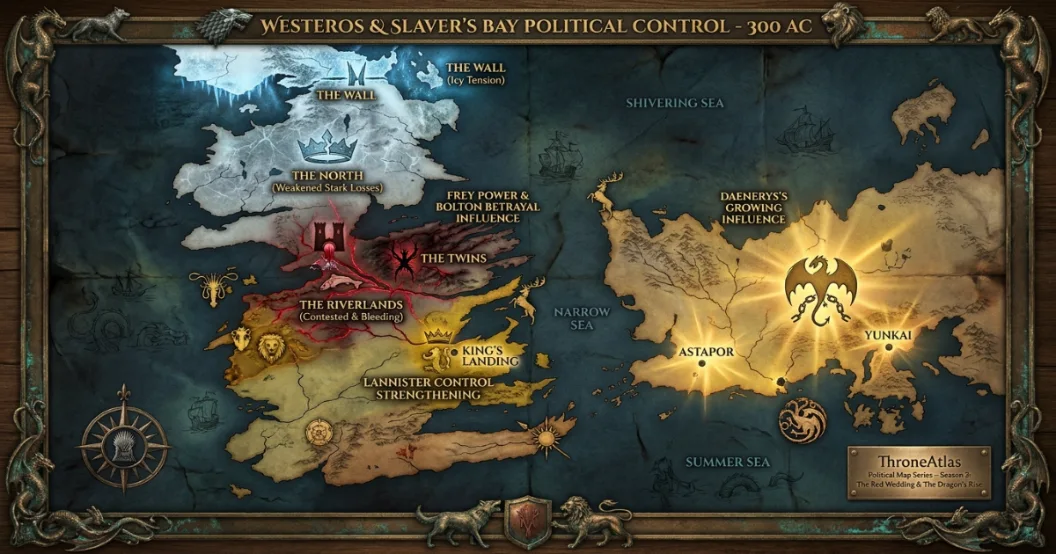
Season 3 does not redraw the map with clean borders. It changes the meaning of control. The North still exists as a region, but its army is broken. The Riverlands still have castles, but their roads are unsafe. The Lannisters still rule from King’s Landing, but their strongest victory happens through allies rather than soldiers.
| Region | Start of Season 3 | End of Season 3 | Map Meaning |
|---|---|---|---|
| The North | Robb Stark remains King in the North with active field strength. | The Stark campaign is shattered after the Red Wedding. | The North becomes leaderless, vulnerable and open to Bolton domination. |
| The Riverlands | War-torn but still central to Robb’s campaign. | Frey and Lannister influence rises after betrayal at The Twins. | Crossings and castles matter more than open-field victory. |
| King’s Landing | Lannisters are recovering from the Battle of Blackwater. | Lannister power is strengthened by the collapse of northern resistance. | The capital gains security without fighting the decisive battle itself. |
| The Wall | Night’s Watch remains thin, isolated and uncertain. | Jon returns with urgent knowledge of the wildling threat. | The northern frontier becomes a coming war zone. |
| Slaver’s Bay | Daenerys arrives with dragons but limited military power. | She controls the Unsullied and inspires liberated populations. | Essos becomes an active Targaryen campaign map. |
Battle & Conflict Geography
The Red Wedding: Geography as Betrayal
The Red Wedding is not a battle in the traditional sense, yet it is one of the most decisive military events on the Season 3 map. Its power comes from location. The Twins is a controlled crossing, a fortified residence and a political choke point. Robb arrives there not merely as a guest, but as a commander whose army’s future depends on mending a geographic alliance.
Inside the halls, hospitality becomes the battlefield. Outside, the Stark host is isolated from rescue. The Riverlands’ fragmented terrain — roads, fords, castles, bridges and wooded approaches — makes coordination difficult once betrayal begins. The event works because Robb’s enemies understand that destroying an army does not always require meeting it in formation. Sometimes the best battlefield is a room chosen in advance.
From an atlas perspective, the Red Wedding proves that Season 3’s most lethal weapon is access. Walder Frey controls the crossing. Roose Bolton controls trust inside Robb’s command. Tywin Lannister controls the wider strategy from afar. The result is a geographic assassination of an entire rebellion.
The Importance of River Crossings
The Riverlands teach one of the earliest strategic lessons of the war: rivers do not simply divide land, they divide armies. Crossings slow reinforcements, expose supply movement and create diplomatic pressure on commanders who need passage. Robb Stark’s dependence on Frey-controlled access makes his campaign vulnerable long before the wedding feast begins.
The Strategic Importance of Guest Right & Crossings
The Red Wedding is devastating because it violates two systems at once: the social law of guest right and the geographic law of passage. Robb comes to The Twins expecting a repaired alliance, not a battlefield. That expectation is exactly what makes the crossing lethal. In Season 3, the Freys do not merely hold a bridge; they control the ritual space where an army believes it can lower its guard.
Beyond the Wall: The Wildling Approach
Jon’s northern route is a different kind of conflict map. There are no neat banners or castle borders. The wildling world is built from movement: hidden camps, climbing routes, scouting paths and knowledge of terrain. Season 3 turns the Wall from a distant landmark into a military obstacle that both sides are preparing to test.
Slaver’s Bay: Liberation as Campaign Geography
Daenerys’s Season 3 victories are urban conflicts shaped by walls, plazas, slave markets and disciplined infantry. Astapor falls because its rulers misread the power standing in front of them. Yunkai follows because liberation becomes contagious. The map of Slaver’s Bay begins to change not only by conquest, but by reputation.
Episode-by-Episode Location Timeline
| Episode | Main Map Movement | Why It Matters |
|---|---|---|
| S3E1 | Jon enters deeper wildling territory; Daenerys arrives near Slaver’s Bay. | The season opens by expanding the far north and far east while Westeros remains trapped in war. |
| S3E2 | Riverlands roads, Harrenhal and northern movement continue. | The central war zone feels unstable, with captives, outlaws and soldiers moving across damaged land. |
| S3E3 | Daenerys negotiates in Astapor; Jaime and Brienne move through hostile territory. | Essos diplomacy and Westeros captivity both reveal how vulnerable travelers are on controlled roads. |
| S3E4 | Astapor falls to Daenerys and the Unsullied join her. | The eastern map changes dramatically as Daenerys gains her first disciplined army. |
| S3E5 | The Riverlands and northern plots tighten around Robb’s weakening campaign. | The war’s geography begins moving toward The Twins even before the trap is visible. |
| S3E6 | Jon and the wildlings climb the Wall. | The Wall becomes a physical battlefield instead of a distant border. |
| S3E7 | Daenerys approaches Yunkai; Arya remains trapped in Riverlands uncertainty. | Both east and west show movement toward irreversible decisions. |
| S3E8 | Robb prepares to repair the Frey alliance. | The map points toward The Twins as the decisive location of the northern campaign. |
| S3E9 | The Red Wedding occurs at The Twins. | The Stark military position collapses in one controlled location. |
| S3E10 | Power resets across Westeros; Daenerys is hailed outside Yunkai. | The season closes with the North broken and Daenerys rising as a liberator in Essos. |
Where Major Characters End Season 3
| Character | Final Season 3 Location | Map Status |
|---|---|---|
| Robb Stark | The Twins | Dead; northern campaign destroyed. |
| Catelyn Stark | The Twins | Dead; Stark-Tully alliance shattered. |
| Arya Stark | Riverlands roads with the Hound | Alive but cut off from family and home. |
| Jon Snow | Near Castle Black / Wall frontier | Returns with knowledge of the wildling army. |
| Daenerys Targaryen | Yunkai, Slaver’s Bay | Rising conqueror and liberator with the Unsullied. |
| Jaime Lannister | King’s Landing | Returned to the capital changed by captivity and travel. |
| Bran Stark | Northbound toward the Wall | Moving deeper into magical northern geography. |
| Tyrion Lannister | King’s Landing | Politically trapped inside the capital’s marriage strategy. |
Map Evolution: Season 3 to Season 4
Season 3 ends by creating the broken map that Season 4 inherits. The North no longer has a functioning Stark army in the field. The Riverlands are stained by Frey betrayal and Lannister strategy. King’s Landing looks secure, but its own internal pressure is rising toward the Purple Wedding. The Wall is no longer a forgotten edge of the realm; it is the next active front.
The most important change is psychological geography. After the Red Wedding, no road feels safe, no castle promise feels sacred and no wedding hall feels neutral. Season 4 begins in a world where political trust has been mapped as a weakness. That is why the Season 3 atlas is essential: it explains how the war turns from open campaigns into assassinations, trials, sieges and revenge routes.
Season 3 Map FAQ
What is the most important location on the Game of Thrones Season 3 map?
The Twins is the most important location because it controls a major Riverlands crossing and becomes the site of the Red Wedding.
Where does the Red Wedding happen?
The Red Wedding happens at The Twins, the Frey fortress in the Riverlands located on the Green Fork.
Where does Daenerys go in Season 3?
Daenerys moves through Slaver’s Bay, taking Astapor, gaining the Unsullied and then advancing toward Yunkai.
Where is Jon Snow in Season 3?
Jon spends much of the season beyond the Wall with the wildlings before returning toward Castle Black.
How does Season 3 change the political map?
Season 3 breaks Stark military power, strengthens Lannister influence through Frey and Bolton betrayal, and begins Daenerys’s territorial rise in Essos.
What is the main battle in Season 3?
The Red Wedding is not a formal battle, but it is the decisive conflict event because it destroys Robb Stark’s campaign in a single night.
How accurate is the Season 3 map to the books?
The show follows the broad geography of A Storm of Swords, especially The Twins, the Riverlands, the Wall and Slaver’s Bay, while compressing travel time for television pacing.
How does Season 3 set up Season 4?
It leaves the North broken, the Riverlands under hostile control, King’s Landing more confident, the Wall under pressure and Daenerys growing stronger in Essos.
Why is The Twins so important in Season 3?
The Twins is important because it controls a major Riverlands crossing. Robb Stark needs Frey access to keep his campaign moving, which makes the fortress both a bridge and a political trap.
Continue the ThroneAtlas Season Map Series
Follow the map from the Season 2 war expansion into the Season 3 betrayal, then continue toward the Season 4 political aftermath.
View Season 2 Map Explore Game of Thrones Maps Hub Next: Season 4 Map