Dreamfyre Locations Map
Dreamfyre’s life spans two very different Targaryen women and several major locations. Princess Rhaena Targaryen rides the pale-blue she-dragon across the early royal era, including western travels, King’s Landing, Dragonstone and later Harrenhal. After Rhaena’s death in 73 AC, Dreamfyre makes her lair in the Dragonpit at King’s Landing. During Viserys I’s reign, Princess Helaena Targaryen bonds with her and rides her from the capital. After Helaena’s son Jaehaerys is murdered, Helaena can no longer ride. Dreamfyre remains chained in the Dragonpit and dies during the Storming in 130 AC after breaking free, attacking the mob and crashing into the great dome.
Key Takeaways
Western royal travels
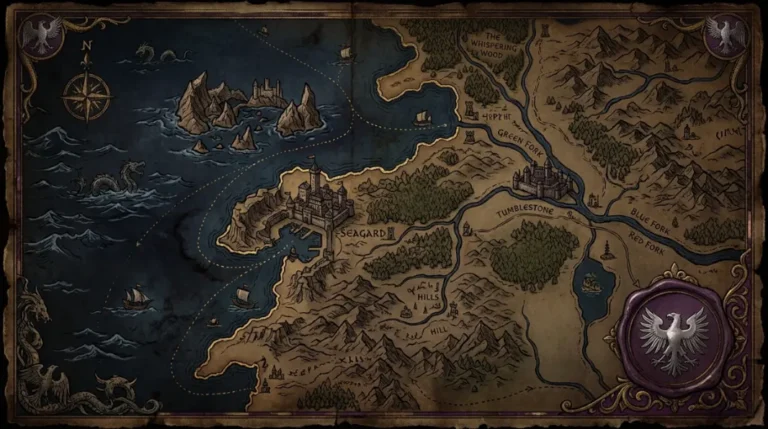
This is a dragon-locations atlas. Confirmed lairs, rider bases and battles are mapped as fixed anchors, while routine flights and unrecorded paths remain broad corridors.
King’s Landing, Dragonstone dragon yards and Harrenhal
Confirmed anchors and reconstructed corridors are separated.
Storming of the Dragonpit
Maintained for 2026.
Visual Atlas
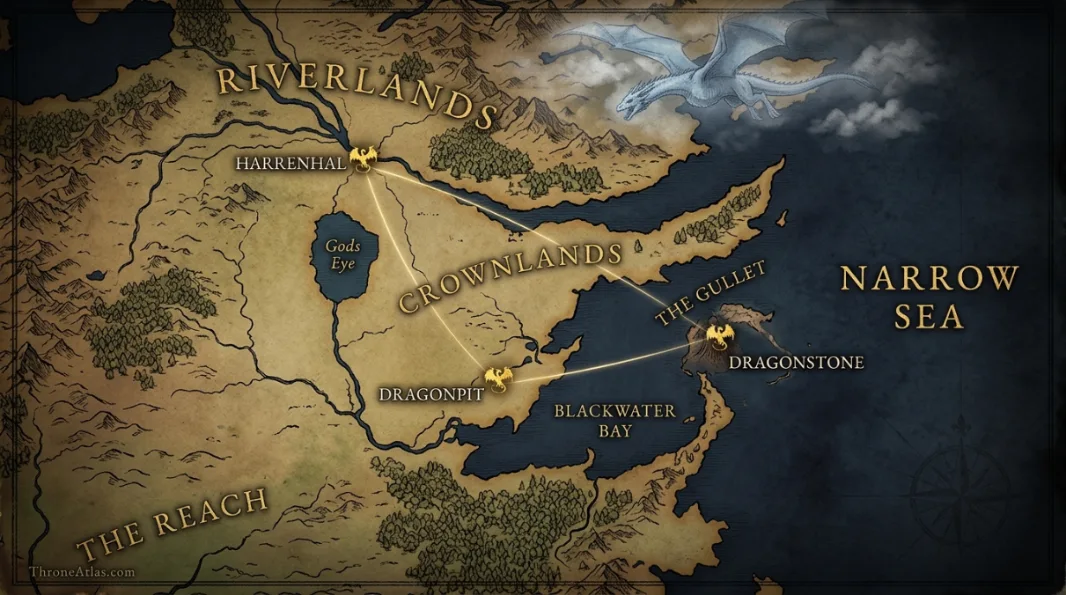
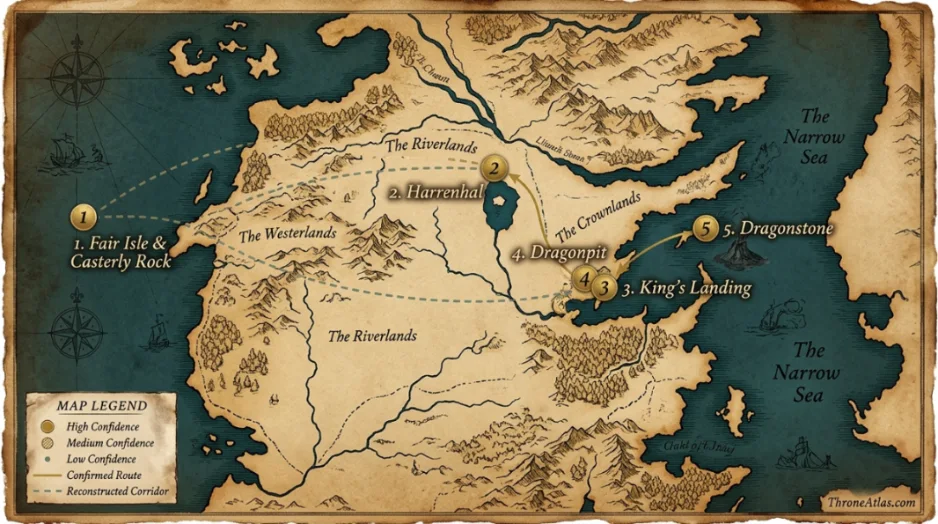
Each marker explains the geographic evidence behind the map.
Mapped Locations and Confidence
| Location / Phase | Confidence | Why it belongs on the map |
|---|---|---|
| 1. Western royal travels | Medium | Rhaena rides Dreamfyre through parts of the westerlands, including the period around Fair Isle and Casterly Rock, but not every flight is documented as a complete route. |
| 2. King’s Landing | High | Rhaena flies Dreamfyre to the capital for royal family events and later returns to report the stolen dragon eggs. |
| 3. Dragonstone dragon yards | High | Rhaena receives Dragonstone as her seat and Dreamfyre lairs there; eggs laid during this period hatch in the island’s dragon yards. |
| 4. Harrenhal | High | Rhaena later isolates herself at Harrenhal while continuing to ride Dreamfyre. |
| 5. Dragonpit | High | After Rhaena’s death, Dreamfyre makes her lair in the Dragonpit at King’s Landing. |
| 6. Helaena Targaryen bond | High | Helaena claims Dreamfyre during Viserys I’s reign and is riding her by age eleven. |
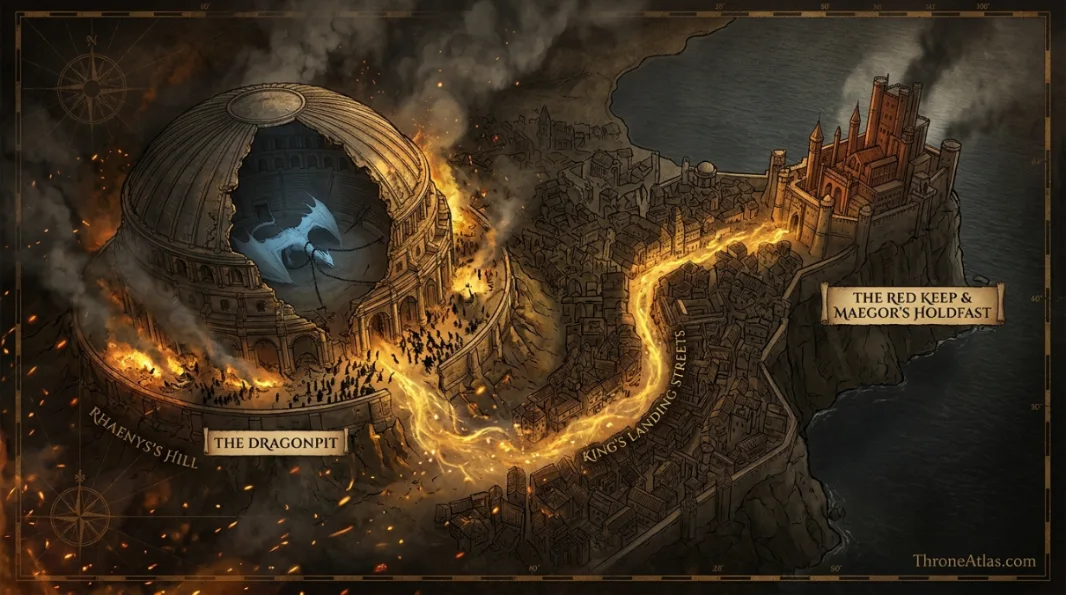
| 7. Maegor’s Holdfast connection | High | Helaena’s death at the Red Keep triggers a violent reaction from Dreamfyre in the Dragonpit across the city. |
| 8. Storming of the Dragonpit | High | Dreamfyre breaks free of her chains, attacks the mob and dies when the dome collapses during the storming. |
1. Western royal travels
Rhaena rides Dreamfyre through parts of the westerlands, including the period around Fair Isle and Casterly Rock, but not every flight is documented as a complete route. This marker belongs on the page because it fixes a major phase of the subject to a real geographic relationship. Read it with the adjacent points to understand sequence, terrain and political meaning together.
2. King’s Landing
Rhaena flies Dreamfyre to the capital for royal family events and later returns to report the stolen dragon eggs. This marker belongs on the page because it fixes a major phase of the subject to a real geographic relationship. Read it with the adjacent points to understand sequence, terrain and political meaning together.
3. Dragonstone dragon yards
Rhaena receives Dragonstone as her seat and Dreamfyre lairs there; eggs laid during this period hatch in the island’s dragon yards. This marker belongs on the page because it fixes a major phase of the subject to a real geographic relationship. Read it with the adjacent points to understand sequence, terrain and political meaning together.
4. Harrenhal
Rhaena later isolates herself at Harrenhal while continuing to ride Dreamfyre. This marker belongs on the page because it fixes a major phase of the subject to a real geographic relationship. Read it with the adjacent points to understand sequence, terrain and political meaning together.
5. Dragonpit
After Rhaena’s death, Dreamfyre makes her lair in the Dragonpit at King’s Landing. This marker belongs on the page because it fixes a major phase of the subject to a real geographic relationship. Read it with the adjacent points to understand sequence, terrain and political meaning together.
6. Helaena Targaryen bond
Helaena claims Dreamfyre during Viserys I’s reign and is riding her by age eleven. This marker belongs on the page because it fixes a major phase of the subject to a real geographic relationship. Read it with the adjacent points to understand sequence, terrain and political meaning together.
7. Maegor’s Holdfast connection
Helaena’s death at the Red Keep triggers a violent reaction from Dreamfyre in the Dragonpit across the city. This marker belongs on the page because it fixes a major phase of the subject to a real geographic relationship. Read it with the adjacent points to understand sequence, terrain and political meaning together.
8. Storming of the Dragonpit
Dreamfyre breaks free of her chains, attacks the mob and dies when the dome collapses during the storming. This marker belongs on the page because it fixes a major phase of the subject to a real geographic relationship. Read it with the adjacent points to understand sequence, terrain and political meaning together.
Dreamfyre is a two-rider, two-era map
Rhaena’s life gives Dreamfyre an early Targaryen geography built around movement and dragon breeding. Helaena’s life gives the dragon a later geography concentrated in King’s Landing. The Dragonpit bridges those eras.
Dragonstone is central to the egg history
Dreamfyre’s eggs make Dragonstone more than a residence. The island’s yards and hatcheries are part of the long Targaryen effort to maintain dragons as a living dynasty.
Harrenhal adds a rare inland residence
Rhaena’s later isolation brings Dreamfyre away from coastal and capital centers into the riverlands. That makes Harrenhal an important geographic contrast within the dragon’s life.
The Dragonpit becomes a permanent second home
After Rhaena dies, Dreamfyre moves into the great dragon stable on Rhaenys’s Hill. This residence lasts into Helaena’s era and places the dragon inside the infrastructure built specifically to contain royal dragons.
Helaena’s trauma stops the riding route
After Blood and Cheese, Helaena cannot ride Dreamfyre. The dragon remains geographically close but functionally removed from the war.
The Storming turns captivity into catastrophe
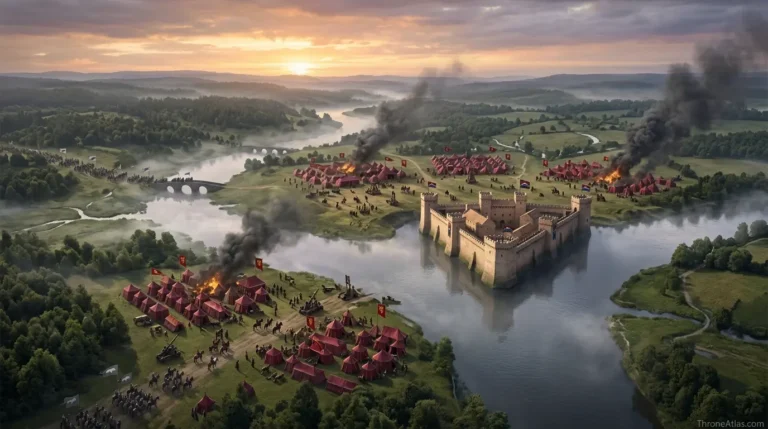
Dreamfyre is the strongest of the dragons trapped inside the Dragonpit during the mob attack. She breaks chains, kills many attackers and finally brings part of the dome down when she crashes into it. The final coordinate is exact even though the event itself is chaotic.
Dragon maps need rider chronology
A dragon can outlive a rider, remain riderless for years and later accept someone new. The map therefore follows phases rather than assuming one continuous political allegiance. Residence, rider and faction can all change while the dragon remains the same geographic subject.
Lairs are stronger evidence than imagined flight lines
When a source names a cave, yard, pit or island where a dragon lairs, that is high-value geographic evidence. Long-distance flights are often recorded only by destination. ThroneAtlas prioritizes the fixed lair and event site over smooth lines that look precise but are not documented.
Dragons compress distance but do not erase strategy
A dragon can cross terrain far faster than an army, yet riders still need castles, fleets, allies and objectives. Dragonstone, the Gullet, King’s Landing and Tumbleton matter because they are strategic systems below the flight path.
Book and screen routes remain separate
House of the Dragon may rearrange encounters or show journeys not described in Fire & Blood. This atlas uses the published historical geography as its structural base and does not silently convert adaptation scenes into book-canon coordinates.
How to read the Dreamfyre Locations Map
Begin with Western royal travels, then locate Harrenhal, and finally follow the page toward Storming of the Dragonpit. Those three anchors establish the center, a major transition and the outer consequence of the map. They are not necessarily three consecutive stops; on a battle or house page they may represent strategic phases rather than a literal journey.
This is a dragon-locations atlas. Confirmed lairs, rider bases and battles are mapped as fixed anchors, while routine flights and unrecorded paths remain broad corridors.
The atlas keeps physical geography separate from temporary political control. A castle can change hands without moving. A dragon can change rider or faction while keeping the same lair. A house can lose lands while its ancestral seat remains fixed. That separation lets the page remain useful across different periods.
Distance, movement and practical geography
Fantasy maps invite straight-line assumptions, but real movement inside the story follows practical constraints. Armies need roads, food and safe crossings. Ships need navigable water and workable weather. Dragons can ignore many ground barriers, yet their riders still act from castles, ports and allied positions. Noble houses depend on the river and road systems around their seats.
For that reason, ThroneAtlas does not turn every pair of known points into a rigid route. If the source describes only origin and destination, the map shows a corridor. If a lair or battlefield is explicitly placed, that point receives stronger confidence. The visual result is intentionally evidence-led rather than decorative.
What changes when you zoom out
At local scale, Western royal travels may dominate the page. Zoom out and it becomes one node inside a larger system. Harrenhal may connect the subject to another kingdom, a battlefront, a maritime chokepoint or a royal capital. Storming of the Dragonpit then shows where that story ends or where its consequences spread.
This is why related maps matter. The same location can play different roles on a regional map, a battle map and a character or dragon route. The geography stays stable while the question changes.
Confirmed geography versus reconstruction
High-confidence markers come from direct place names, published maps or unambiguous narrative positioning. Medium-confidence markers represent broad zones or relationships that are strong but not precise enough for a survey point. Low confidence is reserved for locations or route segments whose exact placement remains unresolved.
Confidence is not the same as importance. A legendary or disputed event can be central to the lore while still being poorly mapped. A small river junction may be geographically exact while receiving only a few lines in the story.
Fast atlas answers
Primary anchor
Western royal travels is the first place to locate for orientation.
Key transition
Harrenhal changes the map’s strategic or chronological meaning.
Final connection
Storming of the Dragonpit gives the clearest endpoint or wider consequence.
Why the geography changes the story
Dreamfyre’s life spans two very different Targaryen women and several major locations. Princess Rhaena Targaryen rides the pale-blue she-dragon across the early royal era, including western travels, King’s Landing, Dragonstone and later Harrenhal. After Rhaena’s death in 73 AC, Dreamfyre makes her lair in the Dragonpit at King’s Landing. During Viserys I’s reign, Princess Helaena Targaryen bonds with her and rides her from the capital. After Helaena’s son Jaehaerys is murdered, Helaena can no longer ride. Dreamfyre remains chained in the Dragonpit and dies during the Storming in 130 AC after breaking free, attacking the mob and crashing into the great dome.
Seen as text alone, these events can feel like a sequence of names. On a map, causes become easier to see. Distance explains why relief arrives late. A bay explains why fleets and dragons operate together. A river confluence explains why a house seat is prosperous. A mountain, forest or castle network explains why an invading army chooses several targets at once.
This spatial reading does not replace the narrative. It tests and organizes it. A good atlas lets readers move back to the story with a clearer sense of what was physically possible, which locations were close, and why commanders or riders made particular choices.
Time, control and changing meaning
Many locations on this page change meaning over time. A dragon lair can become a military base. A town can become a battlefield. A castle can shift from family home to invasion target. A route can carry merchants in peace and armies in war. The page describes those phases rather than freezing one moment as permanent geography.
Chronology is therefore embedded in the numbered sequence and the written sections. The visual atlas should be read as a layered overview, not as proof that every marker represents the same day or political situation.
Cartographer’s field notes
The strongest atlas pages are comfortable leaving some space unresolved. Not every stretch of road has a name. Not every dragon flight has a recorded path. Not every noble estate has surveyed borders. Filling those gaps would make the graphic look complete while making the information less reliable.
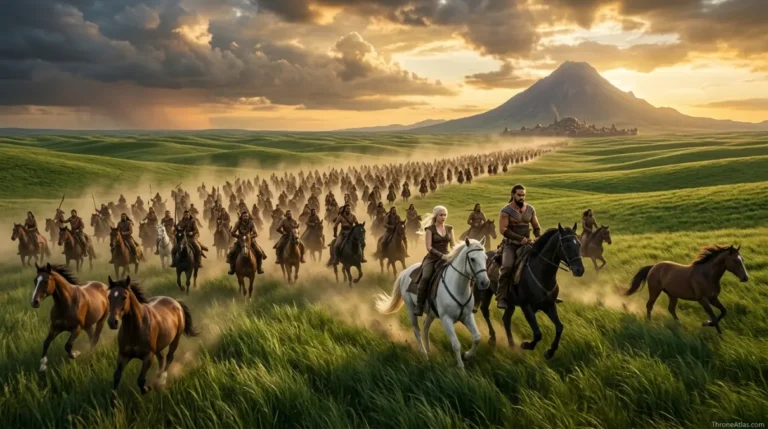
The three image positions are designed for different jobs. The hero establishes atmosphere and region. The primary atlas image should carry the finished geographic visual with labels and terrain. The contextual image can focus on the most important secondary relationship—battlefield, lair, river system, neighboring castle or route. Their alt text describes those roles rather than simply repeating the headline.
If future published material clarifies an uncertain point, the page can be updated without changing the overall structure. That is one advantage of separating confidence from importance: new evidence can move a marker without forcing the whole interpretation to be rewritten.
How this page fits the full ThroneAtlas
The related links below are chosen to change scale or perspective. Regional pages explain the wider landscape. Battle pages show temporary control. House pages explain allegiance. Dragon and character routes add chronology. Using several together gives a clearer picture than forcing every layer into one overcrowded map.
Dreamfyre Locations Map therefore stays focused on one geographic question while still functioning as part of the larger ThroneAtlas network.
What to compare next
Use the related maps below to change scale. A regional map shows the larger terrain; a battle or city map provides close detail; a house or character page explains political or personal movement. The strongest atlas reading comes from comparing the same anchor across several layers.
This page stays focused on its own geographic question so those connections remain clean and useful rather than repetitive.
Map Accuracy and Canon Confidence
High confidence marks geography directly established in the published material. Medium confidence marks a strong regional reconstruction or grouped phase. Low confidence is reserved for unresolved coordinates or disputed placement.
ThroneAtlas does not add exact borders, flight paths, battle lines or minor roads simply to make the graphic look complete. Where the record becomes uncertain, the atlas keeps that uncertainty visible.
Source Basis
This atlas follows Dreamfyre’s published history in Fire & Blood. Rhaena’s principal locations, the later Dragonpit residence and the Storming are firm. Theories connecting Dreamfyre’s stolen eggs to Daenerys’s dragons are not treated as confirmed geographic history.
The page is an interpretive atlas built from established place relationships and chronology. It is designed to answer where events happen, how locations connect and how confidently each part can be mapped.
Frequently Asked Questions
Where does the Dreamfyre locations map begin?
The first major anchor is Western royal travels. From there the atlas follows the strongest chronological or regional sequence.
What is the most important location on this Dreamfyre locations map?
Harrenhal is a major turning point, while Storming of the Dragonpit marks the final or widest consequence of the map.
Is this Dreamfyre locations map based on published canon?
Yes. The base geography follows the published novels, Fire & Blood and official world maps. Uncertain details are labeled rather than presented as equally firm.
Are all map lines exact?
No. Confirmed locations are distinguished from reconstructed corridors. The atlas does not invent a precise flight, march or road where the source only provides destinations.
What does High confidence mean?
High means a place or relationship is directly established by the source geography. Medium marks a strong regional reconstruction. Low is used for genuinely unresolved points.
Why are nearby places included?
Nearby locations explain scale, strategy and movement. Their appearance on the map does not imply ownership or a confirmed visit unless the text says so.
Can I use this map for exact mileage?
No. The visual atlas is designed for relative position, route logic and strategic context rather than modern GPS measurement.
How does ThroneAtlas handle conflicting accounts?
The page preserves the shared geographic facts and identifies where chroniclers disagree instead of choosing one uncertain version without warning.
What should I open next?
The Continue Exploring section links to the strongest regional, battle, house, dragon and location pages connected to the same geography.
When was this Dreamfyre locations map updated?
This ThroneAtlas page is maintained as a 2026 edition and intentionally avoids a fixed day-and-month freshness stamp.