Essos Map Free Cities · Dothraki Sea · Valyria · The Far East
Braavos · Pentos · Vaes Dothrak · Slaver’s Bay · Qarth · Asshai
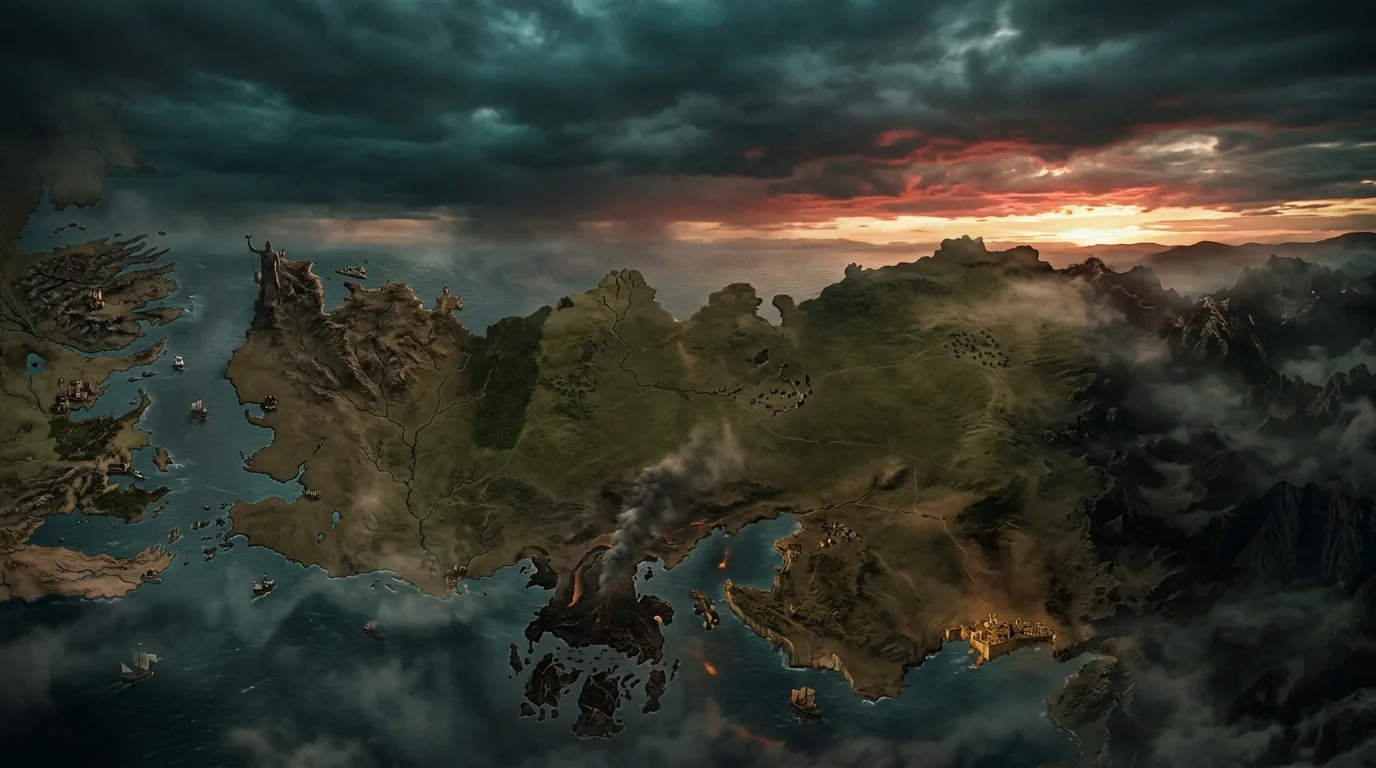
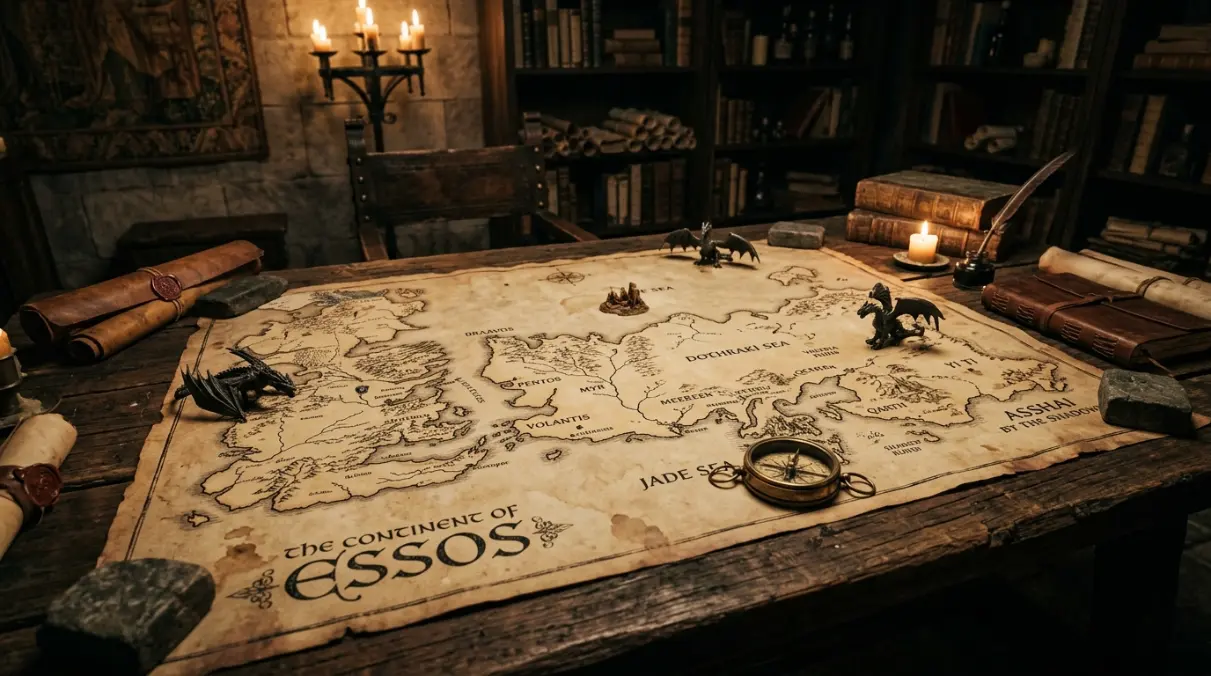
The complete Essos map — from the Nine Free Cities on the Narrow Sea coast, through the horse-lord grasslands of the Dothraki Sea, past the slave cities of Astapor and Meereen, into the ruins of Old Valyria, through the gates of Qarth, and on to the shadowed edge of Asshai where the known world ends.
The Essos map covers the vast eastern continent of the Known World in Game of Thrones and A Song of Ice and Fire. Essos lies east of Westeros across the Narrow Sea and contains nine major regions: the Free Cities (Braavos, Pentos, Volantis, and six others), the Dothraki Sea grasslands, Slaver’s Bay (Astapor, Yunkai, Meereen), the ruins of Old Valyria, the merchant city of Qarth, the far-eastern empire of Yi Ti, and the shadowed city of Asshai. It’s the continent where Daenerys Targaryen builds her power, dragons return, and the deepest lore of the series takes root.
Essos Map: Key Facts
Eight fast facts to orient you before exploring the full atlas — the continent is enormous, and knowing the major zones saves a lot of scrolling.
The Complete Essos Map
A stylized ThroneAtlas cartographic map showing all nine major Essos regions. Click any region to open its guide below.
Explore Essos Region by Region
Select any region to read about its cities, culture, story role, and where it sits on the Essos map relative to everything else.
The Free Cities
The Free Cities are nine independent city-states strung along the western coast of Essos, all within sailing distance of Westeros across the Narrow Sea. Braavos, Pentos, Volantis, Myr, Lys, Tyrosh, Norvos, Qohor, and Lorath each have their own government, economy, faith, architecture, and cultural memory — most shaped by old Valyrian influence, though none more fiercely independent than Braavos, which was founded by escaped slaves and has never forgotten it.
What Is the Essos Map? A Region-by-Region Breakdown
The Essos map shows the eastern continent of the Known World — a landmass that makes Westeros look modest by comparison. And that’s the point. Westeros is a continent of houses, castles, inheritance claims, and feudal grudges. Essos is a continent of trade roads, sea gates, nomadic empires, slave economies, burned ruins, and prophecies that predate any living king.
Essos sits east of Westeros, separated by the Narrow Sea. Its western coastline is close enough for regular traffic: merchants, exiles, sellswords, and royal claimants cross that stretch of water routinely. But the deeper you travel inland or east, the older and stranger the world becomes. The Free Cities feel politically familiar. The Dothraki Sea feels alien. Old Valyria is terrifying. Asshai is barely mappable.
Where Is Essos Located on the Game of Thrones Map?
Essos begins just across the Narrow Sea from Westeros. Its closest point to the Seven Kingdoms is the stretch between Braavos (northwest Essos) and the eastern coast of Westeros — a crossing that characters make in a matter of days. Pentos sits almost directly opposite King’s Landing. Volantis guards a powerful position far to the south.
From that western coastline, Essos stretches east for an enormous distance. The Dothraki Sea fills the continent’s central interior. Slaver’s Bay sits on the southern coast. Old Valyria occupies a ruined peninsula southeast of the Free Cities. Then come Qarth, the Jade Sea, the distant empire of Yi Ti, and finally Asshai at the very edge of the known world. Most Westerosi nobles understand maybe the first quarter of that geography. The rest is rumor to them.
The Nine Free Cities: Westeros’s Eastern Neighbors
The Free Cities are the first thing you hit on the Essos map when traveling east from Westeros, and they’re worth understanding individually rather than lumping together. Nine city-states. Nine different identities. Each one shaped by trade, Valyrian history, and centuries of competing with the others for commercial dominance.
What they share is independence — from each other, from Westeros, and from any memory of the Valyrian Freehold that once dominated this coast. What they don’t share is much else. Braavos abolished slavery from its founding. Lys built its entire economy around it. Tyrosh and Myr fight each other constantly over the Disputed Lands. Volantis clings to Valyrian tradition so hard it’s practically fossilized. These aren’t variations on a theme. They’re genuinely different political animals.
Braavos — The Iron Bank, the Faceless Men, and Arya Stark
Braavos is probably the most important city on the western Essos map for the show’s story. It was founded by escaped slaves from Valyria and has an institutional hatred of slavery built into its identity. That makes it politically distinct from nearly every other wealthy power in Essos. The Iron Bank of Braavos doesn’t just lend money — it effectively controls who wins wars, because it funds whoever’s most likely to repay the debt.
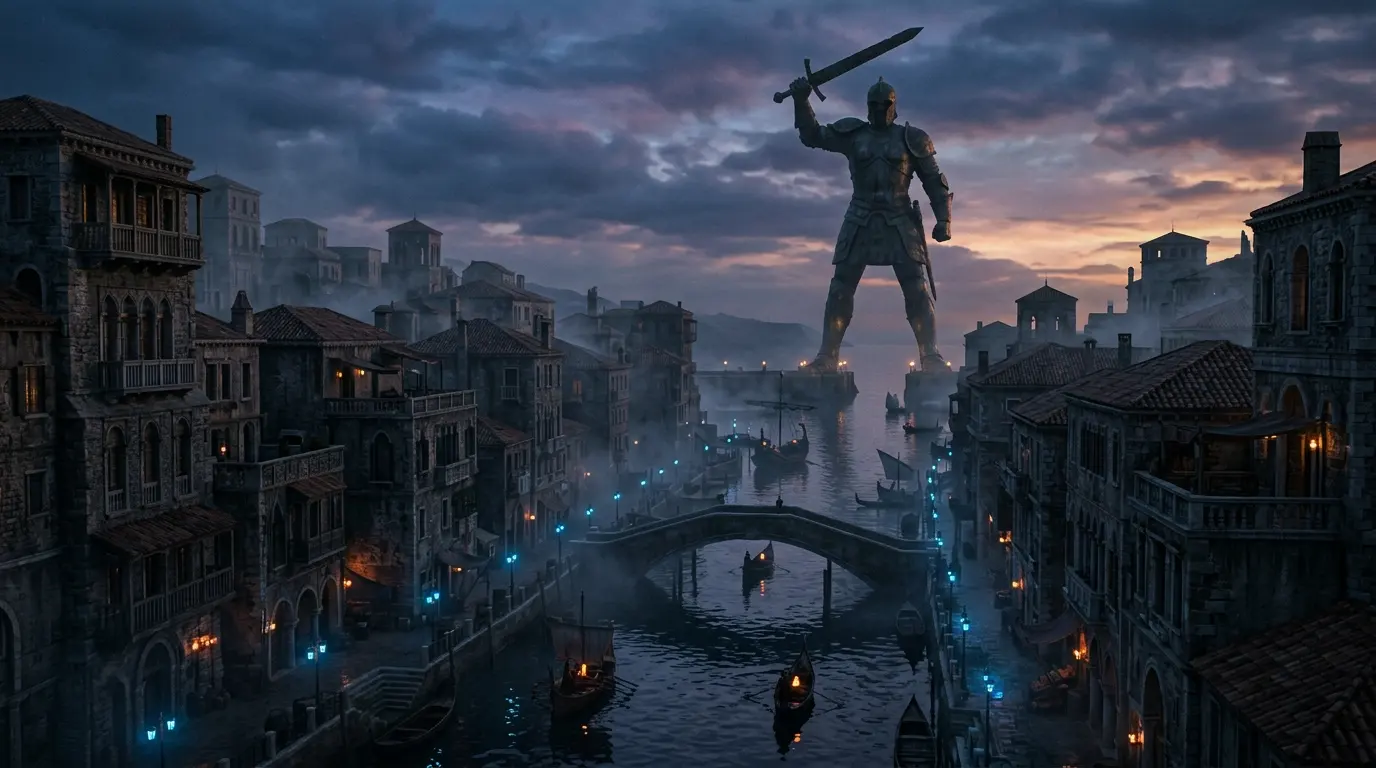
For Arya Stark, Braavos is where identity goes to die. The House of Black and White sits there. The Faceless Men operate there. And the city’s canal streets, fog, and giant Titan statue make it one of the most visually distinctive locations in the series — different enough from any Westerosi city to feel genuinely foreign.
Pentos and Volantis
Pentos is where Daenerys Targaryen begins her story in exile, hosted by the wealthy magister Illyrio Mopatis before her marriage to Khal Drogo. It’s a comfortable city of trade and politics — nothing like what comes after. Volantis, by contrast, is one of the oldest Free Cities, a former Valyrian colony that still treats its Valyrian heritage as a mark of superiority. Red priests of R’hllor — the Lord of Light — are a powerful presence there, which matters for Melisandre, Thoros, and the broader religious storyline.
The Dothraki Sea: A Continent Inside a Continent
The Dothraki Sea is one of the most memorable geographical concepts in the entire series, and it works because of the name. It’s not a sea. It’s a vast grassland — but grass moves in the wind the way water moves in a current, and the khalasars that cross it move like ships on an ocean. When you look at the Essos map and see that enormous blank interior, that’s the Dothraki Sea. It covers more ground than the Seven Kingdoms of Westeros.
Vaes Dothrak is the Dothraki’s sacred gathering city at the center of the Sea. No blood is shed within its walls — an unusual rule for a civilization built around warfare. It’s where the widows of dead khals (the Dosh Khaleen) live, and where Daenerys is taken after Khal Drogo dies. Her escape from Vaes Dothrak — with dragons — is one of the story’s turning points. The Dothraki Sea stops being a place where Daenerys is a captive and starts being the source of her first real army.
Slaver’s Bay: Astapor, Yunkai, and Meereen
Slaver’s Bay is where the show’s most sustained moral and political argument plays out. The three major cities — Astapor, Yunkai, and Meereen — are built on the old Ghiscari Empire’s foundation and have run on slave labor for centuries. They’re not villains because the story says so. They’re villains because the economics are visible: the Unsullied army that makes Daenerys so formidable exists because thousands of boys were tortured into obedience.
Astapor is where Daenerys acquires the Unsullied, trading a dragon (briefly) for an army of 8,000 elite soldiers. Yunkai is a city of pleasure slaves and political cowardice that folds when confronted directly. Meereen is the hardest problem — a city Daenerys takes by force but cannot govern without violence, resistance, and constant compromise. The show spends three full seasons there because ruling is harder than conquering, and the Essos map never lets you forget it.
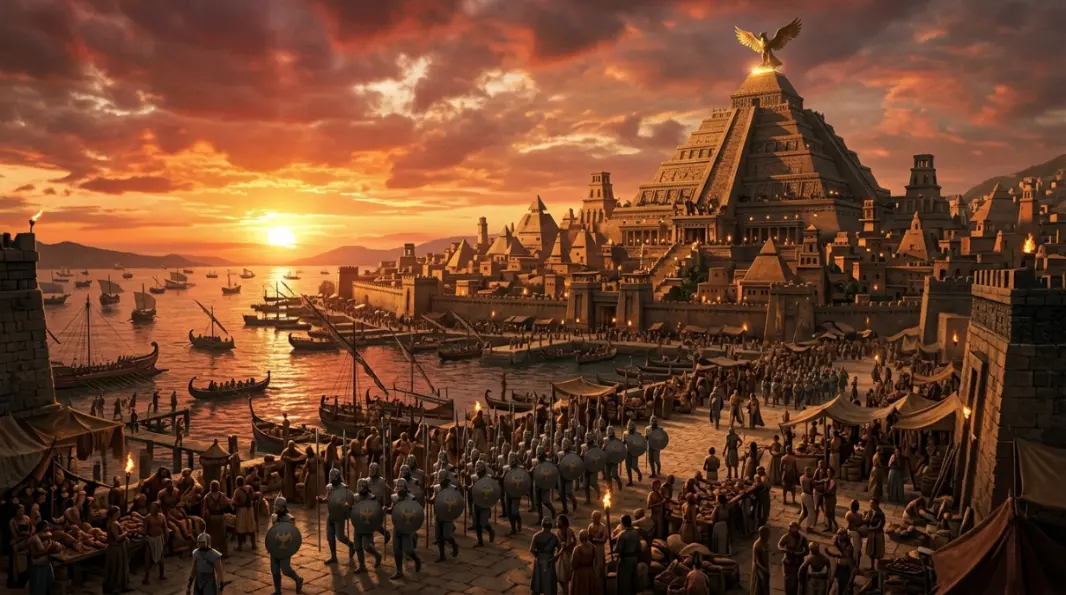
Old Valyria: The Essos Map’s Haunted Core
Old Valyria is one of the most important locations on the Essos map, and one of the least visited. It was the capital of the Valyrian Freehold — an empire of dragonlords, sorcerers, and scholars that dominated much of the known world for five thousand years. The Doom of Valyria destroyed it in a single cataclysm about 400 years before the main story, leaving behind ruins, poisoned water, dangerous roads, and a supernatural dread that keeps most sailors away.
Why does it matter if nobody goes there? Because everything important traces back to it. Valyrian steel — the only kind that kills White Walkers — was forged there using dragon fire and lost magic. The Targaryen family’s identity, their dragons, their language, their architecture at Dragonstone — all of it is Valyrian. Even the Game of Thrones itself begins with a Valyrian family surviving the Doom and eventually claiming a continent. Old Valyria isn’t background. It’s the wound the whole story grew out of.
Qarth: The Wealthiest City in Essos
Qarth sits near the eastern end of the known world’s main trade route and calls itself the “greatest city that ever was or will be.” That’s a bit much — but it’s not entirely wrong about its commercial importance. The city controls access to the Jade Gates, making it the chokepoint between the western Essos trade network and everything to the east: the Jade Sea, Yi Ti, and the spice routes beyond.
For Daenerys, Qarth is beautiful and treacherous in equal measure. She arrives desperate, is taken in by the merchant Xaro Xhoan Daxos, and promptly finds herself in a city where everybody wants something from her dragons and nobody wants her to leave with them. The Spice King, the Thirteen, the Warlocks of Qarth — they’re all variants of the same problem: people who mistake hospitality for control. Her escape sets the pattern for how she handles every powerful city after it.
Yi Ti and Asshai: The Far East of the Essos Map
Yi Ti and Asshai represent the parts of the Essos map that the show only gestures at — but George R. R. Martin describes at length in the companion books. Yi Ti is an enormous ancient empire east of Qarth, comparable in age and cultural complexity to the Valyrian Freehold. It has its own dragon mythology, its own dynasties, its own relationship with the Lord of Light. Most Westerosi characters couldn’t find it on a map.
Asshai is something else entirely. It’s a city at the very edge of the known world, in the Shadow Lands where the sun barely rises. Melisandre trained there. Shadowbinders come from there. It appears in prophecy more often than in any trade ledger. On the Essos map, Asshai functions less like a city and more like a warning — a place that confirms the world is larger and stranger than any character fully understands.
How the Essos Map Shapes Daenerys Targaryen
No character travels more of the Essos map than Daenerys Targaryen, and that’s not accidental. Her route is constructed as a geography lesson in power. She enters Essos with nothing but a name and a claim. She exits it with three dragons, an army of Unsullied and Dothraki, ships, and allies across two continents. The map made her.
Pentos taught her what it feels like to be used. The Dothraki Sea taught her that strength isn’t always physical. The Red Waste taught her that survival is a form of faith. Qarth taught her that admiration and captivity can look identical. Slaver’s Bay taught her that being right doesn’t make governing easy. Every region added something she couldn’t have gained in Westeros — where she’d have been either hidden or killed long before episode three.
Essos vs. Westeros: Why They Feel So Different
Westeros is organized vertically: lord above vassal, king above lord, bloodline above everything. The central question is always “who has the better claim?” Essos is organized differently — horizontally, by commerce, military strength, religion, and geography rather than inheritance. In Westeros, you win by being born right. In Essos, you win by controlling the right road, port, slave market, or god.
That’s why the two continents feel tonally different even when they’re part of the same story. Westeros has a ceiling: the Iron Throne. Essos has a horizon. The map literally doesn’t end in the east — it just gets less known. For a character like Daenerys, that’s not a problem. It’s a runway.
Daenerys Targaryen’s Route Across Essos
The best way to understand the Essos map is to follow someone who crosses most of it. Here’s what each stop on Daenerys’s journey actually changed about her.
Season 1
Seasons 1–2
Season 2
Season 2
Seasons 3–6
Season 7
Characters, Cities, and Lore Tied to Essos
The Essos map connects outward to dozens of ThroneAtlas pages covering the characters who live there, the cities that matter, and the ancient history underneath it all.
Major Characters in Essos
Daenerys Targaryen travels the most of it. Arya Stark disappears into Braavos. Tyrion Lannister crosses from the Free Cities to Meereen. Jorah Mormont serves as guide and witness throughout. Melisandre was trained in Asshai. Each character sees a different Essos — and the map shows why. Follow their individual routes in the routes section.
Ancient Lore and History
Essos is where the deep history lives. The Valyrian Freehold, the Doom of Valyria, the Ghiscari Empire, the Long Night’s origins, the founding of Braavos by escaped slaves, the first red priests — none of this happened in Westeros. The continent is, in a real sense, older than the story being told.
Economics of the Essos Map
The Iron Bank of Braavos finances wars across both continents. Slave trade in Slaver’s Bay funds a regional economy larger than most Westerosi kingdoms. Qarth’s merchant princes control spice and silk routes. Essos runs on commerce, and whoever controls the ports controls the power — a very different system from the Iron Throne’s feudal inheritance model.
Essos Map — Common Questions Answered
Quick answers to the most-searched questions about the Essos map, its regions, and how it connects to the Game of Thrones story.
Essos is the vast eastern continent of the Known World in Game of Thrones and A Song of Ice and Fire. It lies east of Westeros, separated by the Narrow Sea, and contains nine major regions: the Free Cities, the Dothraki Sea, Slaver’s Bay, Old Valyria, Qarth, the Red Waste, Yi Ti, the Jade Sea coast, and the Shadow Lands near Asshai. It’s significantly larger than Westeros and is where Daenerys Targaryen builds her power before returning to claim the Iron Throne.
Essos is significantly larger than Westeros. Westeros spans roughly 3,000 miles from Castle Black in the north to Dorne in the south. Essos stretches far further east than the show ever visits — the Dothraki Sea alone is wider than Westeros, and Yi Ti and the Shadow Lands extend beyond that. Most of the story takes place in the western quarter of Essos. The full continent is largely unmapped even within the story’s fictional world.
The Nine Free Cities are independent city-states on or near the western coast of Essos: Braavos, Pentos, Volantis, Myr, Lys, Tyrosh, Norvos, Qohor, and Lorath. All were shaped to varying degrees by old Valyrian influence, though each has its own distinct government, culture, economy, and relationship to slavery. Braavos is unusual in having been founded specifically by escaped Valyrian slaves — giving it an anti-slavery identity most other Free Cities don’t share.
Old Valyria is located in southern Essos, on a peninsula southeast of the Free Cities and west of Slaver’s Bay. It was the heartland of the Valyrian Freehold — a dragonlord civilization that dominated much of the known world for five thousand years before the Doom of Valyria destroyed it roughly 400 years before the main story. The ruins remain dangerous to approach, and the roads leading to it (the old Valyrian roads, which survive intact) are one of the only physical legacies of the empire outside of Valyrian steel and the Targaryen bloodline.
Daenerys visits Pentos (Season 1, where she begins her exile), Vaes Dothrak in the Dothraki Sea (Seasons 1 and 6), Qarth (Season 2), Astapor (Season 3, where she acquires the Unsullied), Yunkai (Season 3), and Meereen (Seasons 4–6, where she rules for three seasons). She also crosses the Red Waste between the Dothraki Sea and Qarth in Season 2. Her entire Essos journey spans six seasons before she finally sails to Dragonstone and Westeros in Season 7.
The Dothraki Sea is the vast central grassland of Essos — not a body of water, but a sea of grass that moves and ripples in the wind like an ocean. It covers most of Essos’s interior and is home to the Dothraki people, who travel it in nomadic groups called khalasars. Vaes Dothrak, the only permanent city on the Dothraki Sea, serves as a sacred gathering point where khalasars meet, trade, and honor their traditions. No blood may be shed within Vaes Dothrak — a stark contrast to Dothraki culture everywhere else.
Asshai is a remote city at the far eastern edge of the known Essos map, located in the Shadow Lands where sunlight barely reaches. It’s associated with shadowbinding (a form of blood magic), prophecy, and practitioners who deal in dark arts. Melisandre — the Red Woman — was trained in Asshai before arriving in Westeros, which explains both her power and her mysterious origins. In the books, Asshai appears more prominently in prophecy surrounding Azor Ahai, the mythic hero linked to the Lord of Light and the defeat of the Great Other. It’s a place that exists at the border between geography and myth.
Related Maps, City Guides, Routes, and Lore
Essos connects to dozens of ThroneAtlas pages — maps, character routes, city guides, and the deep lore that makes the eastern continent more than scenery.
Essential Maps
Essos City Guides
Character Routes
ThroneAtlas is an independent fan-made map and lore reference site created for readers and viewers of Game of Thrones and A Song of Ice and Fire. It is not affiliated with, endorsed by, or connected to HBO, Warner Bros., George R. R. Martin, or any official Game of Thrones, House of the Dragon, or A Song of Ice and Fire property. All character names, location names, and associated trademarks belong to their respective owners. Last reviewed: 2026.