Game of Thrones Routes Character Journeys, Roads, Sea Paths & War Marches
Jon Snow · Daenerys · Arya · Tyrion · Sansa · Jaime · War Roads · Dragon Routes
Explore the major Game of Thrones routes across Westeros, Essos, and the Known World. This ThroneAtlas hub maps character journeys, royal roads, sea crossings, exile paths, battle marches, dragon flights, and the geographic logic behind every transformation in the story.
The most important Game of Thrones routes are Jon Snow’s route (Winterfell → Castle Black → Beyond the Wall → Dragonstone → the North), Daenerys Targaryen’s route (Pentos → Dothraki Sea → Qarth → Slaver’s Bay → Meereen → Dragonstone → King’s Landing), Arya Stark’s route (Winterfell → King’s Landing → Riverlands → Harrenhal → Braavos → North), and Tyrion Lannister’s route (King’s Landing → Vale → Essos → Meereen → Dragonstone). Route maps explain how movement changes characters, connects major locations, and turns geography into story.
Game of Thrones Routes at a Glance
Routes can be personal, political, military, magical, or maritime. Each type reveals a different dimension of how Westeros and Essos actually function as connected worlds.
Explore Route Maps by Type
Search or filter the ThroneAtlas route pages. Each card links to a full map guide covering stops, strategy, character transformation, and geographic context.
Jon Snow Journey Map
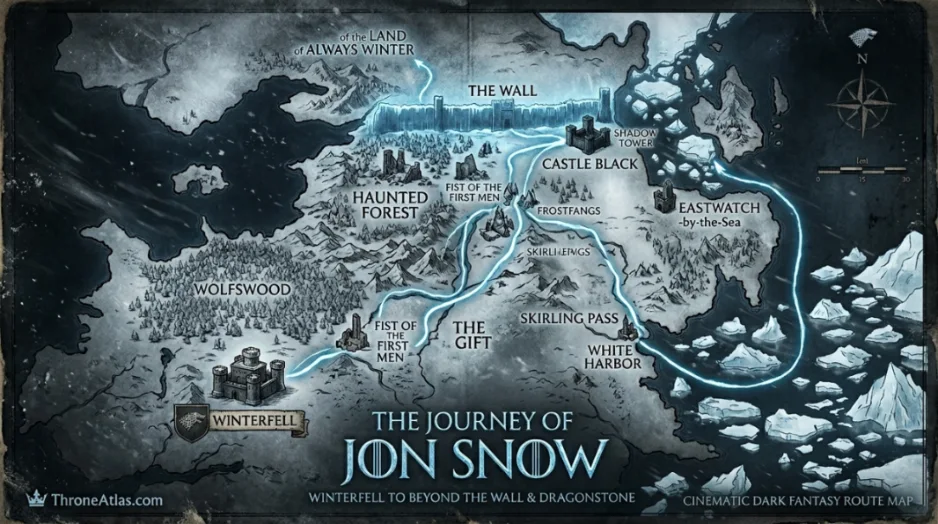
A northern route through duty, exile, leadership, the Wall, the wildlings, Dragonstone, and the return to Winterfell.
Open Route →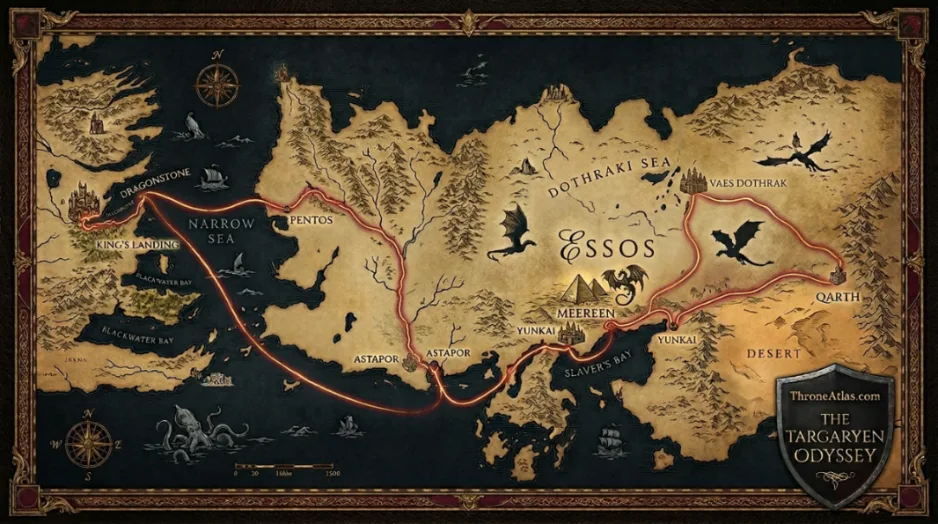
Daenerys Targaryen Route
The great east-to-west transformation route from exile to dragons, rule, conquest, and return to Westeros.
Open Route →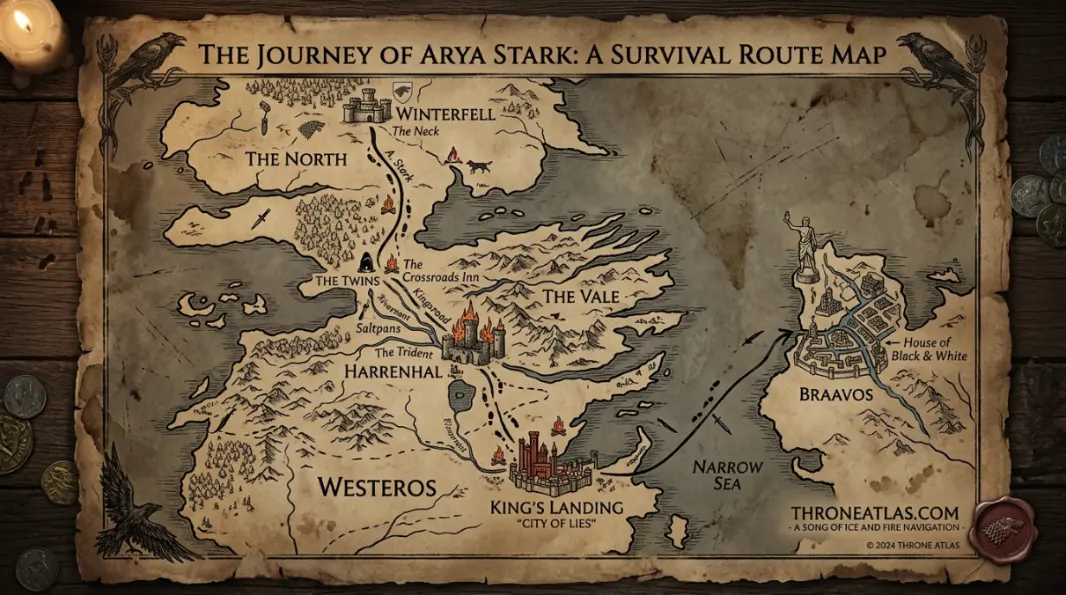
Arya Stark Route
A survival road through the capital, war-torn Riverlands, Harrenhal, Braavos, and a changed return north.
Open Route →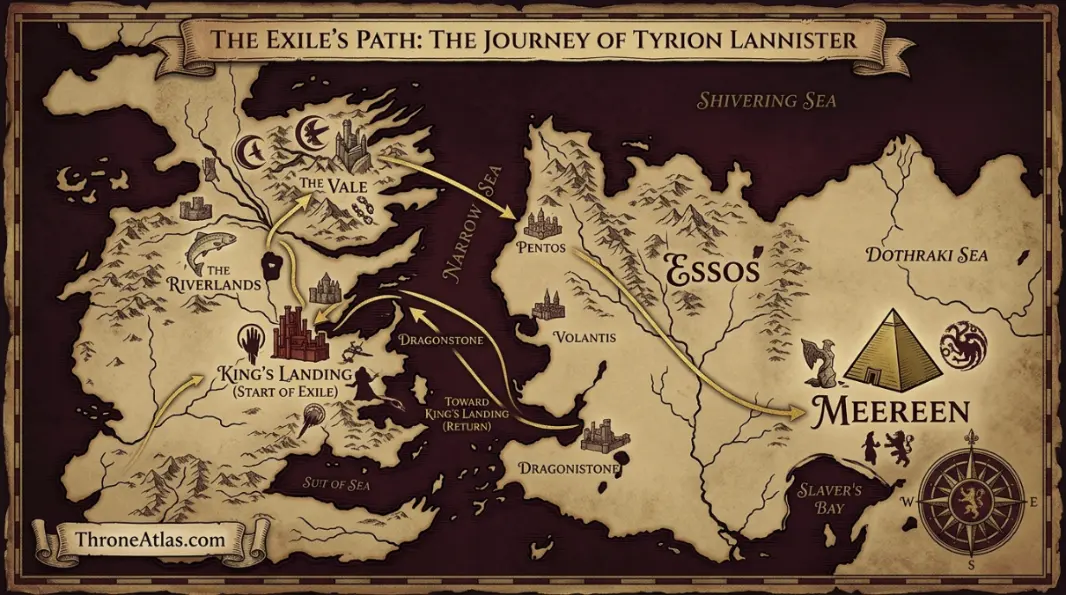
Tyrion Lannister Route
A route from court power to accusation, captivity, exile, Essos, Meereen, Dragonstone, and counsel to a queen.
Open Route →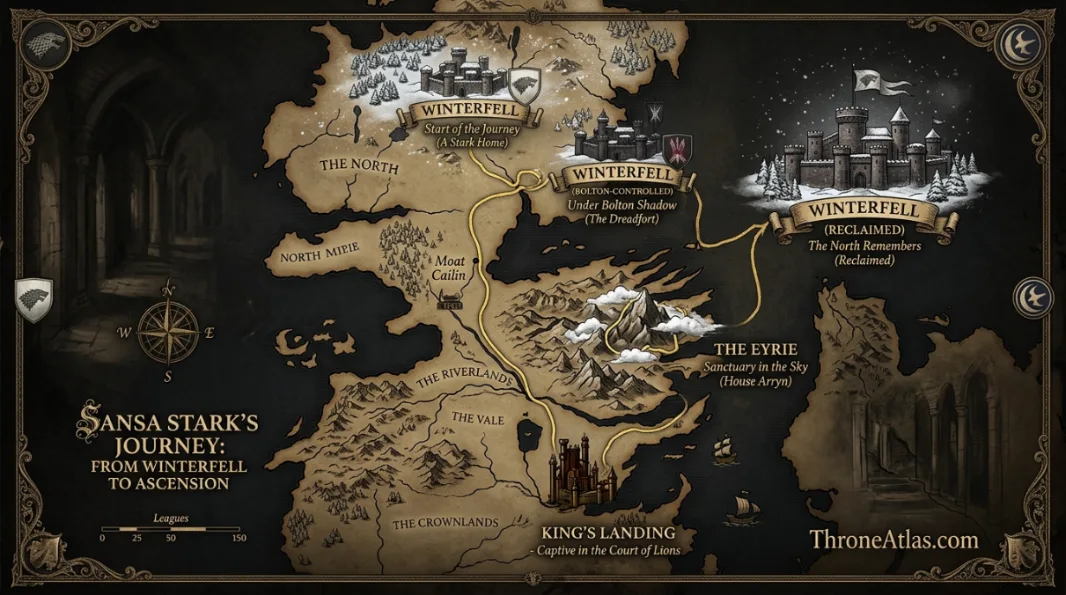
Sansa Stark Route
A route through hostage politics, King’s Landing courts, the Vale, Bolton captivity, and reclaimed Winterfell.
Open Route →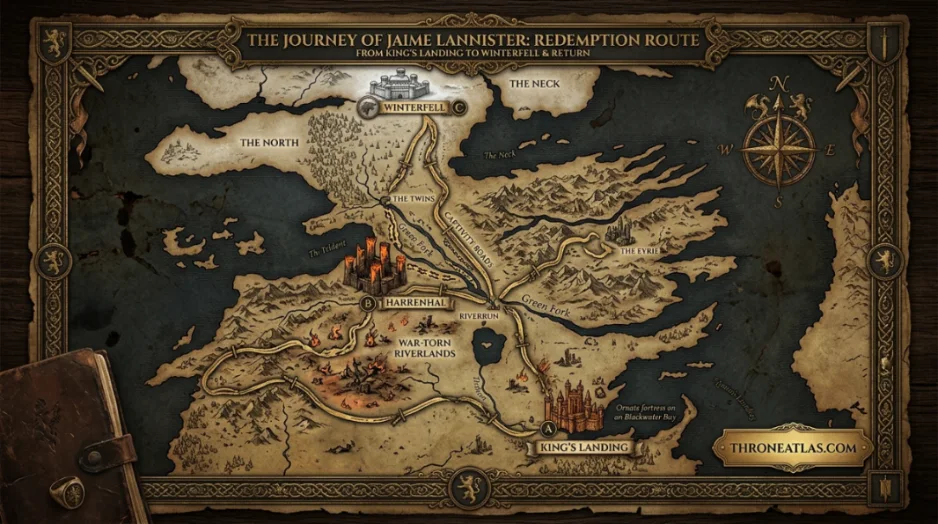
Jaime Lannister Route
A redemption arc traced through the Riverlands, Harrenhal, Brienne’s roads, King’s Landing, and the march north.
Open Route →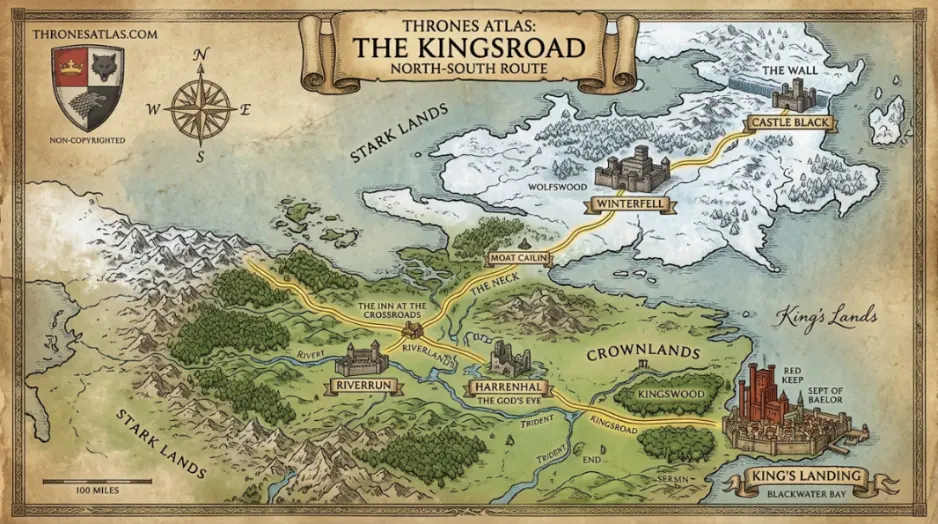
The Kingsroad Route
The main north-south artery linking Castle Black, Winterfell, the Riverlands, and King’s Landing.
Open Route →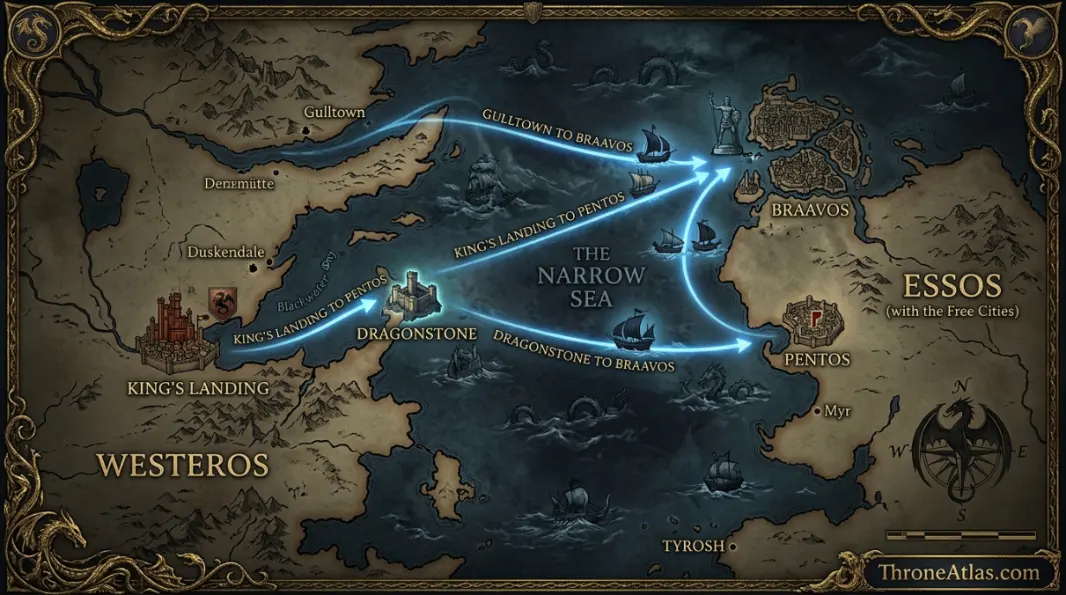
Narrow Sea Crossings
The sea corridor that carries exiles, claimants, merchants, assassins, fleets, and dragon-era politics between continents.
Open Route →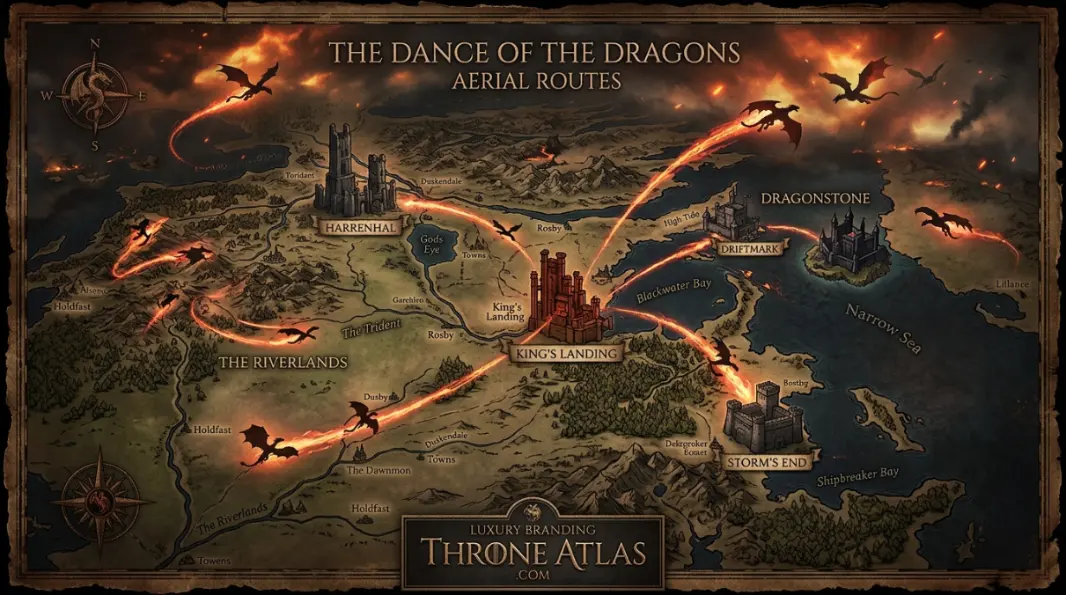
Dance of the Dragons Routes
Dragonstone, King’s Landing, Driftmark, Harrenhal, Storm’s End, and the aerial routes of the Targaryen civil war.
Open Route →Major Routes Across Westeros and Essos
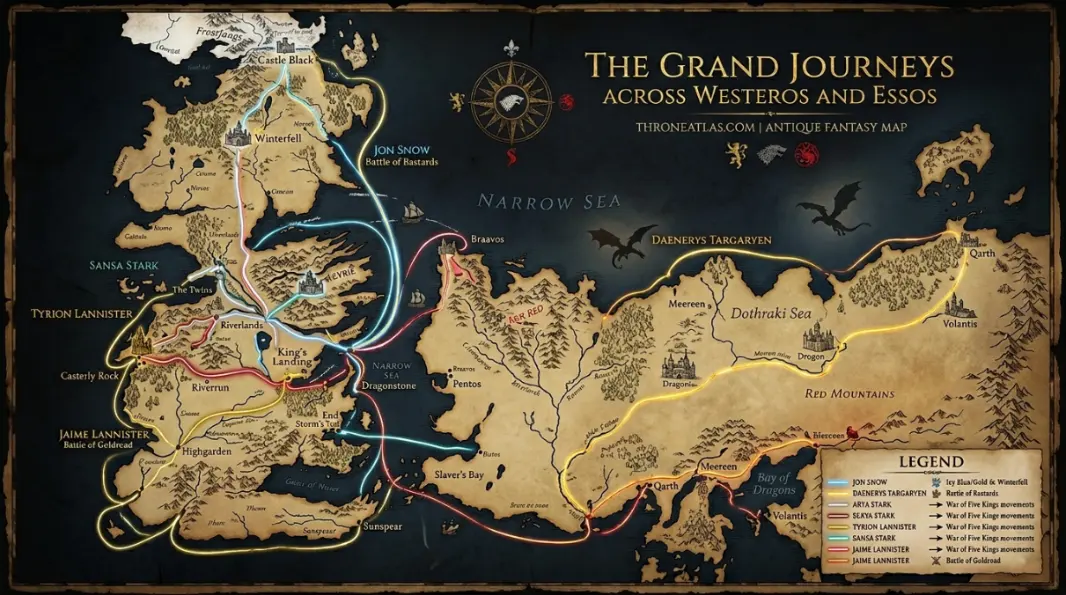
A stylized overview of the great route systems: northern roads, eastern exile paths, Narrow Sea crossings, Riverlands war movement, and dragon flight corridors.
Why Game of Thrones Routes Matter More Than Maps
A route in Game of Thrones is never only travel. It’s the shape of change. A character leaves one place with one identity and arrives somewhere else with that identity damaged, hardened, or completely remade. Jon Snow doesn’t become the same man if he never leaves Winterfell for Castle Black. Daenerys Targaryen doesn’t become a queen of armies and dragons if she never crosses the Dothraki Sea. Arya Stark doesn’t become Arya without roads, disguises, Riverlands violence, and Braavos. The road doesn’t carry the story — it creates it.
That’s why this routes hub exists as a separate system from the locations hub. A standard map shows where places are. A route map shows what happens between them. It connects the dots, but more importantly, it explains the pressure in the space between: danger, distance, hunger, weather, loyalty, pursuit, exile, military timing, sea crossings, and the emotional cost of moving through a broken world.
Game of Thrones Major Routes Compared
Not all routes are equal in length, danger, or transformation. Here’s how the major character routes compare across the full series — from starting point through final destination.
| Character | Route Type | Start | End | Core Theme |
|---|---|---|---|---|
| Jon Snow | Northern | Winterfell | Beyond the Wall | Duty & identity |
| Daenerys Targaryen | Exile → Conquest | Pentos (Essos) | King’s Landing | Liberation & destruction |
| Arya Stark | Survival | Winterfell | Winterfell → Westeros seas | Survival & vengeance |
| Tyrion Lannister | Political exile | King’s Landing | King’s Landing (Hand) | Politics & exile |
| Sansa Stark | Captivity | Winterfell | Winterfell (Queen) | Captivity & power |
| Jaime Lannister | Redemption | King’s Landing | King’s Landing (death) | Honor & redemption |
Jon Snow’s Route: From Winterfell to the Edge of the World
Jon Snow’s route is the clearest northern journey in the entire series. It begins at Winterfell, where he’s raised among the Starks but never fully allowed to forget his ambiguous place in the family. His decision to take the black and join the Night’s Watch takes him north along the Kingsroad to Castle Black — a place most southern lords treat as a punishment posting.
For Jon, the Wall becomes something else. He joins ranging parties Beyond the Wall, encounters the wildlings, and eventually becomes Lord Commander. His route then pivots: south to Winterfell for the Battle of the Bastards, east across the Narrow Sea to Dragonstone to negotiate with Daenerys Targaryen, and finally back to the frozen north that first shaped him. The route mirrors his identity almost perfectly. He starts as a boy outside the family line, becomes a leader among enemies, becomes a claimant he never wanted to be, and ends as a kind of permanent exile by choice.
Geographically, his route is one of the few in the series that goes both north of the Wall and south of King’s Landing. No other character covers quite that much vertical distance across Westeros.
Daenerys Targaryen’s Route: Exile, Dragons, and Return
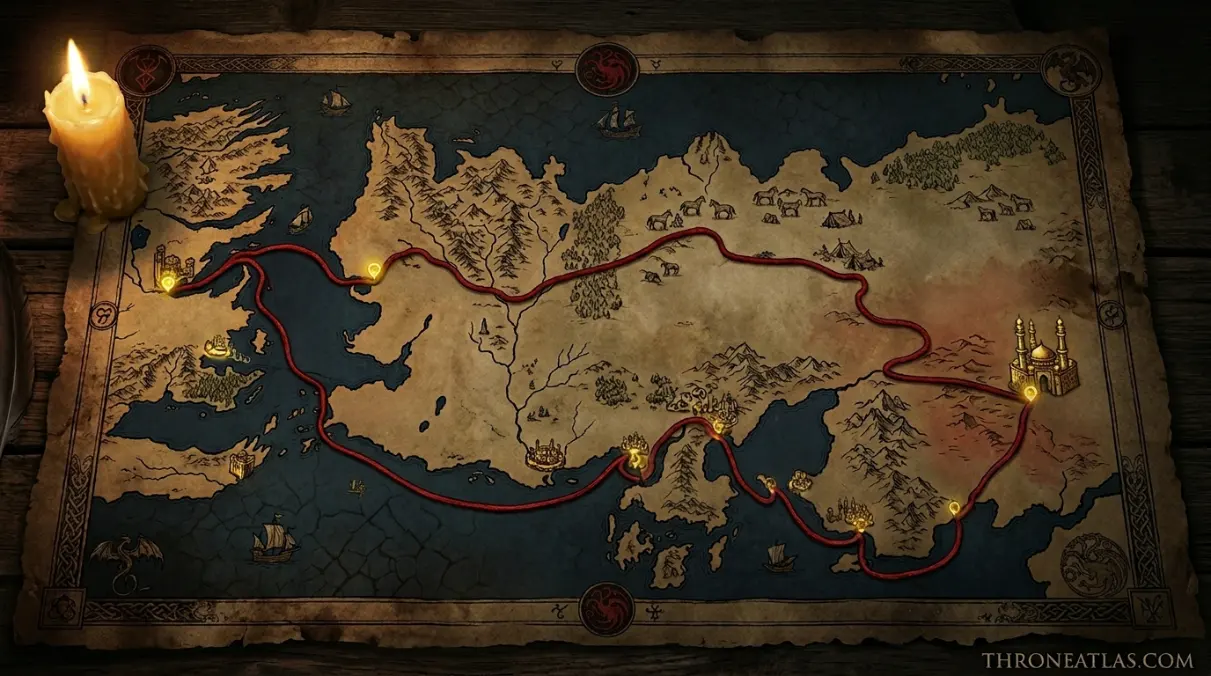
Daenerys Targaryen’s route is the greatest east-to-west transformation arc in Game of Thrones. It begins in exile near the Free Cities — sold into a marriage alliance before she can make any choice for herself — and ends with her burning King’s Landing from the back of Drogon. What happens in between is one of the most geographically ambitious journeys in the story.
The route runs: Pentos → Dothraki Sea → Vaes Dothrak → Red Waste → Qarth → Astapor → Yunkai → Meereen → Narrow Sea → Dragonstone → King’s Landing. Each stop adds a layer. The Dothraki Sea gives her cultural rupture and, eventually, command of a khalasar. Astapor gives her the Unsullied and her first real army. Meereen gives her the experience of governing — messy, contested, and nothing like conquest. Dragonstone gives ancestral legitimacy. King’s Landing gives the final collision between the queen she was building toward and the tyrant she had always feared becoming.
Her route matters because it’s impossible to understand what she becomes without understanding where she’s been. The destruction of King’s Landing isn’t random — it’s what happens when every piece of her journey converges at once under unbearable pressure.
Arya Stark’s Route: Survival on the Road
Arya Stark’s route is the route of survival. She begins at Winterfell, travels south to King’s Landing with her father, escapes into the back alleys after Ned Stark’s execution, and then disappears into the roads with nothing but a sword and a list of names. Her journey takes her through the Riverlands, into Harrenhal as a prisoner, alongside the Brotherhood Without Banners, toward the Twins (and the Red Wedding), to Braavos and the House of Black and White, and eventually back north to Winterfell and — ultimately — west, beyond the edge of the known map.
Her route is one of the best examples of what war does to ordinary ground. Nobles debate armies and claims, but Arya sees destroyed villages, prisoners chained in the road, bodies left in fields, and people crushed between the banners of houses that don’t know their names. Her map isn’t just a line of locations. It’s a record of what political decisions do to real ground.
Tyrion Lannister’s Route: Politics, Captivity, and Exile
Tyrion’s route is a route of intelligence under sustained pressure. It begins in Lannister privilege — comfortable but constrained — moves through Winterfell and the Wall (briefly), into captivity at the Eyrie, through King’s Landing and the war, through trial and near execution, into escape, exile, Essos, Pentos, up the Rhoyne River, toward Meereen, and finally back west to Dragonstone and King’s Landing as Hand to Daenerys.
What makes Tyrion’s route distinctive is that it’s entirely defined by his mind, not his body. He survives captivity through conversation and political trade. He survives Essos through observation and counsel. He survives Meereen by reading power structures he barely understands. His route removes him from Lannister machinery and forces him to rethink power in systems he didn’t grow up inside — which is arguably what makes him capable of eventually functioning as someone else’s Hand.
Sansa Stark’s Route: Captivity, Courts, and Reclaimed Power
Sansa Stark’s route is one of the most underestimated in the series — because it reads, at first glance, like a route of passive suffering. She travels from Winterfell to King’s Landing as an excited child and spends years there as a hostage, learning court politics under conditions of constant threat. Then she escapes to the Eyrie with Littlefinger. Then she travels under disguise back into Bolton-controlled Winterfell. Then she reclaims Winterfell. Then she becomes Queen in the North.
The geographic compression of her route — she never crosses the Narrow Sea, never leaves Westeros — is the point. Sansa’s transformation happens in one of the world’s most politically concentrated spaces. Every castle she passes through teaches her something specific: King’s Landing teaches manipulation and survival; the Eyrie teaches how power exploits grief; Winterfell under the Boltons teaches what it costs to reclaim something that was always yours. Her route is a masterclass in how confinement can be as transformative as freedom.
Jaime Lannister’s Route: The Road That Unmade the Kingslayer
Jaime Lannister’s route is the clearest redemption arc in the series — and it’s also a deeply geographic story. He starts in King’s Landing, a man whose reputation rests on a single act of betrayal (killing Aerys II to stop the wildfire) and whose identity is entirely bound to his sword hand and his Lannister name. The road strips both of those away.
His journey takes him through the Riverlands at war, into captivity alongside Brienne of Tarth, through Harrenhal where he loses his hand, back toward King’s Landing, and then — in one of the series’ most significant final acts — north to Winterfell to fight in the Battle against the dead. That northern march is entirely against Lannister interest and entirely consistent with the person the road turned him into.
Geographically, Jaime’s route loops back. He ends at King’s Landing, where he started. But the man who returns is not the same one who left. That’s what the Riverlands, Harrenhal, and Brienne’s company actually did to him — which is why ThroneAtlas maps the route rather than just describing the character arc in the abstract.
Key Takeaways — Game of Thrones Routes
- Route maps explain how movement changes characters — not just where they went, but what the journey between locations cost them and built in them.
- Jon Snow’s route is the only one in Game of Thrones that crosses both Beyond the Wall and Dragonstone, covering nearly the full vertical length of the known world.
- Daenerys Targaryen’s route runs from Pentos through Dothraki Sea, Qarth, Slaver’s Bay, Meereen, Dragonstone, and King’s Landing — one of the longest journeys in the series.
- Arya Stark’s route maps what war does to ordinary ground — not noble strategy, but human consequence, village by village.
- Sansa Stark’s transformation is the most geographically concentrated: she never leaves Westeros, yet every confined space teaches her a different kind of power.
- Jaime Lannister’s route is a loop — he starts and ends at King’s Landing — but the man who returns is entirely different, remade by the Riverlands, Harrenhal, and Brienne’s roads.
- The Kingsroad is the structural spine of Westeros: whoever controls it controls the flow of information, armies, and political consequence between north and south.
- Dragon routes compress distance in ways that fundamentally change military logic — a castle 10 days away by road is 2 hours away by wing, which makes the whole concept of defensive positioning obsolete.
The Kingsroad: The Spine of Westeros
The Kingsroad is more than infrastructure — it’s the nervous system of Westeros. Running from Castle Black in the far north through Winterfell, the Neck, the Riverlands, and all the way to King’s Landing in the south, it’s the primary artery that carries news, nobles, prisoners, soldiers, merchants, and ravens. Armies use it. Exiles use it. The Stark family uses it at the very beginning of the series, heading south toward a world that will kill most of them.
A road like the Kingsroad shapes military campaigns as much as terrain does. Armies that control the Kingsroad can move faster and supply themselves more effectively. Armies cut off from it have to find alternative routes through forests, bogs, and mountains — which costs time, men, and morale. This is why so much early War of the Five Kings maneuvering happens around the road’s chokepoints rather than in open-field engagements.
The Narrow Sea: Why Every Exile Matters
The Narrow Sea is the most important sea route in the Known World because it separates Westeros from Essos while keeping them within reach of each other. The sea is roughly 300 miles wide at its narrowest — enough to be genuinely dangerous in bad weather, but not enough to make return impossible.
This matters because it makes Targaryen exile survivable and reversible. It keeps Braavos within reach of Arya Stark. It lets Stannis access the Iron Bank. It connects Dragonstone to both continents simultaneously, which is why Dragonstone has always functioned as a strategic hinge point rather than a purely defensive island fortress.
The Narrow Sea isn’t a wall. It’s a delay. And in the political logic of Westeros, a delay is often all you need to gather armies, dragons, or enough gold to change the balance completely.
War Routes Through the Riverlands
The Riverlands are the most important route zone in Westeros not because they’re the strongest region, but because every army has to pass through them. Roads, rivers, castle crossings, and central geography make the region simultaneously valuable and catastrophically vulnerable. When great houses fight, the Riverlands suffer — not because they chose the wrong side, but because their location makes neutrality nearly impossible.
The war routes through the Riverlands during the War of the Five Kings map four separate armies moving through the same territory at different times: Robb Stark moving south, Lannister forces moving north and east, Tywin anchoring at Harrenhal, and various flanking forces crossing Frey bridges and Tully river fords. Understanding those movements is what makes the Red Wedding make sense — it wasn’t betrayal from nowhere. It was the logical endpoint of a geographic dependency Robb Stark had accepted without fully accounting for the cost.
Dragon Routes and the Speed of Fear
Dragon routes are categorically different from all other routes in the Known World because they eliminate the concept of distance as a defensive advantage. A castle that feels unreachable by land is a few hours away by wing. Supply columns that feel safe on an open road become targets visible from 500 feet up. Armies that rely on terrain for protection discover that dragons don’t use terrain at all.
This is why the House of the Dragon route system needs its own map logic. The Dance of the Dragons is not a war between armies following roads — it’s a war where some combatants move through air while others are still constrained by ships, roads, and weather. Aemond Targaryen riding Vhagar from King’s Landing to Storm’s End to Harrenhal in a matter of days represents a kind of strategic compression that no medieval general could match. The fear that produces is as important as the fire.
How to Read a Game of Thrones Route Map
ThroneAtlas route pages are built in a specific structure. Reading them in sequence gives you the full strategic picture rather than disconnected character impressions.
Start With the Route Overview
Each route page opens with a full list of stops in order — starting point, major waypoints, and endpoint. Read this first to orient yourself before diving into individual sections.
Identify the Route Type
Is this a character route, a war march, a sea crossing, or a dragon flight? The route type determines what forces are shaping the journey — personal choice, military command, captivity, or exile.
Read the Transformation Notes at Each Stop
Every major stop on a character route includes a transformation note explaining what changed there — what the character gained, lost, learned, or survived. This is the core of route analysis.
Check the Geographic Pressure
Look at what terrain, political borders, or physical obstacles are shaping the route. Routes are rarely chosen freely — geography, war, captivity, and political necessity all constrain where characters can go.
Follow the Connected Location and House Links
Each route stop links to the relevant location page and house page, keeping you inside the connected ThroneAtlas system rather than reading isolated articles about disconnected places.
Which Route to Read First
This priority order builds the strongest character, location, and geographic coverage across the atlas.
How Route Maps Support the Whole Atlas
Routes are the connective tissue between characters, houses, locations, battles, and lore. Every route naturally links to everything else.
Key Places
Every route naturally links to the places it passes through: Winterfell, King’s Landing, Dragonstone, the Wall, Braavos, Meereen, Harrenhal, Qarth, Storm’s End, and the Riverlands all gain deeper context when seen through route logic.
Key Characters
Character journeys become clearer when mapped as routes. Jon, Daenerys, Arya, Tyrion, Sansa, Jaime, Rhaenyra, Daemon, and Aemond each need route logic to make their transformations legible and connected.
Events & Lore
Major routes support deeper lore pages about exile, conquest, the Long Night, the Dance of the Dragons, the War of the Five Kings, and the Valyrian return — because those events are all, at their core, about movement through space.
Game of Thrones Route Questions Answered
A Game of Thrones route map shows how a character, army, or dragon moves between major locations across Westeros, Essos, or the Known World. It explains the starting point, major stops in order, endpoint, connected houses, important events at each stop, and how the movement transforms the character or changes the political situation.
Daenerys Targaryen has the longest route in Game of Thrones by geographic distance. Her journey runs from Pentos through the Dothraki Sea, across the Red Waste, through Qarth, Astapor, Yunkai, Meereen, and then back west across the Narrow Sea to Dragonstone and King’s Landing — crossing two continents over the course of the series.
The Kingsroad is the main north-south road in Westeros, running from Castle Black and the Wall through Winterfell, the Neck, the Riverlands, and down to King’s Landing. It’s the primary artery for military movement, trade, communication, and travel between the northern and southern kingdoms — and one of the most strategically important geographic features in the story.
The Narrow Sea separates Westeros from Essos but keeps them within reach of each other. It’s the route that carries Targaryen exiles, Arya Stark to Braavos, Stannis’s financial dealings with the Iron Bank, and Daenerys’s return to Westeros. Because it’s crossable rather than impassable, it makes exile temporary and return possible — which drives much of the series’ political tension.
Sansa’s route is the most geographically compressed in the main cast — she never leaves Westeros and spends most of her journey in a small number of politically charged locations. But those confined spaces (King’s Landing, the Eyrie, Winterfell under the Boltons) each deliver specific political education. Her transformation isn’t about distance traveled. It’s about what captivity in powerful places teaches a person who survives it.
Jaime Lannister’s route is a redemption arc because the road strips away the two things that define him at the start of the series: his sword hand and his Lannister name. Losing his hand at Harrenhal forces him to become someone other than the Kingslayer. Brienne’s company gives him a template for a different kind of honor. His final march north to fight the Long Night — entirely against Lannister interest — is the clearest evidence that the road changed him permanently.
Yes. House of the Dragon route maps include Rhaenyra Targaryen’s movements between Dragonstone, King’s Landing, and the Stepstones; Daemon Targaryen’s wars across the continent; Aemond Targaryen’s dragon routes from King’s Landing through Storm’s End and Harrenhal; and the broader Dance of the Dragons campaign geography across the Crownlands and Riverlands.
Dragon routes compress distance in ways that eliminate most of the strategic advantages that ground-based armies depend on. A destination that takes ten days to reach by road can take a few hours by dragon. This means castles lose their defensive value against aerial threats, supply columns become vulnerable on open ground, and military timing decisions that make sense on a road map become obsolete. Dragon routes require a completely different kind of strategic thinking.
Related Routes, Maps, Locations, and Characters
Character Routes
Essential Maps
ThroneAtlas is an independent fan-made map and lore reference site. It is not affiliated with, endorsed by, or connected to HBO, Warner Bros. Discovery, George R. R. Martin, or any official Game of Thrones, House of the Dragon, or A Song of Ice and Fire property. All route analysis and geographic interpretation is original editorial content by ThroneAtlas.