
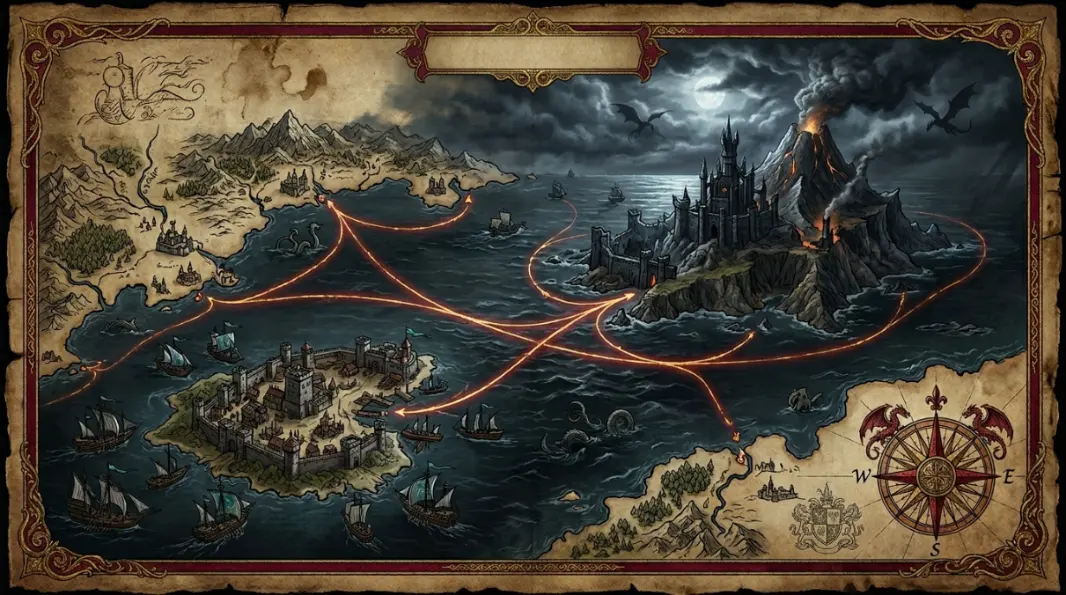
Blackwater Bay Map King’s Landing, Dragonstone, Driftmark, the Gullet & Naval Pressure
Blackwater Bay · King’s Landing · Dragonstone · Driftmark · Narrow Sea
A clear, story-first Blackwater Bay map for readers who want to understand why this stretch of water becomes one of the most important military, political, and dragon-route zones in Game of Thrones and House of the Dragon.
Blackwater Bay lies beside King’s Landing and connects the capital to Dragonstone, Driftmark, the Gullet, and the Narrow Sea. On the map, it matters because whoever controls this water can threaten the capital, protect it, blockade it, or use it as a route into the heart of Westerosi power.
Blackwater Bay Map at a Glance
Use these notes first if you need the map explained quickly before moving into the deeper route analysis.
The sea approach to King’s Landing and one of the most dangerous naval corridors in the story.
The Red Keep and capital defenses make the bay politically priceless.
The island fortress controls the eastern approach toward the bay and the Narrow Sea.
The Velaryon seat gives the region its strongest naval connection in House of the Dragon.
Connects Blackwater Bay to Essos, Dragonstone, the Stepstones, and wider sea travel.
A key sea passage near Dragonstone and Driftmark, especially important for Targaryen-era routes.
The bay becomes a battlefield when Stannis Baratheon attacks King’s Landing.
The map explains why ships, dragons, wildfire, and blockades all matter here.
Blackwater Bay Route and Location Map
This simplified ThroneAtlas map shows the relationship between the bay, King’s Landing, Dragonstone, Driftmark, and the sea lanes that create military pressure.
Explore Key Locations on the Blackwater Bay Map
Click each location to see why it matters and which related map should be opened next.
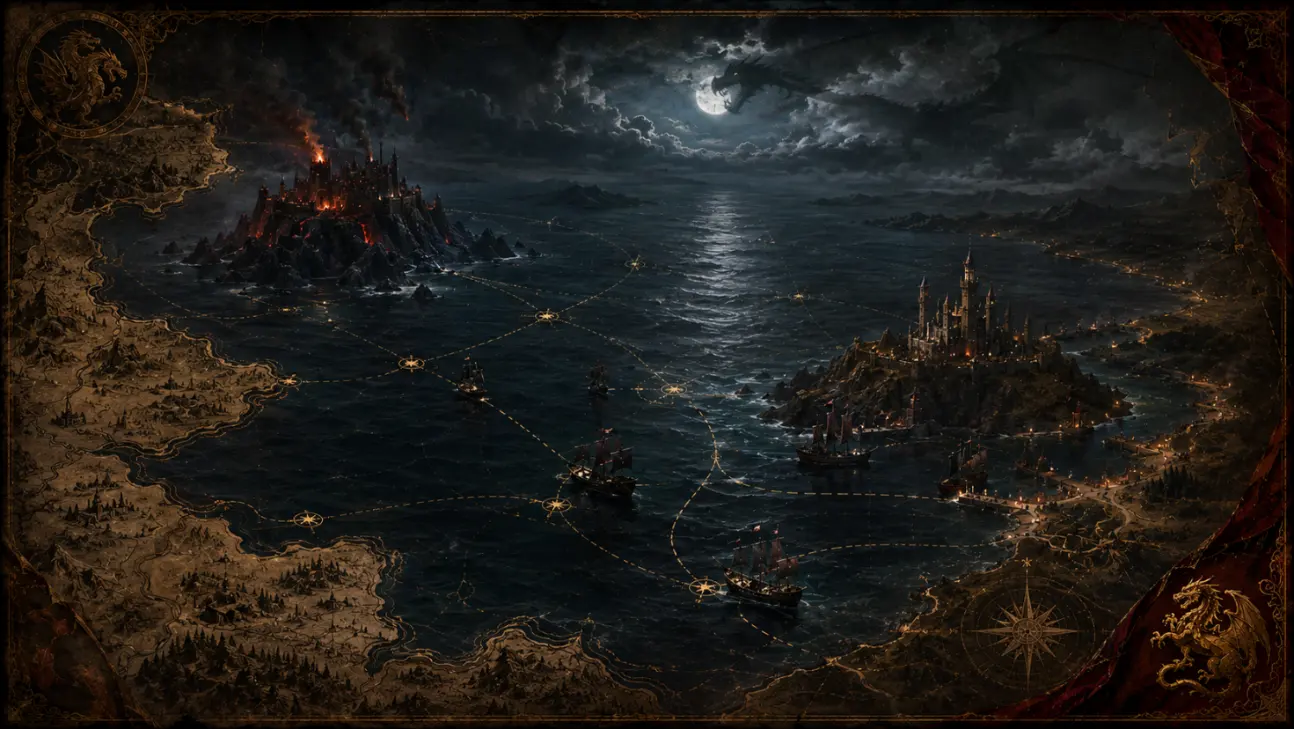
Blackwater Bay
Blackwater Bay is the water beside King’s Landing. It becomes important because it controls the capital’s sea approach, supports defense from the Red Keep, and gives enemies a direct path toward the Iron Throne.
What the Blackwater Bay Map Actually Shows
The Blackwater Bay map shows the body of water beside King’s Landing and the nearby routes that connect the capital to Dragonstone, Driftmark, the Gullet, and the Narrow Sea. That sounds simple until you follow the story through the map. Suddenly the bay is not just scenery. It is the front door of the capital, the path of invasion, the edge of royal defense, and a sea lane that can decide whether a throne claim survives.
On ThroneAtlas, this page is designed to make that geography easy. Instead of forcing readers to jump between isolated names, it places each major location into one connected route. King’s Landing explains the political prize. Dragonstone explains the Targaryen pressure. Driftmark explains fleet power. The Gullet explains sea movement. Blackwater Bay sits in the middle, turning all of those forces into one tense map.
Why Blackwater Bay Matters in Game of Thrones
In Game of Thrones, Blackwater Bay becomes unforgettable because of the Battle of Blackwater. Stannis Baratheon’s attack on King’s Landing is not only a dramatic battle scene; it is a map lesson. Stannis does not march straight into the throne room. He must cross water, enter a defended bay, face the city walls, and survive the capital’s tricks before he can claim anything.
That is why the bay gives the story such strong tension. The attackers are close enough to see the prize, but not close enough to hold it. The defenders are trapped inside a city, but the water also gives them one deadly advantage: the enemy must come through a predictable approach. Once the geography is clear, Tyrion Lannister’s strategy, the use of wildfire, and the panic inside the city all feel sharper.
The battle also shows how much the Iron Throne depends on place. A king may have blood, banners, and a claim, but the map can still break him. Blackwater Bay turns ambition into a physical test: ships, chains, fire, walls, timing, and morale.
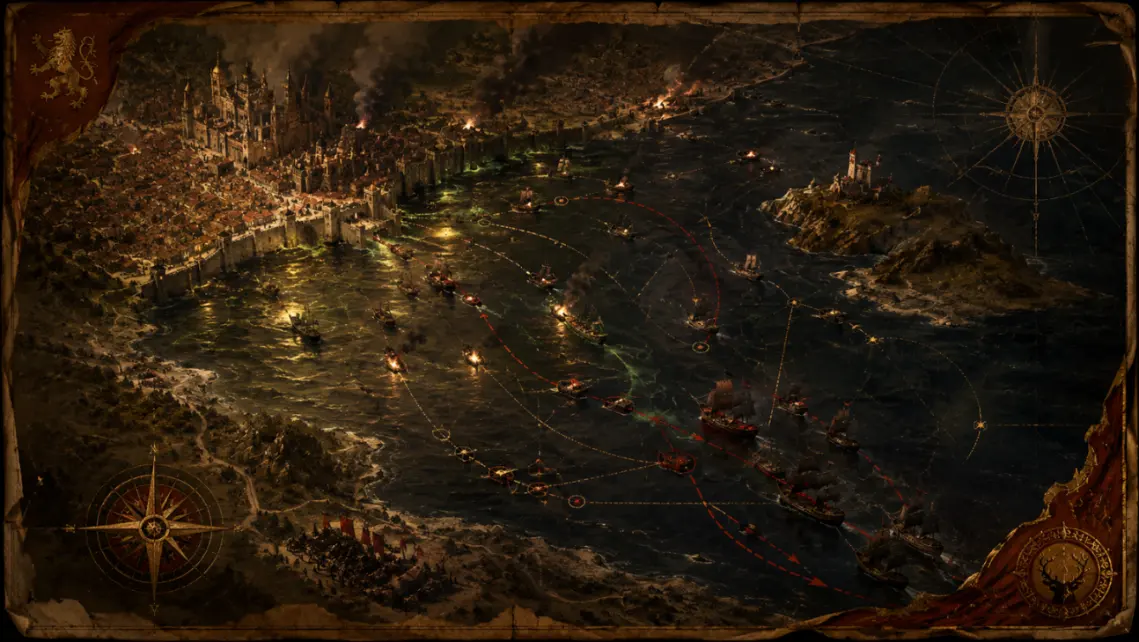
King’s Landing: The Prize at the Edge of the Bay
King’s Landing is the most important location on this map because it turns Blackwater Bay into a political target. Without the capital, the bay would still matter as a harbor and sea route. With the capital beside it, the bay becomes one of the most valuable pieces of water in Westeros.
The Red Keep, the city walls, the harbor, and the Blackwater Rush all shape how the capital can be approached. Anyone who wants the Iron Throne has to think about this geography. Can ships enter safely? Can a fleet be trapped? Can supplies reach the city? Can the defenders hold long enough for help to arrive? These are map questions before they become battle questions.
For readers, this is where the Blackwater Bay map becomes especially useful. It explains why the capital feels exposed and protected at the same time. The water opens King’s Landing to attack, but it also forces attackers into a narrow, dangerous space where the defenders can prepare.
Dragonstone: The Targaryen Pressure Point
Dragonstone gives the Blackwater Bay map its strongest eastern pressure. The island is close enough to threaten the capital, far enough to function as a separate power base, and symbolic enough that every Targaryen return feels heavier when it begins there.
In House of the Dragon, Dragonstone matters because it is tied to Rhaenyra Targaryen, Daemon Targaryen, dragons, succession, and Team Black strategy. In Game of Thrones, it matters again through Stannis Baratheon and Daenerys Targaryen. The people change, but the map logic stays familiar: Dragonstone is the place where a claimant can gather strength while looking west toward King’s Landing.
That makes the line between Dragonstone and Blackwater Bay one of the cleanest power routes in the atlas. It is not a casual journey. It is a statement. When a claimant moves from Dragonstone toward the bay, the story is usually preparing to test the capital.
Driftmark and the Velaryon Fleet
Driftmark adds the naval layer that many casual viewers miss. The island is strongly connected to House Velaryon, and House Velaryon changes the meaning of the surrounding sea. A bay is useful, but a bay controlled by a serious fleet becomes a weapon.
Corlys Velaryon’s power is not only wealth or name recognition. It is movement. A fleet can protect routes, threaten routes, carry troops, support blockades, and turn islands into connected strongholds. When Driftmark is placed beside Dragonstone and the Gullet, the area stops looking like scattered islands and starts looking like a maritime power network.
This is especially important for House of the Dragon readers. Team Black’s geography is not random. Dragonstone and Driftmark together create a sea-facing position that can project pressure toward the capital and the Narrow Sea.
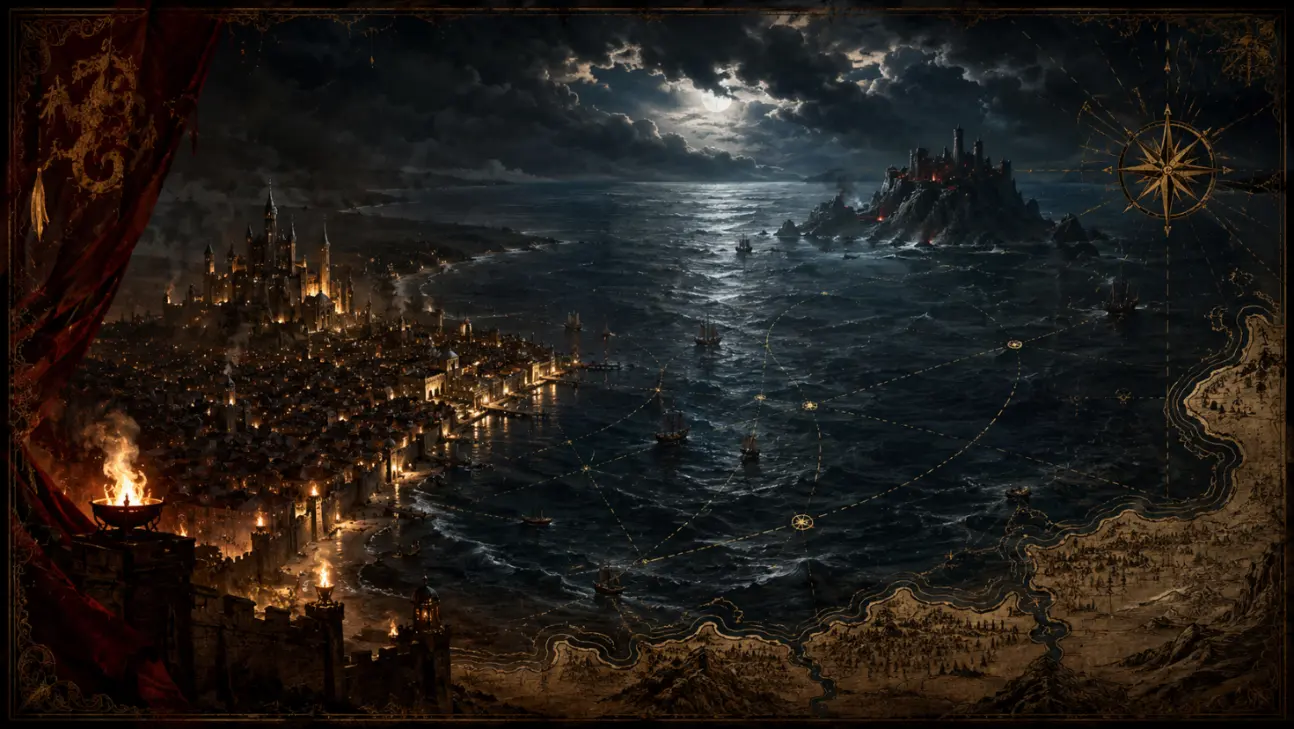
The Gullet and the Narrow Sea Connection
The Gullet and the Narrow Sea widen the map beyond Blackwater Bay itself. They show how the capital connects to the wider world. The Gullet helps explain movement around Dragonstone and Driftmark, while the Narrow Sea links Westeros to Essos, trade, exile, invasion, and return.
This matters because many major storylines begin outside the capital and move inward. Daenerys’s journey, Targaryen memory, Velaryon sea power, and eastern threats all feel more logical when the sea lanes are visible. The map gives the reader a sense of direction: pressure gathers in the east, passes through islands and channels, then points toward King’s Landing.
For deep lore fans, this is also where the region becomes more than a single battle location. The Blackwater Bay map connects to larger atlas paths such as the Dragonstone Map, Driftmark Map, Narrow Sea Map, and Battle of the Gullet Map.
How the Map Explains Character Decisions
Good fantasy geography should explain behavior. On this page, characters are not listed simply because they are famous. They are included because their choices make more sense when you understand the map.
Stannis Baratheon sees the bay as a path to the throne. Tyrion Lannister sees it as a defensive problem that must be solved with timing and terror. Daenerys Targaryen sees the region through the emotional weight of return and conquest. Rhaenyra Targaryen and Daemon Targaryen inherit Dragonstone as both home and war room. Corlys Velaryon reads the same water as a fleet commander.
That is the human side of the map. The bay does not mean one thing to everyone. For one character, it is opportunity. For another, it is danger. For another, it is inheritance. For the viewer, it becomes the place where all those meanings collide.
Major Events Connected to Blackwater Bay
The most obvious event is the Battle of Blackwater, but the region also supports several larger story patterns. It connects capital defense, Targaryen returns, Dragonstone council scenes, naval movement, Velaryon fleet influence, and the wider pressure between Team Black and Team Green.
In a weaker page, these events would be treated as separate facts. On a map-first page, they become connected. A fleet leaving Dragonstone is not isolated from King’s Landing. A blockade near the Gullet is not isolated from Driftmark. A council decision on an island can become a capital crisis because the sea route makes movement possible.
This is why Blackwater Bay deserves its own dedicated map page. It is a connector. It helps readers move from place to place, from event to event, and from character motive to strategic consequence.
Best Reading Order for This Map Cluster
Start with this Blackwater Bay page, then open the King’s Landing Map to understand the capital. After that, read the Dragonstone Map to follow the eastern pressure point. From there, move to Driftmark Map, Battle of the Gullet Map, and the House of the Dragon Map.
This order works because it follows the geography naturally. First, you understand the bay. Then you understand the city it threatens. Then you understand the islands and sea lanes that send pressure toward that city. By the end, the region feels like one connected atlas instead of a list of names.
Why New Readers Need This Page
New viewers often remember dramatic scenes before they understand where those scenes happened. They may remember wildfire on the water, Daenerys arriving at Dragonstone, or council scenes beside painted tables, but the actual route logic can remain blurry. This page fixes that by explaining the map in plain language.
The goal is not to overwhelm readers with every possible lore detail. The goal is to make them feel oriented. A good map page should answer the simple questions first: Where is this? Why does it matter? What connects to it? What should I read next?
Why Deep Lore Readers Need This Page
For deep lore readers, the value is different. This page acts as a hub for nearby maps, house politics, route analysis, and battle geography. It gives the region a clean structure so future pages can connect naturally without repeating the same explanation again and again.
That makes the Blackwater Bay map useful for topical authority too. It supports pages about Dragonstone, King’s Landing, Driftmark, the Gullet, House Targaryen, House Velaryon, Stannis Baratheon, Tyrion Lannister, and major battle routes. The page is not only a destination. It is an internal-link bridge.
Final Map Notes
Blackwater Bay matters because it turns power into movement. A claim must cross water. A city must defend a harbor. A fleet must choose a route. A dragon-backed claimant must decide when to move from island to capital. Once you see those pieces together, the map becomes much easier to read.
For the best next step, continue with the Dragonstone Map, King’s Landing Map, House Targaryen Map, and House of the Dragon Map. Together, these pages create the strongest route through the Blackwater Bay and Targaryen geography cluster.
Where to Go After the Blackwater Bay Map
Follow the route in this order to build a clean understanding of the whole region.
Start here. Learn why the bay controls the sea approach to King’s Landing and why it becomes a battle zone.
Study the prize. The capital explains why enemies are willing to risk ships, armies, and dragons near the bay.
Follow the pressure. Dragonstone is the island base that repeatedly points claimants toward the capital.
Add the fleet. Driftmark and House Velaryon explain why sea control matters so much in this region.
Open the sea lane. The Gullet shows how Dragonstone, Driftmark, and the Narrow Sea connect.
See the wider war. The Dance of the Dragons turns these routes into a full civil-war map.
Key Places, Characters, and Events Connected to Blackwater Bay
Key Places
Blackwater Bay, King’s Landing, the Red Keep, Dragonstone, Driftmark, the Gullet, the Narrow Sea, and the Blackwater Rush are the main locations readers should connect on this map.
Key Characters
Stannis Baratheon, Tyrion Lannister, Daenerys Targaryen, Rhaenyra Targaryen, Daemon Targaryen, Corlys Velaryon, Aegon II, and Aemond Targaryen all connect to this regional pressure map.
Key Events & Lore
Battle of Blackwater, Daenerys’s landing, Team Black sea strategy, Velaryon fleet pressure, Dragonstone councils, capital defense, and Gullet movement all become easier to follow with this map.
Blackwater Bay Map Questions
It shows Blackwater Bay beside King’s Landing and connects the capital to Dragonstone, Driftmark, the Gullet, and the Narrow Sea. The page focuses on routes, battle pressure, and the political value of controlling the water near the capital.
Blackwater Bay is important because it is the sea approach to King’s Landing. Whoever controls it can defend the capital, attack it, blockade it, or move power between Dragonstone, Driftmark, and the Iron Throne.
Yes. Dragonstone sits east of the capital region and works as a major pressure point toward Blackwater Bay. This connection matters for Stannis Baratheon, Daenerys Targaryen, and House of the Dragon storylines.
The most famous event is the Battle of Blackwater, when Stannis Baratheon attacks King’s Landing by sea and the capital’s defenders use the bay’s geography as part of their strategy.
The best next pages are the King’s Landing Map, Dragonstone Map, Driftmark Map, Battle of the Gullet Map, House Targaryen Map, and House of the Dragon Map.
Related Maps, Routes, Lore, and Locations
HotD Routes
ThroneAtlas is an independent fan-made map and lore reference site. It is not affiliated with, endorsed by, or connected to HBO, Warner Bros., George R. R. Martin, or any official Game of Thrones, House of the Dragon, or A Song of Ice and Fire property. All names and trademarks belong to their respective owners.