Game of Thrones Battles Map Hub Wars, Betrayals, Dragon Battles & Turning Points
Winterfell · Blackwater · Trident · Red Wedding · Long Night · Rook’s Rest
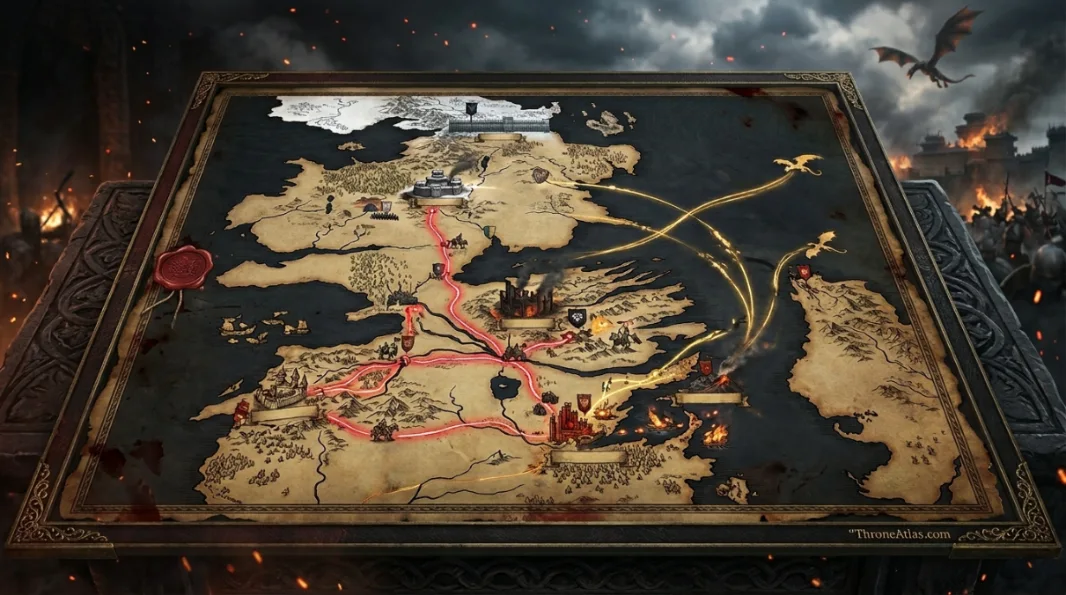
The complete ThroneAtlas war library — battle maps, military geography, dragon war routes, castle sieges, political betrayals, and every major conflict across Westeros and Essos, from Aegon’s Conquest through the Long Night.
The ThroneAtlas Battles Hub is the definitive Game of Thrones and House of the Dragon battle atlas, covering 14+ battle maps, war routes, military geography, and dragon conflicts across Westeros. It includes the Battle of Winterfell, Battle of Blackwater, Red Wedding, Robert’s Rebellion, Battle of the Trident, Hardhome, Rook’s Rest, Aegon’s Conquest, and the full War of the Five Kings — mapped through geography, strategy, and political consequence.
Major Wars and Battle Routes Covered
Use this page as the central war library for the entire ThroneAtlas ecosystem. Every battle below connects to a full map guide, military breakdown, and consequence analysis.
Major Westeros battles, wars, betrayals, and dragon conflicts — each with a dedicated map guide.
The North, Crownlands, Riverlands, the Vale, Beyond the Wall, Essos, and sea war zones.
Sieges, dragon wars, naval invasions, open field battles, betrayals, and survival wars.
New readers: start with Robert’s Rebellion or the War of the Five Kings overview.
Why Game of Thrones Battle Maps Tell a Different Story
The battles of Game of Thrones are not random action sequences. They’re geographic events — shaped by coastlines, castle positions, river crossings, supply routes, chokepoints, and the political borders that armies are forced to respect or break through. ThroneAtlas organizes all of these conflicts into one connected fantasy battle atlas so you can understand not just what happened, but why it happened there, in that location, at that moment in time.
Traditional episode recaps explain events in sequence. Battle maps explain them strategically. When you follow the Battle of Blackwater, the Battle of the Bastards, Hardhome, the Long Night, and Robert’s Rebellion through military geography, you start to see Westeros the way its commanders did — as a continent with pressure points, supply problems, defensible terrain, and catastrophic vulnerabilities. That shift in perspective changes everything about how you understand the story.
It also makes the outcomes feel inevitable rather than arbitrary. Stannis Baratheon didn’t lose at Blackwater because of bad luck. He lost because the geography of Blackwater Bay created a kill zone that Tyrion Lannister exploited with wildfire and a chain barrier. The environment determined the outcome before the first ship made landfall.
How Geography Shapes Every Major Westeros War
The North and the Crownlands fight completely different wars — and the reason is geography. Northern wars are controlled by weather, distance, supply exhaustion, and the loyalty of bannermen spread across enormous distances. Southern wars depend more heavily on naval power, gold, political alliances, and access to roads and harbors.
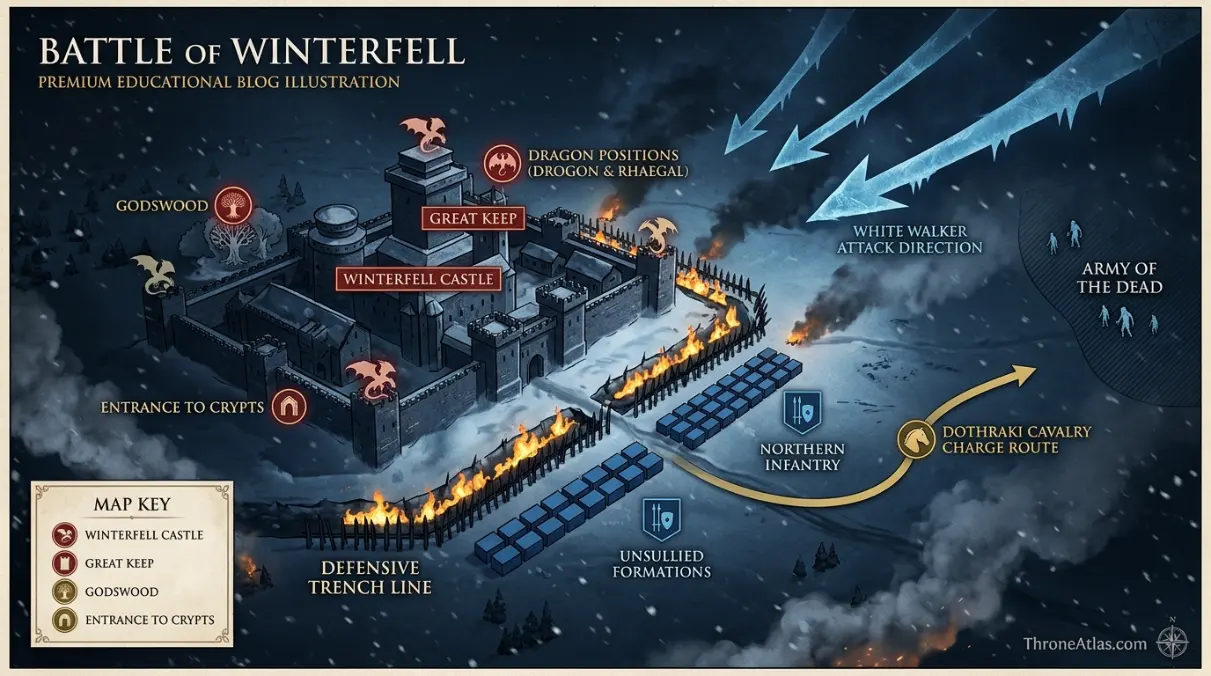
This difference becomes strikingly obvious when you compare the Battle of Winterfell to the Battle of Blackwater. Winterfell is a survival defense built around trench systems, fortified walls, dragon positioning, and the overwhelming numerical pressure of the Army of the Dead. Blackwater is an urban naval battle built around wildfire traps, harbor chain barriers, and the perfectly timed arrival of Tywin Lannister’s reinforcements through the Roseroad. Same war. Completely different military logic.
The Riverlands add another layer entirely. Because the region sits at the intersection of the Trident, the Green Fork, the Blackwater Rush, and every major road connecting north to south, it becomes the default battlefield of multiple wars across Westerosi history. Armies can’t reach each other without crossing through it. That’s why the Riverlands are devastated during the War of the Five Kings — not because they chose the wrong side, but because their geography made them unavoidable.
The Complete Westeros Battle Timeline: From Aegon’s Conquest to the Long Night
Understanding Game of Thrones battles requires knowing where each conflict sits in the broader Westerosi timeline. Here’s every major war and battle mapped by ThroneAtlas, in chronological order from oldest to most recent:
| Era | Conflict | Key Location | Outcome |
|---|---|---|---|
| ~300 BC | Aegon’s Conquest | Field of Fire, Harrenhal | Targaryen dynasty established |
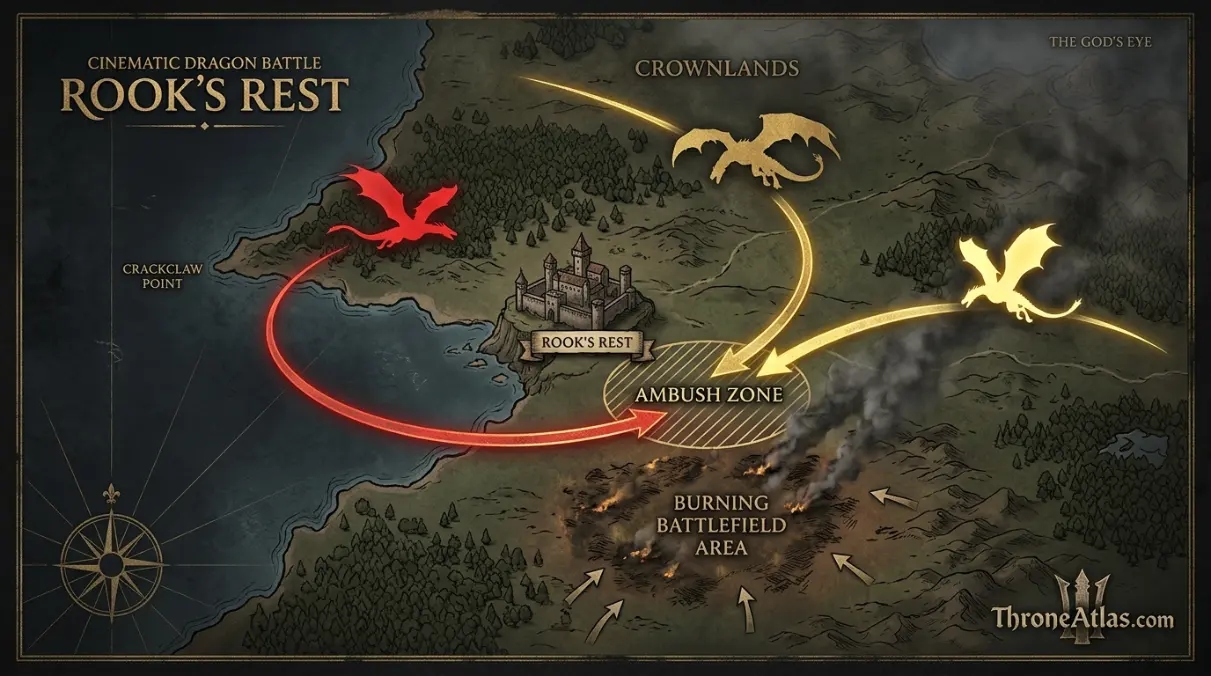
| ~130 AC | Dance of the Dragons | Rook’s Rest, Gods Eye | Targaryen civil war; dragon extinction |
| ~281 AC | Robert’s Rebellion | Trident, Ashford, Storm’s End | Targaryen rule ends; Baratheon dynasty begins |
| ~298–300 AC | War of the Five Kings | Riverlands, Blackwater, the North | Lannister control; northern devastation |
| ~300 AC | Red Wedding | The Twins, Green Fork | Stark rebellion destroyed by betrayal |
| ~303 AC | Battle of the Bastards | Winterfell, the North | Stark reclaim Winterfell; Bolton dynasty ends |
| ~303 AC | Battle of Winterfell (Long Night) | Winterfell | Night King destroyed; Army of the Dead collapses |
| ~303 AC | Sack of King’s Landing | King’s Landing, Blackwater Bay | Cersei Lannister’s death; Iron Throne destroyed |
Robert’s Rebellion: The War That Remade Westeros
Robert’s Rebellion — also called the War of the Usurper — is the single most consequential conflict in the modern Westerosi timeline. It ended over 280 years of Targaryen rule, established House Baratheon on the Iron Throne, and created the political fractures that eventually produced the War of the Five Kings. Everything in Game of Thrones traces back to this war.
The rebellion began as a personal grievance — Prince Rhaegar Targaryen allegedly kidnapped Lyanna Stark, triggering a response from her brother Eddard Stark and her betrothed Robert Baratheon. But the deeper causes were structural: King Aerys II Targaryen, known as the Mad King, had grown erratic and dangerous, burning lords alive and losing the confidence of the realm’s greatest houses. What started as a rescue mission became regime change.
The war’s decisive moment came at the Battle of the Trident, fought along the Tridentine river system in the Riverlands. Robert Baratheon personally killed Prince Rhaegar Targaryen in single combat during the crossing — a moment so symbolically powerful that it effectively ended Targaryen legitimacy. With their crown prince dead and King’s Landing soon to fall to Lannister forces, the Targaryen dynasty collapsed within days.
What the maps reveal that episode recaps don’t: the Trident crossing was not chosen at random. The Riverlands river system forced both armies to converge at a specific set of fords. Geography created the battlefield. Robert didn’t just win because he was the stronger fighter — he won because the terrain eliminated Rhaegar’s tactical options and forced a confrontation in open water where Robert’s physical dominance was decisive.
The War of the Five Kings: A Continent at War With Itself
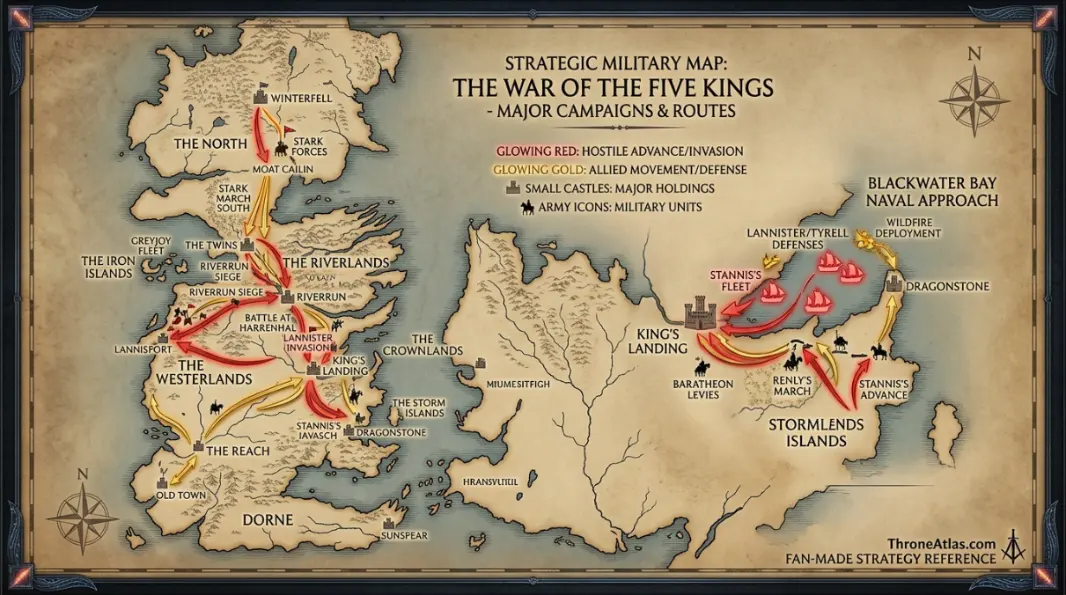
The War of the Five Kings is the broadest political and military conflict in Game of Thrones, running roughly from 298 to 300 AC. It’s not a single war but a cascading series of overlapping campaigns — each driven by competing claims to the Iron Throne, regional independence movements, and opportunistic betrayals. Five kings fight simultaneously across four major regions, which is exactly why Westeros nearly tears itself apart.
The five claimants are: Joffrey Baratheon in King’s Landing (backed by Lannister power), Stannis Baratheon from Dragonstone (backed by his rightful claim), Renly Baratheon from the Stormlands (backed by southern popularity), Robb Stark in the North (fighting for independence after Ned Stark’s execution), and Balon Greyjoy in the Iron Islands (attempting to exploit the chaos through coastal raiding).
From a military geography standpoint, this war is defined by two strategic failures. First: the Stark failure to hold the Riverlands and maintain supply line control through the Trident crossings. Second: Stannis’s failure to take Blackwater Bay before Lannister reinforcements arrived from the south. Both failures trace directly to terrain decisions and political timing rather than simple battlefield defeat.
The Red Wedding is the war’s true ending — and it’s a geographic story as much as a political one. Walder Frey controlled the Twins, the only viable crossing of the Green Fork in that region. Robb Stark’s entire northern campaign depended on Frey loyalty because he had no alternative river crossing route. The betrayal worked because Robb had surrendered geographic leverage before the trap was ever set.
The Importance of Chokepoints in Westeros Military Strategy
Chokepoints don’t just shape battles — they determine which wars are even possible. In Westeros, five locations act as structural control points that armies must either hold, bypass, or negotiate access to before any campaign can succeed.
Moat Cailin controls all land access to the North from the south. Historically, it has never been taken from the north — only captured from behind. This is why the Bolton forces held it against the Ironborn and why armies invading the North almost always fail before they reach Winterfell. The Twins control the Green Fork river crossing in the central Riverlands — as Robb Stark learned to his permanent cost.
The Wall is less a military fortification than a psychological barrier: 300 miles of ice that funnels the Night King’s forces toward a small number of defensible gates. Blackwater Bay protects King’s Landing from naval assault by creating a narrow approach that defenders can control with fire, chain, and elevated batteries. And Harrenhal — despite being a ruin — dominates surrounding territory through scale and fear alone, which is why every faction that occupies it eventually loses control of the Riverlands anyway.
These aren’t just interesting geographic details. They’re the structural skeleton of Westerosi military history. ThroneAtlas maps each chokepoint in detail because understanding terrain mechanics is the fastest way to understand why any given campaign succeeded or collapsed.
How Dragon Warfare Broke Westeros Military Logic
Dragon warfare doesn’t just change tactics — it invalidates centuries of defensive thinking. The moment a dragon enters a battlefield, every advantage that traditional castles, fortified walls, elevated terrain, and supply-line strategy normally provide is reduced to almost nothing. Aegon the Conqueror proved this within the first years of his campaign when he destroyed Harrenhal — the largest castle ever built in Westeros — using Balerion the Black Dread. The lesson was immediate: stone walls don’t stop dragonfire.
The Dance of the Dragons (the Targaryen civil war of roughly 130 AC) takes this logic further. When dragon riders fight each other, the battlefield becomes three-dimensional and almost incomprehensibly dangerous. Rook’s Rest illustrates this precisely. Aegon II Targaryen staged an ambush using Vhagar — the largest living dragon — against Queen Rhaenys riding Meleys. The battle wasn’t decided by armies on the ground. It was decided by Vhagar’s size advantage in the air. Armies on the field below could only watch and survive whatever fell from the sky.
In Game of Thrones proper, Daenerys Targaryen’s campaigns in the Reach and the Riverlands show what aerial dominance looks like against an unprepared conventional military. The Loot Train Battle — where Drogon destroys an entire Lannister supply column — isn’t just a dramatic set piece. It’s a demonstration of how thoroughly dragon warfare collapses medieval logistics. You can’t protect a supply column from above. There’s no defensive answer to fire that arrives at 40 miles an hour from 200 feet up.
The Political Consequences of Every Battle
No battle in Game of Thrones exists in isolation. Every major conflict reshapes the political map in ways that echo across subsequent seasons and storylines. The Battle of the Trident ends Targaryen rule — directly. The Red Wedding ends northern independence — directly. Blackwater Bay secures Lannister control of the Iron Throne for another three seasons. The Battle of Winterfell restores Stark legitimacy in the North and eliminates the Night King threat that had been building since the first scene of the entire series.
This is why ThroneAtlas separates battle pages from standard location guides. Location pages describe places. Battle pages describe what those places meant at a specific moment in history — the movement of armies, the pressure of geography, the weight of betrayal, and the shifting balance of power that follows every major engagement.
How to Read a Westeros Battle Map
If you’re new to ThroneAtlas, the battle map pages are designed to be read in a specific order. Following this sequence gives you the full strategic picture rather than disconnected episode impressions.
Start With the Regional Map
Every battle guide opens with a regional overview showing which kingdoms and territories surround the battlefield. Read this first to understand the political context — who controls the roads, the castles, and the surrounding land before the armies arrive.
Identify the Chokepoints and Terrain Features
Look for rivers, elevated ground, city walls, harbors, and road intersections on the battlefield map. These terrain features explain why the battle happened in that specific location — armies don’t choose battlefields randomly. Geography forces the convergence.
Trace the Army Movement Routes
Follow the directional arrows showing how each army approached the battlefield. Movement routes reveal supply line vulnerabilities, strategic timing, and the flanking opportunities that winning commanders exploited — or that losing commanders failed to anticipate.
Read the Turning Point Analysis
Each battle guide includes a turning point breakdown — the specific moment when the outcome became inevitable. In the Battle of Blackwater, it’s Tywin’s arrival. In the Battle of the Bastards, it’s the Knights of the Vale cresting the hill. In the Long Night, it’s Arya’s strike on the Night King. The turning point is usually a geographic event as much as a tactical one.
Follow the Political Consequence Links
At the end of every battle guide, ThroneAtlas links to the political and territorial consequences — which houses gained or lost land, which alliances shifted, and which subsequent battles were made possible or inevitable by the outcome you just read about. This keeps you inside the connected atlas rather than reading isolated articles.
Key Takeaways — Game of Thrones Battle Geography
- Every major Westeros battle is shaped by geography first — terrain, chokepoints, and supply routes determine outcomes before armies engage.
- The War of the Five Kings is the broadest conflict in Game of Thrones, involving five simultaneous claimants across four major regions between 298 and 300 AC.
- Robert’s Rebellion ended at the Battle of the Trident when Robert Baratheon killed Prince Rhaegar Targaryen — collapsing 280+ years of Targaryen rule in a single engagement.
- Dragon warfare invalidates traditional castle defense because aerial firepower bypasses walls, supply protection, and elevated terrain advantages entirely.
- Chokepoints — Moat Cailin, the Twins, the Wall, Blackwater Bay — are the structural skeleton of Westerosi military history.
- The Red Wedding was a geographic betrayal as much as a political one — Robb Stark’s army had no alternative river crossing, which made Frey loyalty existential.
- ThroneAtlas maps Westeros through military geography because geography reveals why events happened where they did, not just what happened in chronological order.
Why ThroneAtlas Uses a Map-First Storytelling Structure
Most Game of Thrones fan sites approach the world through episode breakdowns, character profiles, or house lineages. ThroneAtlas approaches it through geography — because geography is the hidden engine that drives almost every decision in the story. Where armies march, where kings build their castles, where betrayals are staged, where dragons are deployed: these are all geographic choices with geographic consequences.
The map-first structure creates a natural connective tissue between battle guides, location pages, character journey maps, and house territory breakdowns. You can move from the Battle of Blackwater into the strategic importance of King’s Landing into the political history of House Baratheon without losing the thread — because geography connects all of it. That’s the ThroneAtlas difference, and it’s why battle maps are at the center of this atlas rather than at the margins.
Expand Beyond the Battles
Castle Maps
Explore Winterfell, Dragonstone, Castle Black, Harrenhal, and the Red Keep through structural map guides and defensive layout breakdowns. Understand how castle architecture shapes the battles fought around them.
Explore CastlesCharacter Journeys
Track Jon Snow, Arya Stark, Daenerys Targaryen, Tyrion Lannister, and Daemon Targaryen through interactive route maps showing every major movement across the continent and how those journeys intersect with military events.
Character MapsHouse Territories
Understand how House Stark, House Lannister, House Targaryen, House Baratheon, and House Velaryon controlled — and lost — their regions across the Seven Kingdoms and how territory shifts after every major battle.
House TerritoriesGame of Thrones Battle Questions Answered
Start with the War of the Five Kings Map for the broadest political and military overview, or the Battle of Winterfell Map if you want to begin with the largest survival conflict in the series. For House of the Dragon fans, the Rook’s Rest map is the best entry point into dragon warfare.
The Battle of Winterfell during the Long Night is considered the deadliest single engagement, involving massive northern army casualties, Unsullied losses, Dothraki destruction, White Walker invasion, and the Night King’s direct assault on Bran Stark. The Field of Fire during Aegon’s Conquest — where Aegon’s dragons burned 4,000 soldiers in a single pass — is the deadliest in Westerosi recorded history.
The Battle of Blackwater is widely regarded as the most strategically executed defense in the series. Tyrion Lannister used wildfire naval traps, a harbor chain barrier, and defensive chokepoints to neutralize Stannis Baratheon’s larger fleet — then relied on precisely timed Tywin reinforcements through the Roseroad to complete the rout. Geography, preparation, and timing all worked together perfectly.
The Battle of the Trident was the decisive turning point where Robert Baratheon killed Prince Rhaegar Targaryen at a crossing of the Tridentine river system. With the crown prince dead and Jaime Lannister killing the Mad King shortly after, the Targaryen dynasty collapsed within days. The sack of King’s Landing by Lannister forces formally ended their 280-year reign.
Dragon battles bypass traditional military logic entirely because aerial firepower can destroy castles, supply columns, troop formations, and defensive walls from above — removing the terrain advantages that infantry and cavalry depend on. Aegon’s Conquest demonstrated this immediately by destroying Harrenhal, the largest castle in Westeros, in a single engagement. The Dance of the Dragons showed what happens when dragon riders fight each other directly.
Robb Stark’s campaign failed for geographic as much as political reasons. His entire northern army depended on Frey access to the Twins river crossing — the only viable route across the Green Fork in that region. Once he broke his marriage pact with House Frey, he surrendered that geographic leverage with no alternative crossing available. The Red Wedding was the consequence. Tactically, Robb never lost a battle — he lost because his supply line depended on a loyalty he couldn’t keep.
King’s Landing controls the Iron Throne, Blackwater Bay, and the Roseroad — which makes it the single most contested location in Westeros. But from a purely military geography standpoint, Moat Cailin may be more strategically decisive: whoever holds it controls all land access between the North and the rest of Westeros. No southern army has ever successfully taken it by direct assault — only by going around it or through treachery.
Game of Thrones battle maps focus primarily on ground warfare, naval engagements, and the Long Night — conflicts where armies, terrain, and political betrayal drive outcomes. House of the Dragon battle maps are dominated by dragon warfare, aerial positioning, and the Targaryen civil war known as the Dance of the Dragons. The military logic is genuinely different: GoT battles are medieval in structure; HotD battles introduce aerial combat that has no medieval equivalent.
Related Hubs and War Routes
ThroneAtlas is an independent fan-made map and lore reference website and is not affiliated with HBO, Warner Bros. Discovery, George R. R. Martin, or official Game of Thrones and House of the Dragon properties. All battle analysis and geographic interpretation is original editorial content by ThroneAtlas.