Battle of the Gullet Map Jacaerys Velaryon · Triarchy Fleet · Dragonstone · Driftmark · 130 AC
The Gullet · Dragonstone · Driftmark · Blackwater Bay · Narrow Sea · Stepstones
The Battle of the Gullet (130 AC) was the pivotal naval engagement of the Dance of the Dragons. This map traces every location — from Dragonstone’s sea approach to the Velaryon fleet’s last stand — and explains why Jacaerys Velaryon’s death here changed the war’s trajectory.
The Battle of the Gullet was a major naval engagement fought in 130 AC during the Dance of the Dragons — the Targaryen civil war between Rhaenyra Targaryen (Team Black) and Aegon II Targaryen (Team Green). The Triarchy fleet of roughly 90 warships entered the strait known as the Gullet, clashing with the Velaryon fleet. Jacaerys Velaryon, Rhaenyra’s eldest son and heir, died in this battle alongside his dragon Vermax, dealing a catastrophic blow to Team Black’s cause.
Battle of the Gullet Map — Key Data Points
Everything a reader needs to orient themselves before exploring the full guide.
The Battle of the Gullet took place in 130 AC, during the second year of the Dance of the Dragons civil war.
The Gullet is the narrow strait between Dragonstone and the Stepstones — the main sea entrance to Blackwater Bay.
The Triarchy — an alliance of the Free Cities Lys, Myr, and Tyrosh — sent roughly 90 warships allied with Team Green.
House Velaryon, commanded by Corlys Velaryon (“the Sea Snake”), held the largest fleet in Westeros from their seat at Driftmark.
Jacaerys Velaryon, age 19, died in the battle alongside his dragon Vermax — Rhaenyra’s heir and her most irreplaceable diplomatic asset.
Six baseborn dragonriders (Dragonseeds) including Hugh Hammer and Ulf the White flew in this battle, changing the war’s power balance.
The Velaryon fleet survived but Team Black lost Jacaerys, their best dragonrider commander, accelerating Rhaenyra’s political collapse.
Dragonstone — the ancestral Targaryen seat — sits at the northern edge of the Gullet and is the strategic heart of Team Black’s territory.
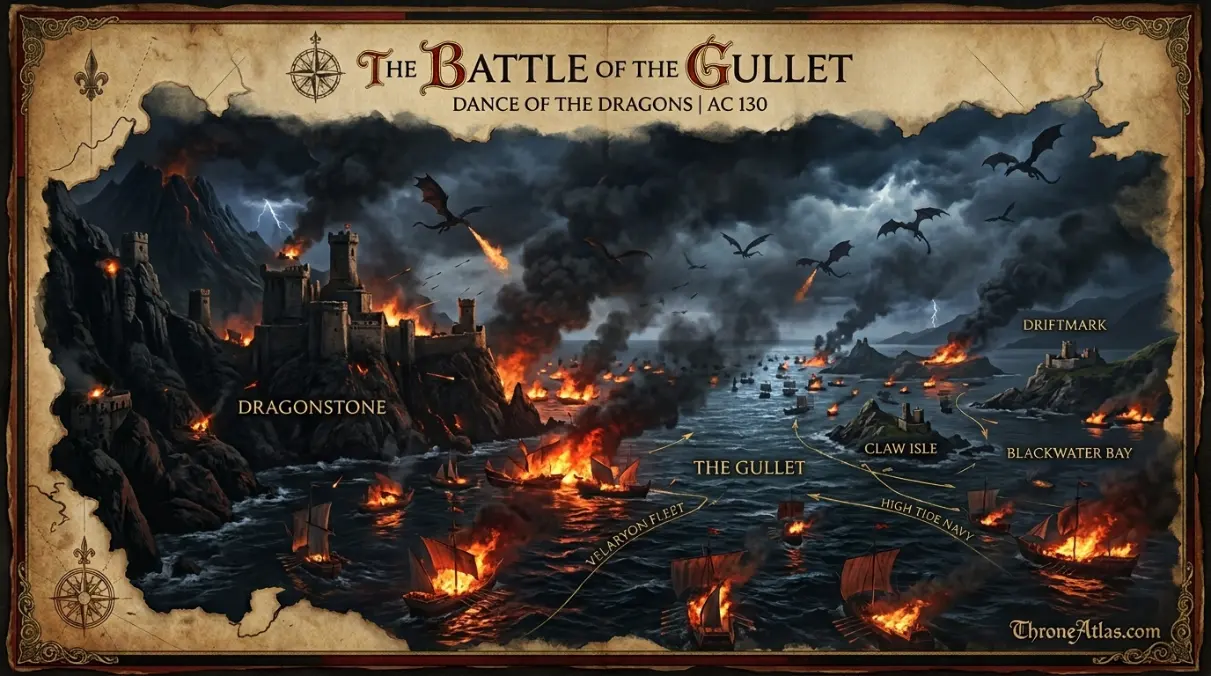
Battle of the Gullet — Route and Location Map
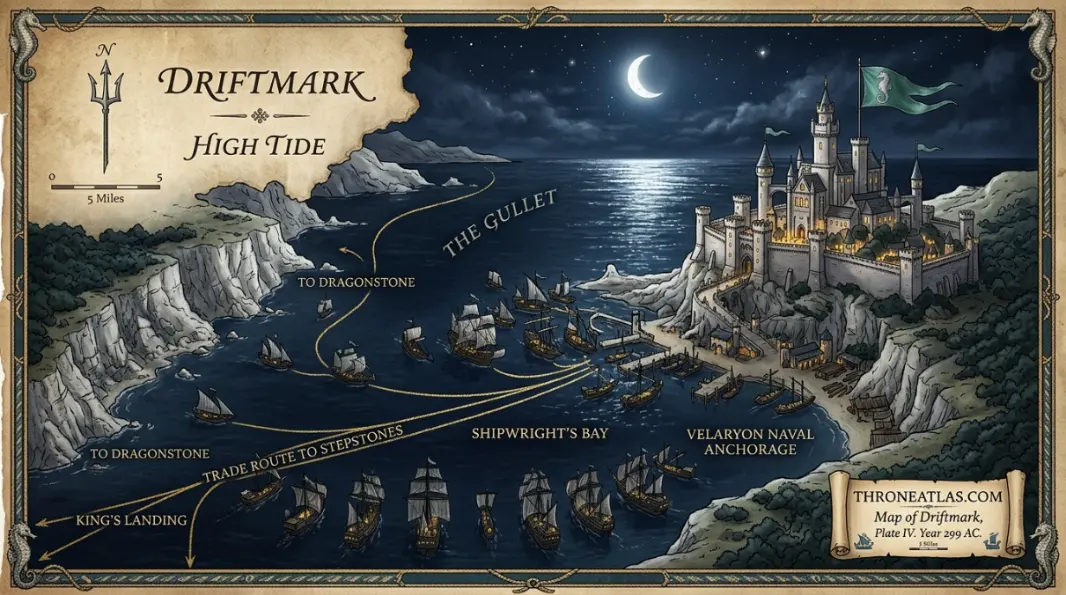
A stylized ThroneAtlas map showing the Gullet strait, Velaryon fleet positions, Triarchy approach route, and surrounding strategic locations in 130 AC.
Explore Every Key Location on the Battle of the Gullet Map
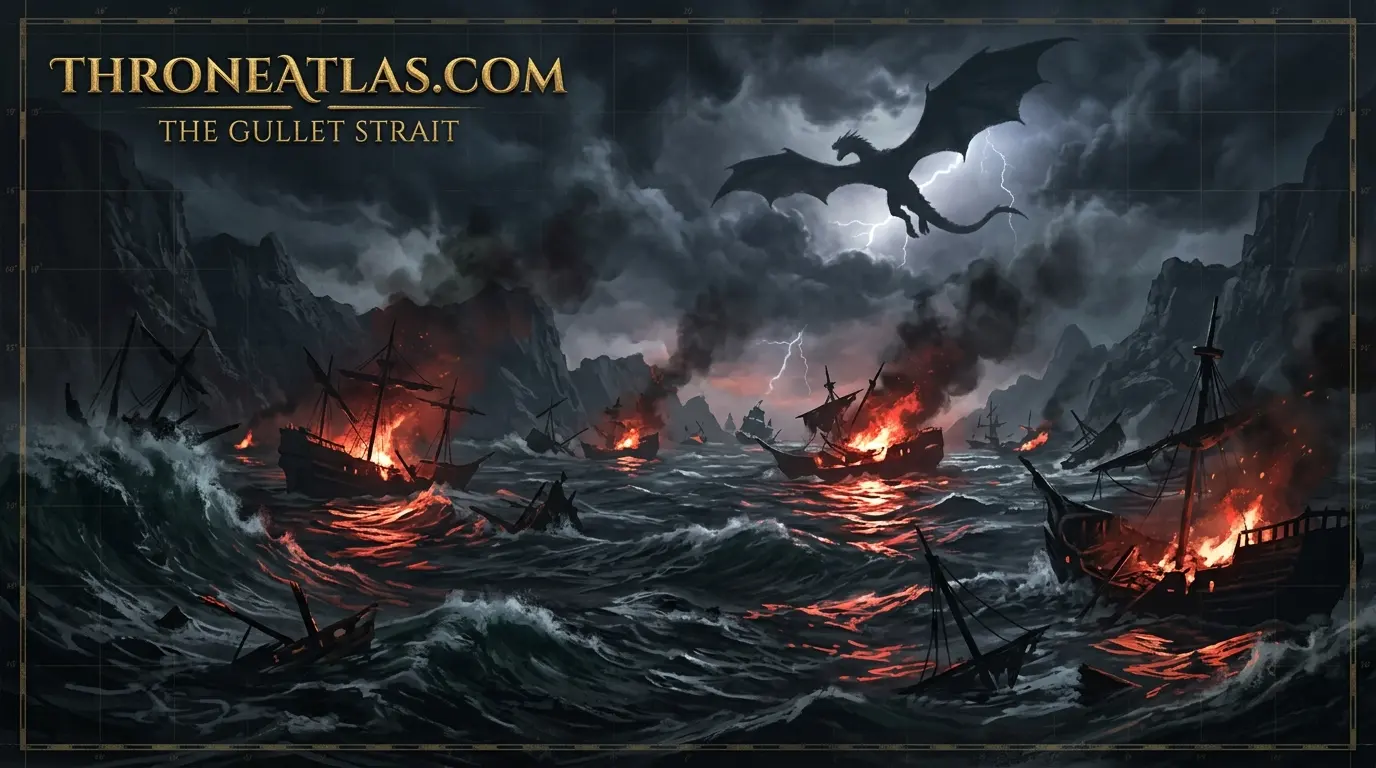
The Gullet
The Gullet is the narrow strait south of Dragonstone that separates Blackwater Bay from the open Narrow Sea. Controlling the Gullet meant controlling maritime access to King’s Landing and the entire eastern coastline — making it the pivotal chokepoint of the Dance of the Dragons.
TL;DR — Battle of the Gullet in Five Facts
- The battle took place in 130 AC, the second year of the Dance of the Dragons, in the strait called the Gullet south of Dragonstone.
- The Triarchy — the Free Cities alliance of Lys, Myr, and Tyrosh — sent roughly 90 warships allied with Team Green (Aegon II).
- Jacaerys Velaryon, Rhaenyra’s eldest son and heir, died here at age 19 when his dragon Vermax was brought down and drowned.
- Six Dragonseeds — baseborn Targaryen descendants — flew dragons for the first time in this battle, including Hugh Hammer and Ulf the White.
- The Velaryon fleet survived but the loss of Jacaerys was strategically catastrophic, triggering a cascade of betrayals and losses for Team Black.
What Is the Battle of the Gullet?
The Battle of the Gullet is one of the most consequential naval engagements in Westerosi history. Fought in 130 AC during the Dance of the Dragons — the civil war that tore House Targaryen apart — it pitted the Velaryon fleet and a handful of dragon riders against the Triarchy’s formidable sea power. The battle’s name comes from its location: a narrow strait south of Dragonstone, where the geography funneled ships into close combat and made dragon strikes uniquely devastating.
Unlike most battles in the Dance of the Dragons, the Gullet engagement was both a sea battle and a dragon battle. Scorpion-mounted warships, dragonriders swooping through sea spray, and a fleet stretched across a chokepoint combined into something neither side had truly planned for. The result was a tactical draw that functioned as a strategic defeat for Team Black.
Why the Gullet’s Geography Decided Everything
The Gullet is not just any stretch of water. It’s the maritime gateway between the open Narrow Sea and the enclosed waters of Blackwater Bay. Whoever commands the Gullet can strangle trade, block resupply fleets, and threaten both King’s Landing and Dragonstone simultaneously. This is precisely why Corlys Velaryon — the Sea Snake — built House Velaryon’s entire strategic identity around controlling it.
Dragonstone sits at the northern rim of the Gullet. Driftmark, the Velaryon seat, guards the western approach. Together these two islands form a natural fortress — not of stone, but of sea lanes. When the Triarchy fleet entered the Gullet from the south, it was deliberately probing the most defensible space in Team Black’s territory, and it knew it.
The Triarchy’s Motive: The Stepstones Trade Route
The Triarchy — an uneasy commercial alliance of Lys, Myr, and Tyrosh — had previously lost the Stepstones to Daemon Targaryen in a brutal campaign. Their alliance with Aegon II Targaryen’s Team Green was partly revenge and partly mercantile calculation: if Team Green won the Dance, the Triarchy expected the Stepstones back, along with favorable trade terms. Sending 90 ships to destroy the Velaryon fleet was their down payment.
Jacaerys Velaryon — The Cost of the Battle
Jacaerys Velaryon was nineteen years old when he died in the Gullet. He was Rhaenyra Targaryen’s eldest son by Laenor Velaryon (or by Harwin Strong, as his enemies claimed). More importantly, he was the boy who had ridden north to secure the alliances with the Vale, the Riverlands, and the North that gave Team Black its early stability. He was, by every account, his mother’s most capable child.
His dragon Vermax — a young but large beast — was struck by multiple scorpion bolts from Triarchy warships. Dragons in the Dance proved more vulnerable than legend suggested: they were massive targets, their wings could be pierced, and the sea gave them nowhere to recover from wounds. Vermax crashed into the Gullet and drowned. Jacaerys drowned with him.
Rhaenyra never fully recovered from losing Jacaerys. Within months, her other sons were dead, her council fractured, and King’s Landing fell without a real fight. The Battle of the Gullet set that collapse in motion.
The Dragonseeds: New Riders, New Variables
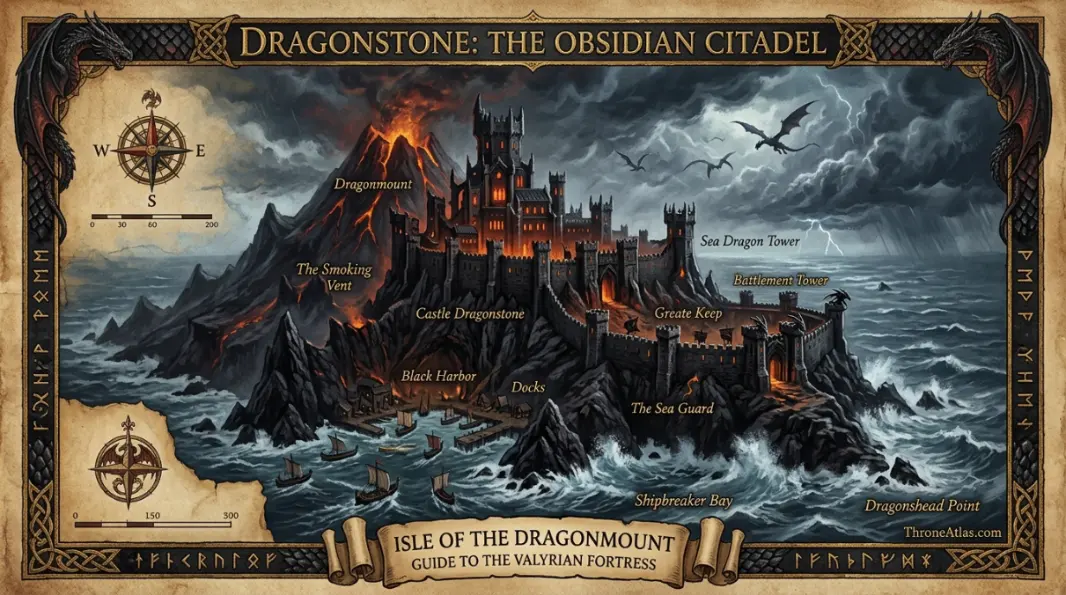
Before the Battle of the Gullet, Rhaenyra made a desperate and consequential decision: she opened the Dragonstone dragoncaves and invited anyone with Targaryen blood — however distant — to try to claim an unclaimed dragon. Several succeeded. These Dragonseeds became important wildcard figures in the battle and beyond.
Hugh Hammer — a blacksmith’s bastard — bonded with Vermithor, the great bronze dragon once ridden by King Jaehaerys I Targaryen. Ulf the White, another baseborn claimant, bonded with Silverwing. Both flew in the Battle of the Gullet. Both would later betray Team Black in the Second Dragonfire. Without the battle to prove their dragon bonds, the betrayal that followed may never have been possible.
Four other Dragonseeds flew at the Gullet as well, though their individual fates varied. The key point is that the Gullet battle was the proving ground for a new generation of ad-hoc dragonriders — people who had never expected to be part of a war and who reshaped its outcome in ways Rhaenyra never anticipated.
Driftmark and the Velaryon Naval Command
Driftmark — High Tide castle, seat of House Velaryon — sits just west of the Gullet. It was the base from which Corlys Velaryon, the Sea Snake, coordinated the most powerful fleet in Westeros. The Velaryon navy represented decades of maritime trade, mercantile aggression, and naval investment. Without it, Team Black had no effective way to contest the sea lanes or threaten King’s Landing from the water.
Corlys survived the Dance of the Dragons, though not without loss. His decision to maintain fleet cohesion even after the Gullet battle proved strategically vital — it kept Dragonstone from being blockaded and prevented Team Green from landing an invasion force on the eastern shore.
How the Battle of the Gullet Connects to Dragonstone
Dragonstone is the emotional and strategic center of every major event in the Dance of the Dragons. It’s where Rhaenyra based her government, where the dragons were kept, and where the Dragonseeds were recruited. After the Battle of the Gullet, Dragonstone became increasingly isolated — a fortress under pressure rather than the confident headquarters it had been in 129 AC.
This page connects directly to the Dragonstone Map and the wider House of the Dragon Map. Together, they trace the full arc of Team Black’s geography — from the confident opening of the war through the cascade of disasters that ended with Rhaenyra’s death on Dragonstone itself.
The Battle’s Aftermath: Why It Was Worse Than a Defeat
Most military losses can be absorbed — armies regroup, fleets rebuild, alliances hold. The Battle of the Gullet was worse than a defeat because it simultaneously killed Team Black’s future (Jacaerys), introduced uncertain new power-brokers (the Dragonseeds), and signaled to neutral houses that Team Black was no longer invincible. The news of Jacaerys’ death reached the northern allies he had personally recruited. Some held firm; others began to reconsider.
Rhaenyra’s other children died in rapid succession after the Gullet. Baela Targaryen lost her dragon Moondancer. Rhaena could not find a dragon to bond with until it was too late. The Dragonseeds’ defection removed two of Team Black’s largest combat dragons. By the time King’s Landing fell, Rhaenyra had nothing left but the name of queen — and not even that for long.
Reading the Map: How to Use This Guide
Start with the TL;DR box at the top to anchor the key facts. Then trace the SVG map above — follow the Velaryon fleet line (gold dashes) from Driftmark north through the Gullet to Dragonstone, and the Triarchy approach (red dashes) from the Stepstones into the strait. The dragon arc shows Jacaerys’ last flight.
Use the interactive explorer below the map to understand each location’s strategic role in the battle. Then read the full prose sections for context, character detail, and lore depth. After finishing this page, continue to the Dragonstone Map, the Dance of the Dragons Map, and the House Targaryen Map to trace the full arc of the civil war.
How House of the Dragon Depicts the Battle
In the HBO series House of the Dragon, the Battle of the Gullet is adapted with significant dramatic weight. The showrunners use the battle to mark the end of the war’s opening phase — where both sides still believed they could win cleanly. Jacaerys’s death functions narratively as the moment Rhaenyra’s story shifts from ambition to tragedy.
This guide works in tandem with the House of the Dragon Map, Dance of the Dragons Map, and Team Black vs Team Green Locations to give viewers and readers a complete geographic picture of the conflict.
How the Battle of the Gullet Unfolded — Step by Step
Team Green courts the Free Cities. Aegon II’s supporters promise the Triarchy restored control of the Stepstones trade route in exchange for naval support against the Velaryon fleet.
~90 Triarchy warships enter the Narrow Sea. They approach from the Stepstones — the island chain southwest of Dragonstone — moving into the southern mouth of the Gullet strait.
Rhaenyra’s new dragonriders fly for the first time in battle. Hugh Hammer on Vermithor, Ulf the White on Silverwing, and four others engage the Triarchy fleet above the Gullet’s waters.
Scorpion bolts strike Vermax. Jacaerys Velaryon’s dragon is wounded and dragged into the sea. Both Jacaerys and Vermax drown in the Gullet, ending Rhaenyra’s hope for a stable succession.
The Velaryon fleet repels the Triarchy but cannot celebrate. News of Jacaerys’ death spreads across Westeros. Allied houses begin to waver. The second phase of the Dance — full of betrayals — begins.
Hugh Hammer and Ulf the White switch sides. Having proven their dragon bonds at the Gullet, they later join “the Second Dragonfire” rebellion against Rhaenyra — taking two of Team Black’s largest dragons with them.
Key Places, Characters, and Events on the Battle of the Gullet Map
Key Places
The Gullet (battle site), Dragonstone (Team Black HQ), Driftmark (Velaryon seat), Blackwater Bay (strategic approach), Narrow Sea (Triarchy entry route), Stepstones (Triarchy base), King’s Landing (ultimate political prize).
Key Characters
Jacaerys Velaryon (died in battle), Corlys Velaryon (fleet commander), Rhaenyra Targaryen (Team Black queen), Hugh Hammer (Dragonseed, later traitor), Ulf the White (Dragonseed, later traitor), Triarchy admirals (Team Green naval allies).
Key Events & Lore
Gullet naval battle (130 AC), Triarchy fleet attack, Death of Vermax, Dragonseeds’ first battle flight, Velaryon fleet defense, Second Dragonfire (Hugh Hammer & Ulf defect), Fall of Rhaenyra (cascade of losses following the Gullet).
Battle of the Gullet — Questions & Answers
The Battle of the Gullet was a major naval and dragon engagement fought in 130 AC during the Dance of the Dragons — the Targaryen civil war. The Triarchy (a Free Cities alliance allied with Team Green) sent roughly 90 warships into the Gullet strait south of Dragonstone. The Velaryon fleet, supported by Dragonseeds riding newly claimed dragons, defended the strait. Team Black’s heir, Jacaerys Velaryon, died in the battle alongside his dragon Vermax.
The Gullet is the narrow strait in the eastern Narrow Sea that connects the open ocean to Blackwater Bay. It runs between Dragonstone (north) and the Stepstones (south). Geographically, it sits roughly 50 miles southeast of King’s Landing. Controlling the Gullet means controlling maritime access to Blackwater Bay — and therefore to King’s Landing itself — which is why it became the focal point of Team Black’s naval strategy.
According to George R.R. Martin’s Fire & Blood, Jacaerys Velaryon died when his dragon Vermax was struck by scorpion bolts fired from Triarchy warships. Vermax was wounded and fell into the sea. Dragons can fly wounded, but cannot survive prolonged submersion. Vermax drowned in the Gullet, and Jacaerys drowned with him. He was approximately 19 years old. The House of the Dragon series dramatizes this death as one of the pivotal turning points of the civil war.
Dragonseeds were baseborn individuals with Targaryen blood — distant enough to be illegitimate but close enough to potentially bond with dragons. Before the battle, Rhaenyra Targaryen opened Dragonstone’s dragoncaves and invited any such claimants to try. Six succeeded in bonding with unclaimed dragons and flew at the Battle of the Gullet. The most significant were Hugh Hammer (who bonded with the great dragon Vermithor) and Ulf the White (who bonded with Silverwing). Both later betrayed Rhaenyra in what became known as the Second Dragonfire.
The Triarchy — the Free Cities alliance of Lys, Myr, and Tyrosh — joined Team Green for two reasons. First, they had previously lost the Stepstones to Daemon Targaryen in a costly war; they wanted them back and expected Aegon II to return them as payment. Second, they saw an opportunity to weaken House Velaryon, their greatest naval competitor in the Narrow Sea. Attacking the Gullet struck both at Team Black’s heir (Jacaerys) and at the Velaryon fleet that enforced Rhaenyra’s sea power.
Yes. The Battle of the Gullet is depicted in the HBO series House of the Dragon, adapted from George R.R. Martin’s Fire & Blood. The battle is treated as a major dramatic turning point — the moment that ends Team Black’s sense of momentum and begins the war’s tragic second act. The depiction focuses on Jacaerys Velaryon’s death and the role of the Dragonseeds in the engagement.
Related Maps, Routes, Lore, and Characters
Dance of Dragons
Battle Locations
ThroneAtlas is an independent fan-made map and lore reference site. Not affiliated with, endorsed by, or connected to HBO, Warner Bros., George R.R. Martin, or any official Game of Thrones, House of the Dragon, or A Song of Ice and Fire property. All names, characters, and intellectual property belong to their respective owners. Lore references drawn from Fire & Blood (2018) by George R.R. Martin.