Great Sept of Baelor Map: Visenya’s Hill, Plaza, Crypts & Routes
A landmark-scale atlas of the Faith’s great center in King’s Landing—its position atop Visenya’s Hill, white marble plaza, seven crystal towers, interior worship space, crypts and the streets connecting it to the rest of the capital.
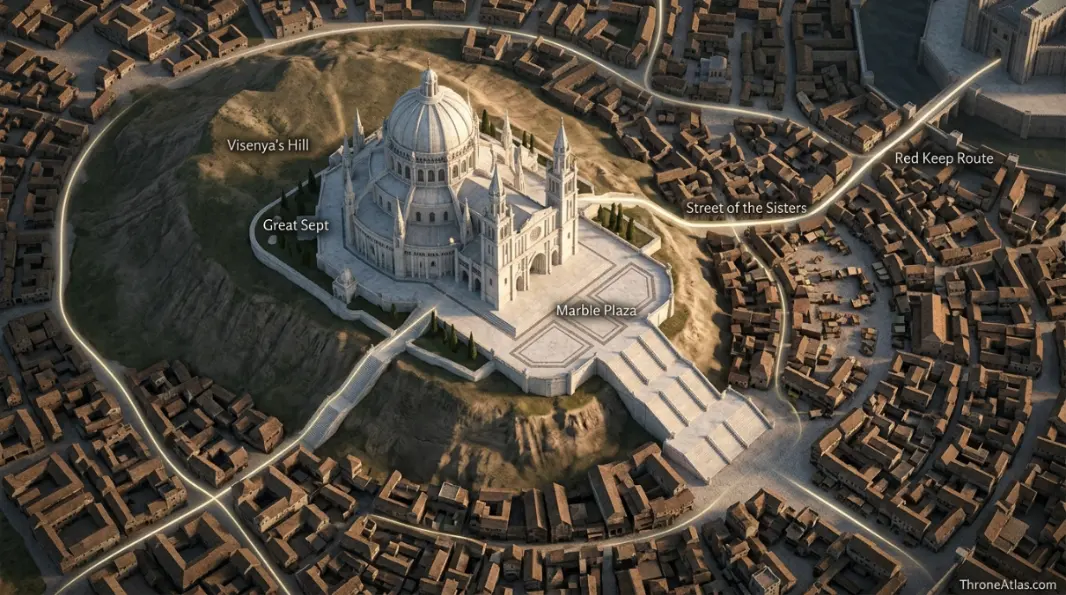
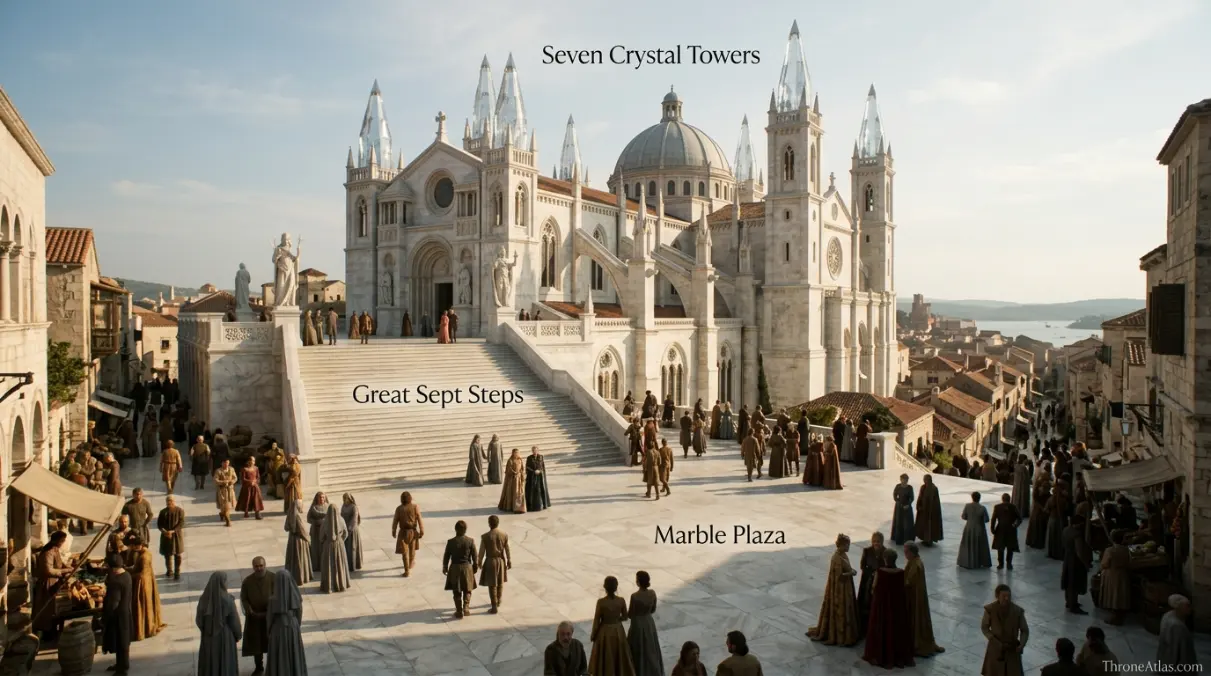
The Great Sept of Baelor stands atop Visenya’s Hill in King’s Landing. A broad white-marble plaza surrounds the sept, whose great dome and seven crystal towers dominate the hill. Inside, seven broad aisles meet beneath the dome, while chapels, crypts, cells and ceremonial spaces extend through and below the complex. Its hilltop position makes the sept both a religious center and a powerful public stage.
Great Sept of Baelor Map — Sacred Space & City Movement
The sept is both a building and an urban destination. The map must therefore show two scales: internal sacred layout and external movement across Visenya’s Hill, plaza and streets toward the rest of King’s Landing.
Visenya’s Hill, Plaza, Sept Interior & City Routes
Tap a marker to reveal why that place matters. Marker positions are interpretive unless the canon confidence note says otherwise.
Canon Confidence & What This Map Claims
The sept’s hilltop position, plaza, dome, seven towers, seven aisles, crypts, chapels and several internal functions are described in detail. Exact architectural dimensions and a complete floor plan remain incomplete, so the plan is schematic rather than falsely surveyed.
In This Guide
- Visual Atlas & Map
- Canon Confidence
- Map Index
- Where Is the Great Sept of Baelor in King’s Landing?
- The Marble Plaza and Steps: Why the Exterior Is Part of the Map
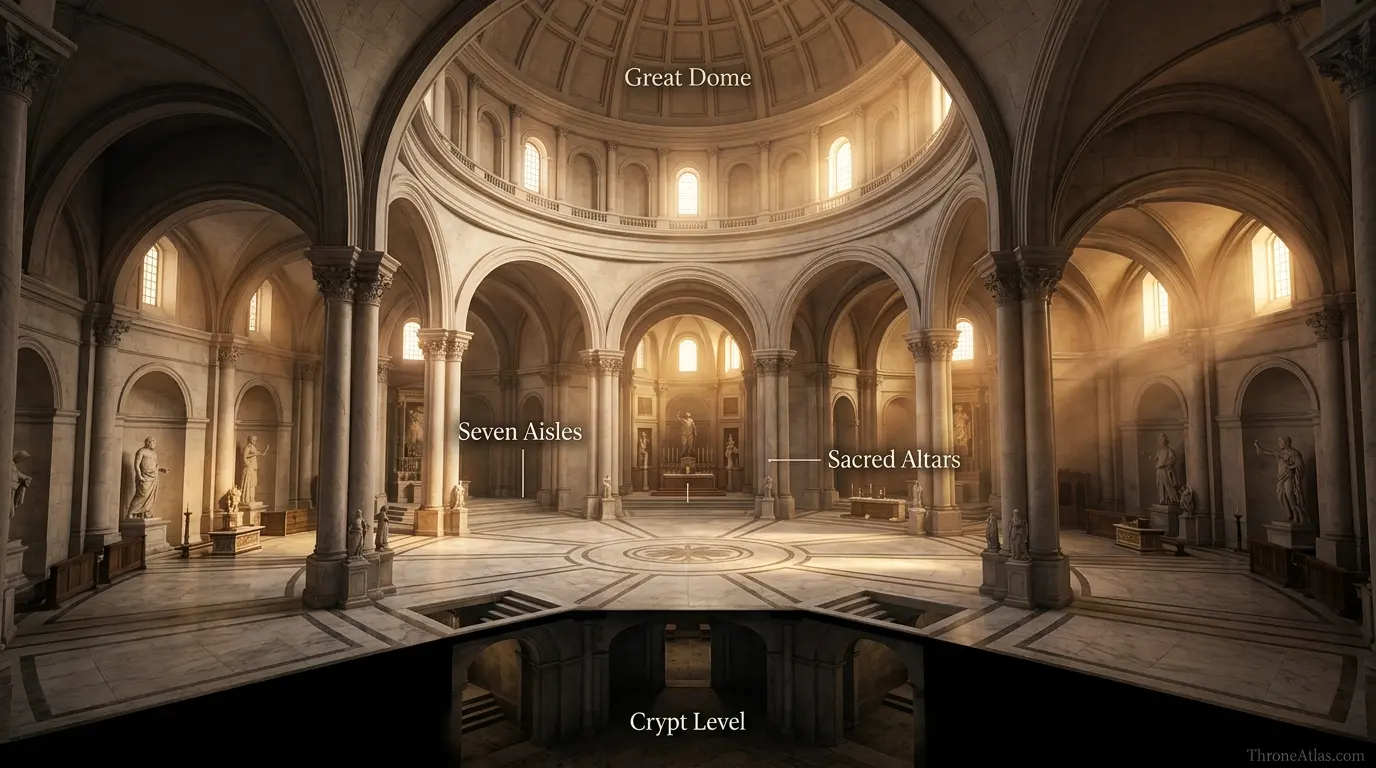
- Inside the Great Sept: Seven Aisles, Dome and Sacred Organization
- Crypts, Chapels, Cells and the Vertical Map
- Crown Versus Faith: The Route Between the Sept and Red Keep
- Book Canon vs HBO: What Happens to the Great Sept?
- Cartographer Field Notes
- Direct Answers
- Source & Canon Basis
- FAQs
Great Sept of Baelor Map: What Matters Most
The sept crowns Visenya’s Hill
Its elevated position makes it visible and turns religious gatherings into city-scale events.
The plaza is part of the landmark
Crowds gather outside before they ever enter the sacred interior.
Seven towers reinforce religious symbolism
Architecture repeats the number central to the Faith of the Seven.
Seven aisles organize the interior
Worship space converges beneath the great dome.
The building extends below ground
Crypts, chambers and cells make the map vertically layered.
It replaced Oldtown as Faith center
The High Septon’s seat moved from the Starry Sept to King’s Landing.
Public justice happened on its steps
Ned Stark’s execution and later religious spectacles turn the plaza into political geography.
Screen destruction requires a continuity note
The HBO series destroys the sept; book continuity has not reached the same event, so the map must label which version it describes.
Places, Zones & Connections to Plot
| Place | Zone | Why It Matters | How to Read It on the Map |
|---|---|---|---|
| Great Sept of Baelor | Top of Visenya’s Hill | Central seat of the Faith of the Seven in King’s Landing. | Main landmark; orient both internal plan and external city routes around it. |
| White marble plaza | Around sept | Large gathering space for crowds, ceremonies and public spectacle. | Treat as part of the functional complex, not empty decoration. |
| Seven crystal towers | Sept exterior | Distinctive symbolic towers associated with bells and the Seven. | Useful skyline markers rather than separate destinations. |
| Great dome / sept proper | Interior center | Primary worship space where seven broad aisles converge. | Central interior node for ceremonies and movement. |
| Crypts and chapels | Below / around interior | Burial, devotion and secondary sacred spaces. | Add vertical depth without pretending every chamber is fully surveyed. |
| Audience / holding chambers | Below sept | Private religious authority and confinement spaces appear in the lore. | Shows institutional power below the public worship level. |
| Street of the Sisters | Between Visenya and Rhaenys hills | Major route linking hill districts of the capital. | Critical external orientation line toward the Dragonpit side of the city. |
| Red Keep route | Toward Aegon’s High Hill | Political path between religious and royal centers. | Explains why processions and confrontations between crown and Faith are spatially visible. |
Where Is the Great Sept of Baelor in King’s Landing?
The Great Sept of Baelor stands at the top of Visenya’s Hill, one of the three great hills inside King’s Landing.
That high position is fundamental to the landmark. The sept is not hidden inside a dense neighborhood; it crowns a major hill and can draw enormous crowds into the surrounding plaza. Religion therefore occupies one of the capital’s dominant pieces of topography, just as royal authority occupies Aegon’s High Hill through the Red Keep.
The third great hill, Rhaenys, holds the Dragonpit. Seen together, the three hills create a simple mental model of King’s Landing: crown, faith and dragon legacy distributed across elevated landmarks. Streets and crowds move between them, turning topography into political theater.
For users, the simplest orientation is therefore hill first, building second. Once Visenya’s Hill is fixed on the King’s Landing map, the sept becomes easy to place relative to the Red Keep and Dragonpit.
The Marble Plaza and Steps: Why the Exterior Is Part of the Map
The white-marble plaza and broad approach to the Great Sept function as a civic stage where worship, announcements, crowds and political spectacle spill outside the sacred building.
A map focused only on interior walls would miss some of the sept’s most important scenes. The plaza can hold huge numbers of people, which makes it a pressure chamber between private religious authority and public opinion.
The steps matter for the same reason. They create a threshold between city and sanctuary, but also a platform where power can be displayed. Ned Stark’s execution transforms the approach into one of the saga’s most famous political locations, even though the event is not a normal religious ritual.
This is urban geography in action. A monument with a large open forecourt can host mass events that a narrow alley cannot. The physical design amplifies spectacle, making the sept a citywide stage rather than only a place of worship.
Inside the Great Sept: Seven Aisles, Dome and Sacred Organization
The sept proper is organized around seven broad aisles meeting beneath a great dome, with altars, statues and ceremonial areas reflecting the Faith of the Seven.
The number seven is architectural as well as theological. Towers, aisles and sacred symbolism repeat the structure of the religion, so the building communicates belief through space. A visitor does not simply hear doctrine; the layout reinforces it.
The central dome creates a shared interior volume while individual altars allow different devotional focus. Marriages, funerals, prayers and public religious moments can therefore occupy different parts of the same complex without requiring entirely separate buildings.
For a schematic plan, this supports a radial rather than rectangular visual. The goal is not to invent measurements but to show convergence: multiple sacred paths meeting under one dominant center.
Crypts, Chapels, Cells and the Vertical Map
The Great Sept extends beyond its public floor into crypts, chapels, private chambers and cells, making the landmark a vertical institution rather than a single open hall.
This lower level matters because institutional power often operates out of sight. The public sees bells, marble and prayer. Beneath or behind that space are rooms for burial, deliberation, penance and confinement.
The contrast becomes especially important when the Faith Militant grows politically powerful. A religious complex that can hold accused nobles and host private audiences is not only symbolic. It has practical infrastructure for authority.
A responsible atlas can show “below-ground sacred and holding spaces” without claiming to know the exact tunnel under every tower. That keeps the vertical concept accurate while avoiding the false precision that weakened Batch 1.
Crown Versus Faith: The Route Between the Sept and Red Keep
The Great Sept and Red Keep occupy different hills, so every confrontation or procession between crown and Faith becomes a literal movement across King’s Landing.
That separation is politically valuable. Neither institution is physically inside the other. The High Septon has a great center of his own, while the king has the Red Keep. Their power can cooperate, compete or collide across the city.
Cersei’s walk of atonement makes that geography unforgettable in the later story: the journey is not just emotional humiliation but a route from religious custody back toward royal space. Crowds occupy the streets between the two institutions, making public opinion part of the passage.
This is exactly the kind of story that benefits from map-first explanation. Instead of saying “she walked across King’s Landing,” the atlas can show why the start and end points symbolize different authorities and how the city itself becomes the stage between them.
Book Canon vs HBO: What Happens to the Great Sept?
The HBO series destroys the Great Sept of Baelor in the wildfire explosion orchestrated by Cersei, while the published novels have not reached that same event; the page therefore separates screen and book continuity.
This distinction matters because the two continuities no longer describe the same King’s Landing. In the show, the landmark’s destruction dramatically changes the skyline and political geography. In the published novels, the sept remains part of the city’s ongoing geography.
A single unlabeled sentence can accidentally turn adaptation plot into book canon. ThroneAtlas avoids that by marking continuity wherever the difference changes the map itself. The same rule applies to precise interior visuals: HBO sets can enrich a screen-version diagram but should not silently overwrite descriptions from the novels.
Keeping those continuities separate answers two different geographic questions without contradiction: where the Great Sept stood in the HBO series, and where it remains in the published novels.
How Each Marker Changes the Map
These notes are deliberately practical. They explain what each point does to movement, power, trade, defense, religion or social life instead of repeating a list of place names.
Great Sept of Baelor
On the atlas, Great Sept of Baelor should not be treated as an isolated pin. Its position in Top of Visenya’s Hill matters because Central seat of the Faith of the Seven in King’s Landing.. The practical map-reading question is therefore Main landmark; orient both internal plan and external city routes around it.. That relationship is more useful than pretending the world has modern surveyed coordinates.
White marble plaza
White marble plaza earns a place on this map for a different reason from a famous capital or battlefield. In Around sept, Large gathering space for crowds, ceremonies and public spectacle.. When following characters, fleets, merchants or armies, read this point through the lens of Treat as part of the functional complex, not empty decoration.; it explains what can realistically happen around it.
Seven crystal towers
A good map gives Seven crystal towers context, not just a label. Here the relevant geographic frame is Sept exterior. Distinctive symbolic towers associated with bells and the Seven.. For route and strategy purposes, the important takeaway is Useful skyline markers rather than separate destinations., which is why this location connects naturally to the surrounding markers.
Great dome / sept proper
The cartographic value of Great dome / sept proper comes from its relationship with the wider Interior center network. Primary worship space where seven broad aisles converge.. In practical terms, Central interior node for ceremonies and movement.. That makes the point meaningful even when the source material never provides exact mileage or a street-by-street survey.
Crypts and chapels
On the atlas, Crypts and chapels should not be treated as an isolated pin. Its position in Below / around interior matters because Burial, devotion and secondary sacred spaces.. The practical map-reading question is therefore Add vertical depth without pretending every chamber is fully surveyed.. That relationship is more useful than pretending the world has modern surveyed coordinates.
Audience / holding chambers
Audience / holding chambers earns a place on this map for a different reason from a famous capital or battlefield. In Below sept, Private religious authority and confinement spaces appear in the lore.. When following characters, fleets, merchants or armies, read this point through the lens of Shows institutional power below the public worship level.; it explains what can realistically happen around it.
Street of the Sisters
A good map gives Street of the Sisters context, not just a label. Here the relevant geographic frame is Between Visenya and Rhaenys hills. Major route linking hill districts of the capital.. For route and strategy purposes, the important takeaway is Critical external orientation line toward the Dragonpit side of the city., which is why this location connects naturally to the surrounding markers.
Red Keep route
The cartographic value of Red Keep route comes from its relationship with the wider Toward Aegon’s High Hill network. Political path between religious and royal centers.. In practical terms, Explains why processions and confrontations between crown and Faith are spatially visible.. That makes the point meaningful even when the source material never provides exact mileage or a street-by-street survey.
Fast Answers About the Map
At the top of Visenya’s Hill in King’s Landing.
It is the central seat of the Faith of the Seven and home of the High Septon in King’s Landing.
A large white-marble plaza, gardens and steps surround the main building.
Seven broad aisles meet beneath the great dome, with altars, statues, chapels and other sacred spaces.
Yes. The lore includes crypts, cells, private chambers and other spaces beneath or within the complex.
In HBO’s Game of Thrones, yes. In the published novels, that screen event has not occurred and should not be treated as book canon.
What This Atlas Is Based On
The Great Sept is unusually rich in both architectural and event geography, but continuity labeling is essential because the HBO storyline changes the physical map in a way the published books have not.
- A Song of Ice and Fire: Detailed exterior and interior descriptions, ceremonies, public events and Faith politics.
- The World of Ice & Fire: History of Baelor, Visenya’s Hill and the Faith’s institutional center.
- Fire & Blood: Earlier King’s Landing religious geography used to distinguish the Great Sept from older septs.
- HBO Game of Thrones: Screen-specific interior visuals and the Season 6 destruction, clearly labeled as adaptation continuity.
Continue Exploring ThroneAtlas Maps
Great Sept of Baelor Map FAQs
Where is the Great Sept of Baelor on the King’s Landing map?
It crowns Visenya’s Hill, west of the Red Keep’s Aegon’s High Hill and connected to other parts of the city by major streets.
Who built the Great Sept of Baelor?
King Baelor I Targaryen ordered its construction, and the landmark was completed after his death.
Why is it called the Great Sept of Baelor?
It is named for Baelor the Blessed, the deeply religious Targaryen king associated with its creation.
What are the seven towers?
The sept’s distinctive crystal towers reinforce the symbolism of the Faith of the Seven and contribute to the landmark’s skyline presence.
Where was Ned Stark executed?
In the story, his execution takes place on the steps outside the Great Sept of Baelor, turning the religious forecourt into a major political site.
Where does Cersei’s walk of atonement begin?
It begins at the Great Sept and proceeds through King’s Landing toward the Red Keep, linking religious and royal centers across the city.
What was the Faith’s main center before the Great Sept?
The Starry Sept in Oldtown served as the principal seat of the Faith before the High Septon’s center shifted to King’s Landing.
Is the Great Sept near the Dragonpit?
Both are on major hills inside King’s Landing, with the Street of the Sisters helping connect the Visenya’s Hill and Rhaenys Hill areas, but they are distinct landmarks.
Does the Great Sept have crypts?
Yes. The complex includes crypts and additional below-ground or enclosed spaces used for burial, religious authority and confinement.
Is the wildfire destruction book canon?
No. The destruction is an HBO television event. The published novels have not reproduced that exact outcome, so maps should label it as screen continuity.
The Great Sept Turns Faith Into Geography
The Great Sept of Baelor is powerful because religion occupies a visible hilltop, a huge public plaza and a layered interior complex at the heart of the capital. Its routes to the Red Keep and Hill of Rhaenys turn major political conflicts into literal movement across the city, while the book-versus-show difference makes continuity labeling essential.