House Bolton Map Dreadfort, Winterfell, Last Hearth & Betrayal Routes
Dreadfort · Winterfell · The North · Red Wedding · Moat Cailin · Last Hearth
Explore the House Bolton map through the cold geography of fear and betrayal: the Dreadfort, Winterfell under Bolton rule, northern roads, Moat Cailin, the Red Wedding aftermath, Last Hearth pressure, and the routes of Roose, Ramsay, Theon, Sansa, and Jon Snow.
House Bolton is a northern house seated at the Dreadfort, a grim castle east of Winterfell and long associated with fear, flaying, and rivalry with House Stark. Its map includes the Dreadfort, Winterfell after the Red Wedding, northern roads, Moat Cailin, the Last Hearth region, and betrayal routes connected to Roose Bolton, Ramsay Bolton, Theon Greyjoy, Sansa Stark, and Jon Snow. House Bolton’s sigil is the flayed man, and its words are “Our Blades Are Sharp.”
House Bolton at a Glance
The Boltons are best understood by connecting the Dreadfort to old northern rivalry, Stark collapse, Winterfell occupation, and fear as a ruling tool.
The ancestral Bolton castle and symbol of old northern fear.
A vast northern region where Bolton ambition challenges Stark legitimacy.
A brutal symbol of terror, punishment, and old Bolton reputation.
“Our Blades Are Sharp” captures threat, precision, and cruelty.
Bolton rule over Winterfell marks the darkest phase of northern politics.
Roose Bolton’s betrayal helps destroy Robb Stark’s campaign.
The southern gate of the North matters in Bolton control and movement.
Captivity, identity loss, escape, and restoration define the Bolton aftermath.
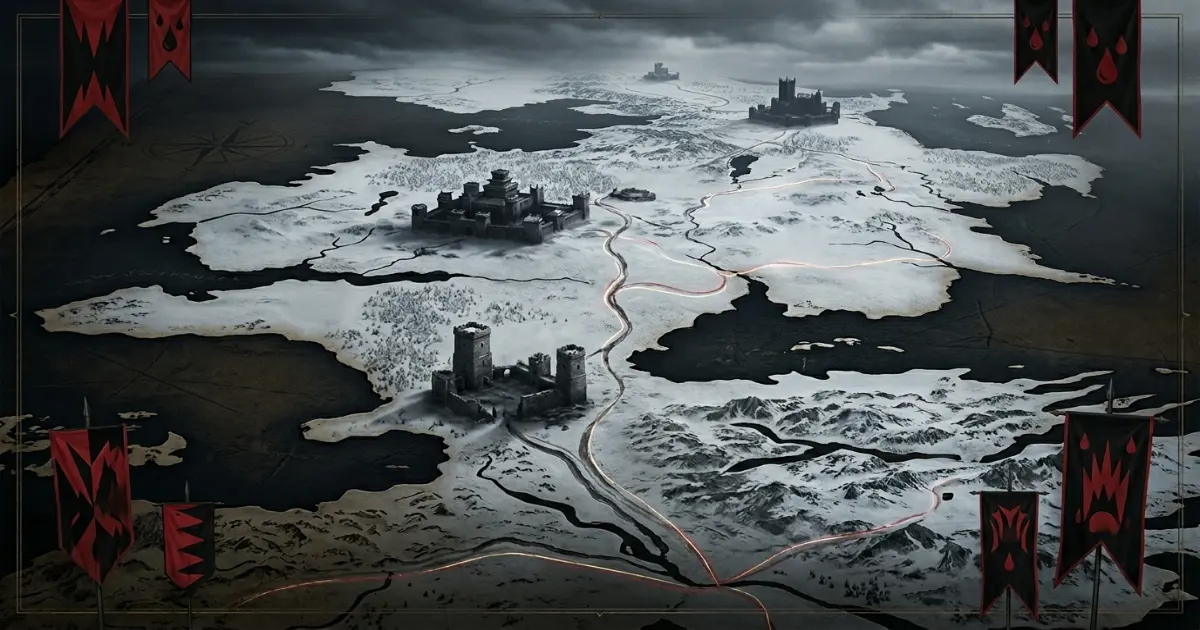
House Bolton Territory and Betrayal Route Map
A stylized ThroneAtlas view of Bolton power, showing the Dreadfort, Winterfell, Moat Cailin, Last Hearth, Red Wedding route, and northern pressure lines.
Explore House Bolton by Power Center and Betrayal Route
Select a Bolton place or route to understand how fear, strategy, Winterfell occupation, northern roads, and captivity shape the Bolton rise.
The Dreadfort
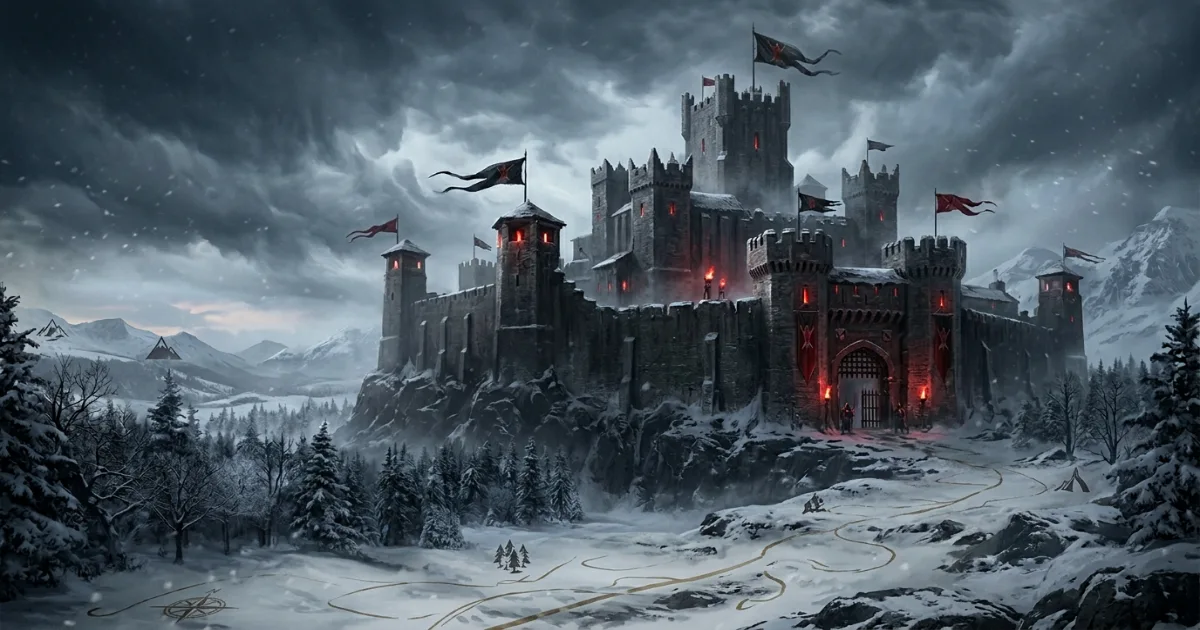
The Dreadfort is the seat of House Bolton and the symbolic center of old northern fear. It represents punishment, silence, controlled cruelty, and the long rivalry between Bolton ambition and Stark legitimacy.
What the House Bolton Map Actually Shows
The House Bolton map is a map of fear moving through snow. The Boltons are not outsiders to the North. That is what makes them so dangerous. Their power grows inside the same region that House Stark once made honorable, loyal, and ancient. While the Starks represent memory, duty, and the old northern heart, House Bolton represents the darker possibility hidden within the same landscape: rule through terror, patience, and betrayal.
A Bolton map cannot be understood as simple villain territory. It must explain the Dreadfort, Winterfell, the northern roads, Moat Cailin, the Red Wedding aftermath, Theon’s captivity, Sansa’s escape, and the uneasy loyalty of northern houses under fear. The Boltons are frightening because their geography is close to the Starks, not far from them. They are the shadow inside the North’s own borders.
The Dreadfort: Seat of Old Northern Fear
The Dreadfort is the ancestral seat of House Bolton and the darkest counterpoint to Winterfell. Its name does not hide its nature. It is not a castle of welcome, harvest, song, or open hearth. It is a fortress of dread, silence, and warning. The Bolton reputation for flaying turns the Dreadfort into more than a seat. It becomes a threat made of stone.
The Dreadfort matters because it preserves the idea that the North was never morally simple. Before the Boltons rise over Winterfell, they already carry an old history of rivalry with the Starks. That ancient tension gives their later betrayal deeper roots. The Red Wedding is shocking, but Bolton ambition does not begin there. The Dreadfort has been waiting on the map for generations.
The North: Stark Land Under Bolton Pressure
The North is the largest region of Westeros and traditionally belongs to Stark leadership. When the Boltons gain power after the Red Wedding, they do not merely take a castle. They disturb the moral order of the North. Their rule shows how quickly a region built around loyalty can be forced into silence when its central house is broken.
This is why Bolton control is so unstable. The Boltons can occupy Winterfell, command fear, and gain outside backing, but legitimacy is another matter. Northern houses may bend in the short term, yet their memory does not easily become Bolton memory. The map may show Bolton control, but the emotional geography of the North remains contested.
Roose Bolton: Betrayal as Strategy
Roose Bolton is the strategic mind behind the house’s rise. He is not loud like Ramsay. His danger is colder. Roose understands timing, power shifts, and the value of appearing useful until betrayal becomes profitable. His route from Robb Stark’s coalition to the Red Wedding and then toward control of the North is one of the clearest examples of political patience turning poisonous.
Roose matters on the map because he connects the North to the Riverlands betrayal system. He stands at the intersection of House Stark, House Frey, House Lannister, and House Bolton. Through him, the Dreadfort reaches the Twins, and the Twins reach Winterfell. That is why the Bolton page should always link to the Frey page and the Red Wedding hub.
The Red Wedding: Where Bolton Power Turns
The Red Wedding is the turning point that makes Bolton rule over the North possible. The Freys provide the location and hospitality trap, but Roose Bolton provides the internal betrayal that destroys Robb Stark from within. When Roose delivers his famous betrayal, he is not only killing a king. He is clearing a road back north.
This is the essential map logic: the Bolton rise begins outside the North, in the Riverlands, at the Twins. A southern betrayal produces a northern regime. The line from the Red Wedding to Winterfell is one of the most important betrayal routes in the entire atlas. It shows how a single event can redraw political geography across regions.
Winterfell Under Bolton Rule
Winterfell under Bolton control is one of the most disturbing map reversals in the story. The castle that once symbolized Stark memory, northern hospitality, and ancestral continuity becomes a stage for fear, abuse, false legitimacy, and broken identities. Bolton rule in Winterfell is powerful precisely because it feels wrong.
This wrongness matters for SEO and story structure alike. Readers searching for Winterfell often want more than the castle location. They want to understand why its occupation feels so painful. A House Bolton page should support pages on Winterfell, Sansa’s Winterfell route, Theon/Reek, the Battle of the Bastards, and Stark restoration.
Ramsay Bolton: Cruelty Without Statecraft
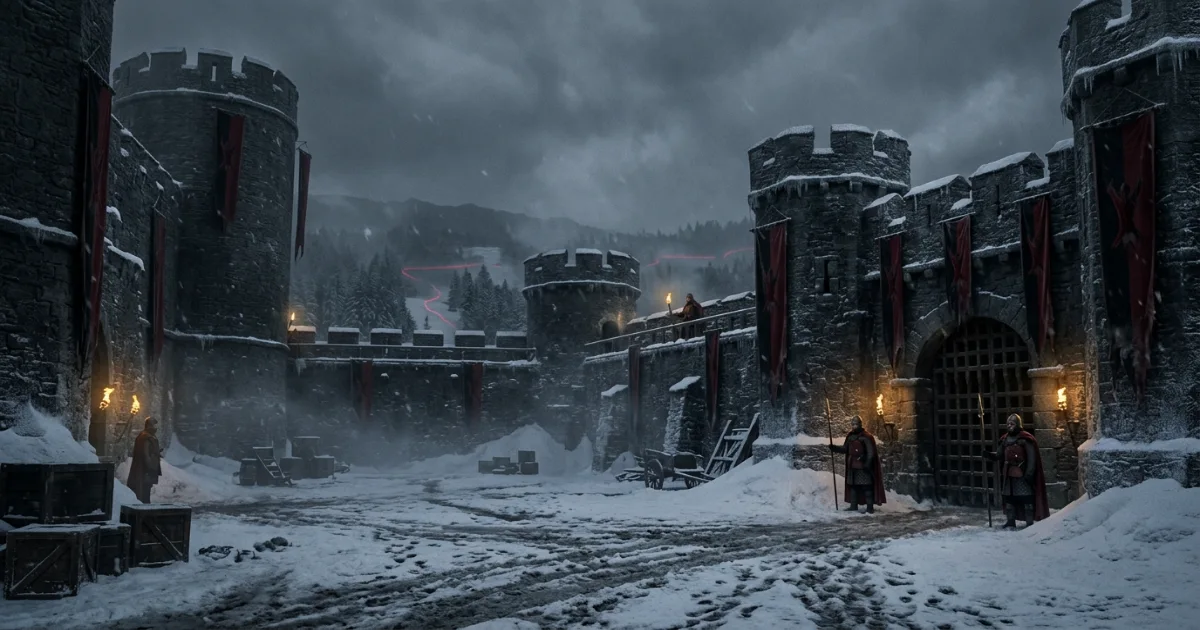
Ramsay Bolton is the terrifying public face of Bolton cruelty, but he is different from Roose. Roose is cold political calculation. Ramsay is appetite, performance, and sadism. His map is built around captivity, hunting, psychological destruction, and the corruption of Winterfell’s meaning. He can terrify people, but terror alone is not durable statecraft.
Ramsay’s importance is strongest in character-route content. He connects the Dreadfort, Winterfell, Theon’s identity collapse, Sansa’s suffering, the northern houses, and the Battle of the Bastards. He turns places into prisons. That makes him one of the most important villains for a map-based storytelling system.
Theon Greyjoy: Captivity and the Map of Broken Identity
Theon Greyjoy is one of the strongest bridges between Greyjoy, Stark, and Bolton pages. His route begins with island identity, passes through Winterfell betrayal, and collapses into Bolton captivity. Under Ramsay, geography becomes psychological: the Dreadfort and Winterfell are not just locations. They become states of fear.
Theon’s captivity shows what Bolton power does at the personal level. Roose changes political maps. Ramsay changes a person’s internal map. The name Reek is a territorial occupation of the self. That is why Theon’s route should be treated as a major internal link from House Bolton to House Greyjoy and House Stark.
Sansa Stark: Escape from Bolton Winterfell
Sansa Stark turns Bolton-controlled Winterfell into a survival route. Her presence there connects Vale politics, Littlefinger’s manipulation, Stark legitimacy, Ramsay’s cruelty, Theon’s broken identity, and the eventual fight to reclaim the North. Her escape gives the Bolton map an important reversal: fear is not permanent when someone survives long enough to carry truth out of the castle.
Sansa’s route also shows why Bolton legitimacy fails. They can occupy Winterfell, but Sansa represents the living Stark claim and memory. Her survival makes northern restoration possible because she carries both witness and bloodline. In map terms, her escape is a line out of darkness toward political recovery.
Moat Cailin and the Southern Gate of the North
Moat Cailin matters to the Bolton map because control of the North requires control of movement. It is the southern gate, the defensive bottleneck, and a place that shapes who can enter or threaten the North. Bolton strategy cannot be understood only by looking at castles. Roads, chokepoints, and ruined strongholds matter.
The Boltons inherit a North that is wounded, but still vast. Holding Winterfell is not enough if roads, houses, and crossings remain uncertain. Moat Cailin helps explain the military geography of control. It is a place where the map narrows and every army must think carefully.
Last Hearth, Northern Houses, and Fearful Loyalty
The Last Hearth and other northern houses matter because Bolton power depends on how much fear can replace loyalty. The Starks rule through memory and mutual obligation. The Boltons attempt to rule through threat and advantage. Some houses bend. Some wait. Some resist in silence. That tension gives the post-Red-Wedding North its uneasy feeling.
Northern houses do not simply become Bolton in spirit. They calculate survival. That is why the Bolton regime feels temporary even when it is dangerous. It has swords, hostages, and outside support, but it lacks the deep emotional roots the Starks possess. Fear can hold a hall quiet, but it cannot make old songs forget their names.
The Flayed Man Sigil and Bolton Identity
House Bolton’s sigil is the flayed man, one of the most disturbing symbols in Westeros. Unlike sigils that suggest animals, weather, honor, or beauty, the Bolton symbol is an act of violence. It does not merely represent the house. It warns the viewer what the house is willing to do.
The words, “Our Blades Are Sharp,” are equally direct. They do not promise justice, winter, fury, or family. They promise readiness to cut. The Bolton identity is therefore built around intimidation. In a map system, their sigil makes every Bolton location feel like a threat before the reader even reaches the details.
This is exactly why the Bolton cluster is valuable for ThroneAtlas. It adds betrayal geography, villain-route structure, northern legitimacy conflict, captivity, psychological control, Stark restoration stakes, and Red Wedding consequences. House Bolton gives the atlas one of its strongest dark clusters because it shows what happens when a region’s deepest identity is occupied by fear.
Explore More Bolton Locations, Routes, and Lore
House Bolton connects some of the darkest paths in the northern story. To understand the full map, continue from this page into the Dreadfort, Winterfell, the Red Wedding, Theon Greyjoy’s journey, Sansa Stark’s route, and the wider North map. These connected guides show how fear moves from the Dreadfort to Winterfell, from the Twins back into the North, and from private captivity into open war.
House Bolton is essential because it explains the North’s darkest political reversal. The Boltons do not simply hold land. They corrupt the meaning of land. They turn Winterfell into a prison, loyalty into fear, and victory into something that feels diseased from the moment it begins.
Where to Go After the House Bolton Map
Follow these connected locations, characters, and events to understand how the Boltons reshape the North after the Red Wedding.
The Bolton seat Explore the grim castle that defines old Bolton fear, flaying reputation, Ramsay’s cruelty, and the house’s long rivalry with Stark rule.
The stolen heart of the North See how Bolton occupation twists the meaning of Stark territory and turns a home of memory into a place of fear.
The betrayal that changes the map Follow the event that destroys Robb Stark’s campaign and opens the road for Bolton control in the North.
The captivity route Trace how Theon’s identity is broken between Greyjoy blood, Stark memory, the Dreadfort, and Bolton Winterfell.
The escape route Follow Sansa’s path through the Vale, Winterfell, Ramsay’s control, Theon’s help, and the return of Stark legitimacy.
The fall of Bolton power Continue to the battle that brings Jon Snow, Sansa Stark, Ramsay Bolton, and the northern houses into the final struggle for Winterfell.
Key Places, Characters, and Events Connected to House Bolton
House Bolton touches the Dreadfort, Winterfell, the Red Wedding, Stark restoration, Greyjoy captivity, and the northern war for legitimacy.
Key Places
The Dreadfort, Winterfell, Moat Cailin, Last Hearth, Twins, Riverlands road, and northern fields are the main places that shape Bolton control and its collapse.
Key Characters
Roose, Ramsay, Theon, Sansa, Jon, Robb, Catelyn, Walder Frey, Brienne, and Davos are the main characters shaped by Bolton power and its collapse.
Key Events & Lore
Red Wedding, flayed man tradition, guest-right fallout, Battle of the Bastards, northern loyalty, and Stark restoration are the major storylines connected to House Bolton.
House Bolton Map Questions
House Bolton is located in the North of Westeros. Its ancestral seat is the Dreadfort, east of Winterfell.
The seat of House Bolton is the Dreadfort, a grim northern castle associated with fear, punishment, and the house’s old reputation for flaying.
House Bolton’s words are “Our Blades Are Sharp.” They reflect threat, cruelty, precision, and the house’s reputation for fear.
House Bolton’s sigil is the flayed man, one of the most disturbing symbols in Westeros and a direct warning of the house’s cruelty.
House Bolton becomes connected to Winterfell after the Red Wedding, when Roose Bolton rises as Warden of the North and the Boltons occupy Stark territory through betrayal and outside support.
Related Bolton Maps, Routes, Lore, and Locations
ThroneAtlas is an independent fan-made map and lore reference site. It is not affiliated with, endorsed by, or connected to HBO, Warner Bros., George R. R. Martin, or any official Game of Thrones, House of the Dragon, or A Song of Ice and Fire property. All names and trademarks belong to their respective owners.