Red Wedding Map The Twins, Frey Bridge, Robb Stark, Catelyn, Bolton Betrayal & Northern Collapse
The crossing, feast hall and betrayal route that ended the Young Wolf’s campaign
The Red Wedding is not only a shocking banquet scene. It is a geography lesson in bridge control, hostage politics, guest right, and how one Riverlands crossing can decide the fate of the North.
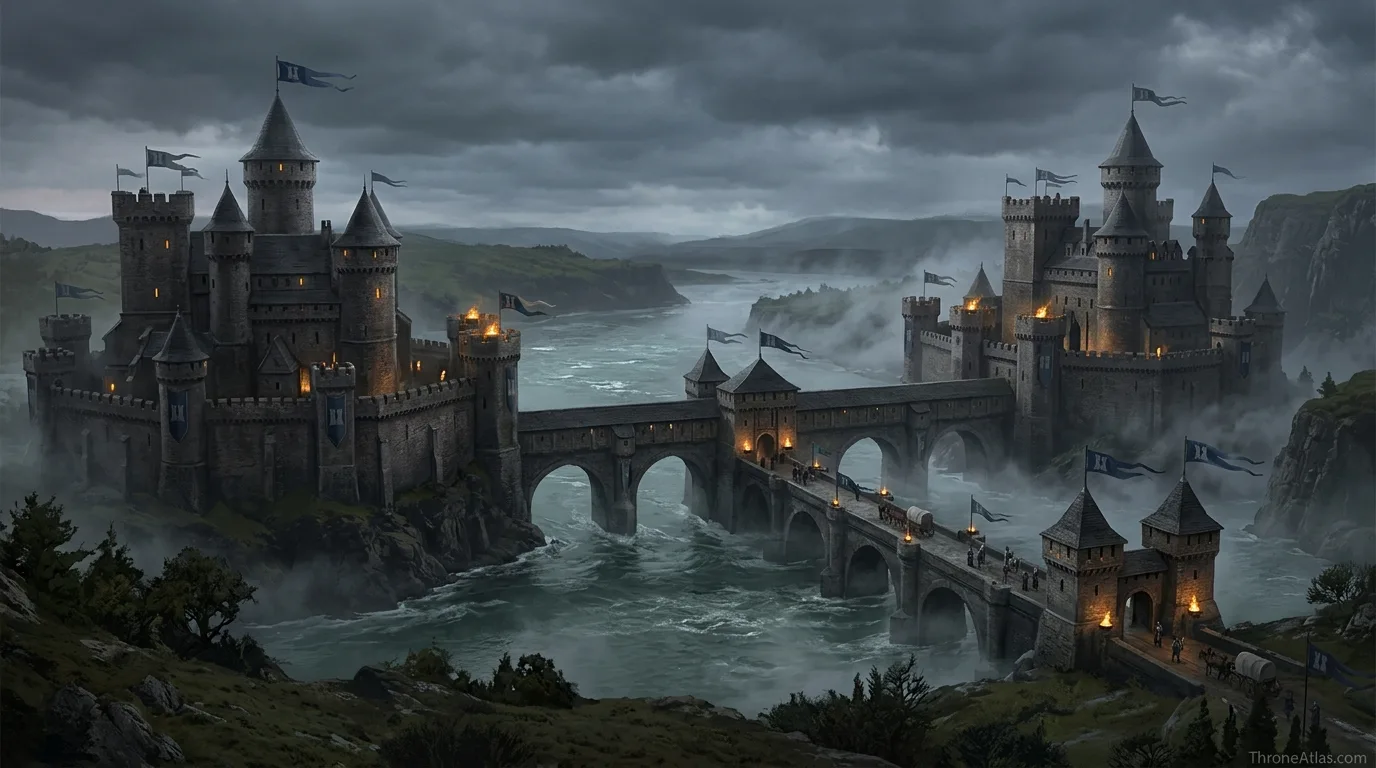
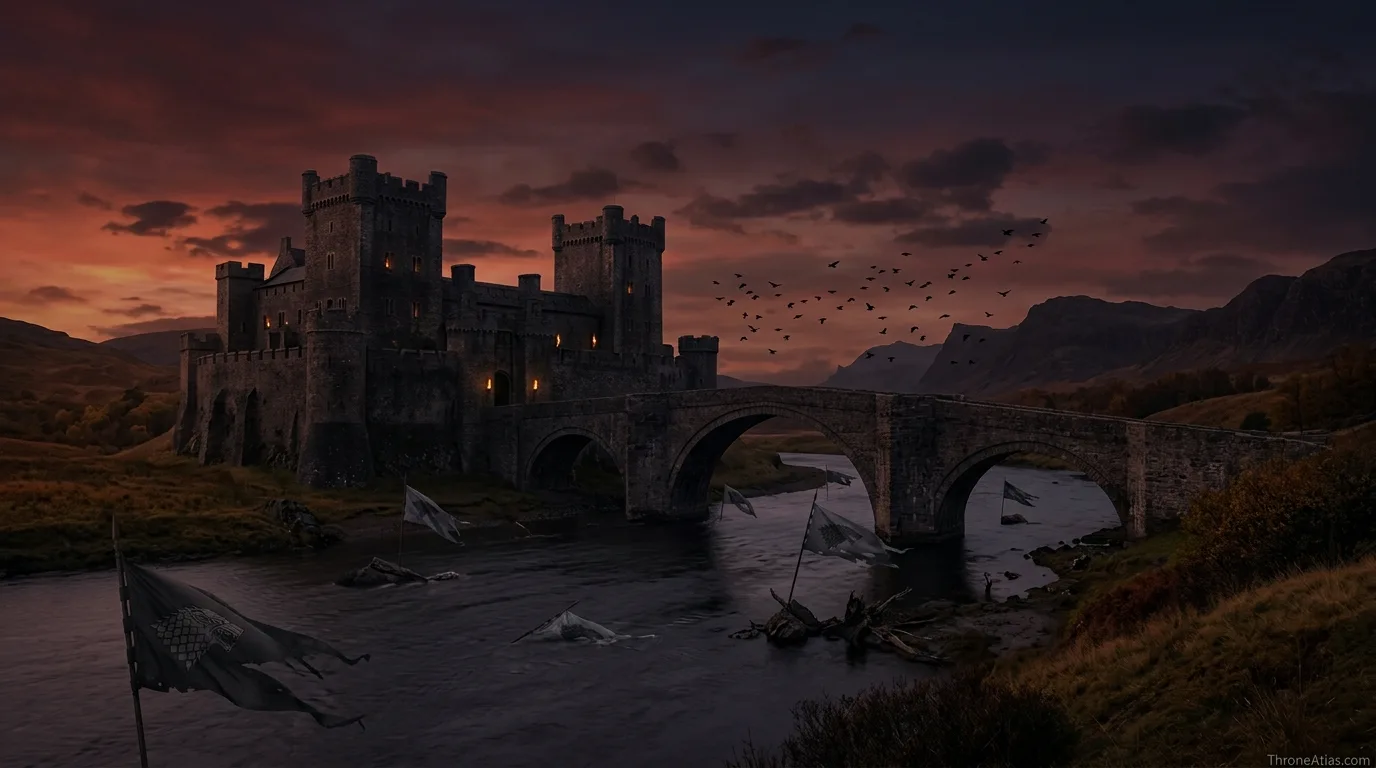
The Red Wedding map is centered on the Twins, the double castle and bridge controlled by House Frey on the Green Fork of the Trident. Robb Stark returns there to repair his broken marriage alliance, but Walder Frey, Roose Bolton and Lannister power turn the wedding feast into a trap. The most important map points are the Frey bridge, the wedding hall, the guest quarters, the surrounding camps, and the roads that carry the news of Stark collapse back through the Riverlands and the North.
What this Red Wedding Map explains
The cards below give the fast orientation before the deeper route, table and FAQ sections.
Main points on the Red Wedding Map
This simplified graphic is designed for reading flow, not exact geographic scale. Use it to understand order, pressure and consequence.
The bridge makes House Frey necessary to northern movement through the Riverlands.
Two towers and a bridge turn geography into toll, insult and leverage.
Robb enters to heal a political wound, not to fight a battle.
Stark allies are separated, softened by hospitality and boxed inside hostile walls.
Music, seating and doors convert a feast into a coordinated ambush.
Catelyn reads the change before the room fully erupts, making the scene tragic and tactical.
Roose Bolton’s role turns the massacre from Frey revenge into northern regime change.
News travels outward and breaks the political map Robb built.
Complete Red Wedding Map Guide
A thin map page only lists names. A strong ThroneAtlas page explains how places create pressure, change decisions and connect to the wider atlas. This guide is built to help readers follow the route, understand the stakes at each stop, and continue into connected maps without losing context.
The Twins as trap geography
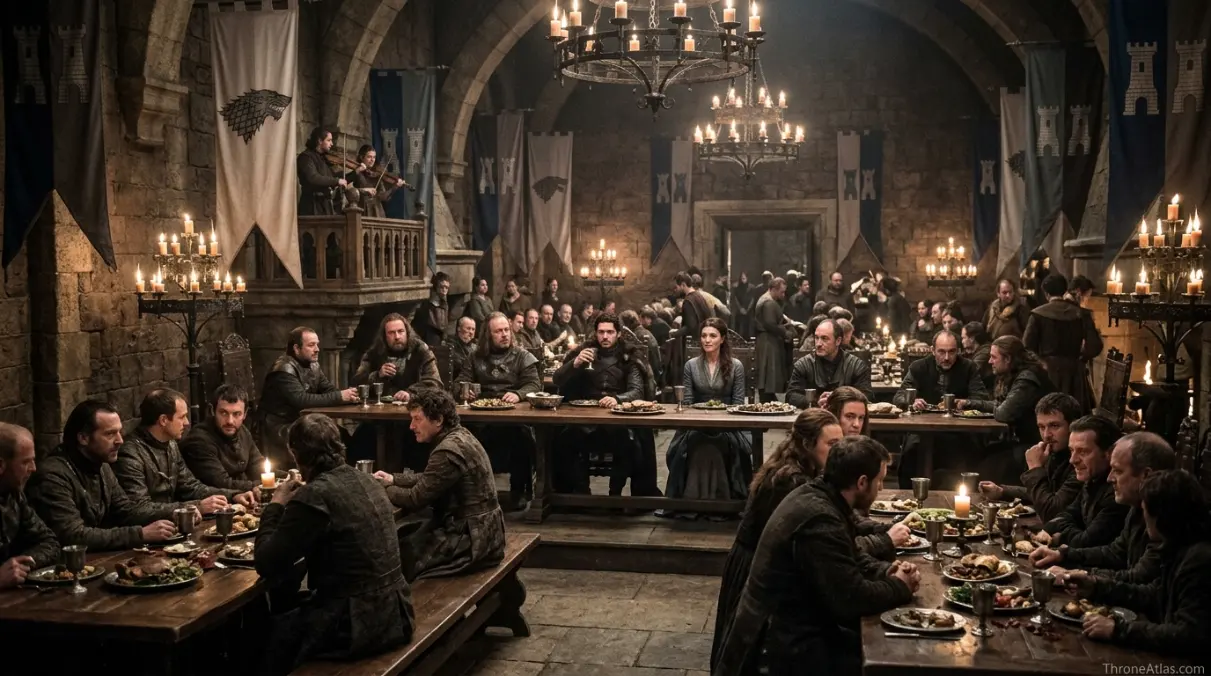
The Twins are the correct center of the Red Wedding map because the castle is a bridge before it is a home. Walder Frey’s power comes from controlling passage across the Green Fork, and that control lets him demand respect from greater houses who otherwise despise him. When Robb needs the crossing, the map gives the Freys bargaining power; when Robb needs reconciliation, the same map gives them the perfect trap.
A thin recap says Robb attends a wedding and is betrayed. A strong map reading explains why this specific place could host the betrayal. Stark forces have to enter Frey space, sleep in Frey rooms, eat at Frey tables and trust Frey doors. The geography is intimate, enclosed and controlled by the host. That is why guest right matters so much: the room is supposed to be safe precisely because the guest has surrendered practical safety.
For readers following the War of the Five Kings, this page should connect directly to Robb Stark’s campaign map, Catelyn Stark’s journey, House Frey, House Bolton, Riverrun and the Riverlands map. The Red Wedding is the point where route planning, alliance planning and family planning all fail at the same table.
Guest right and the horror of the hall
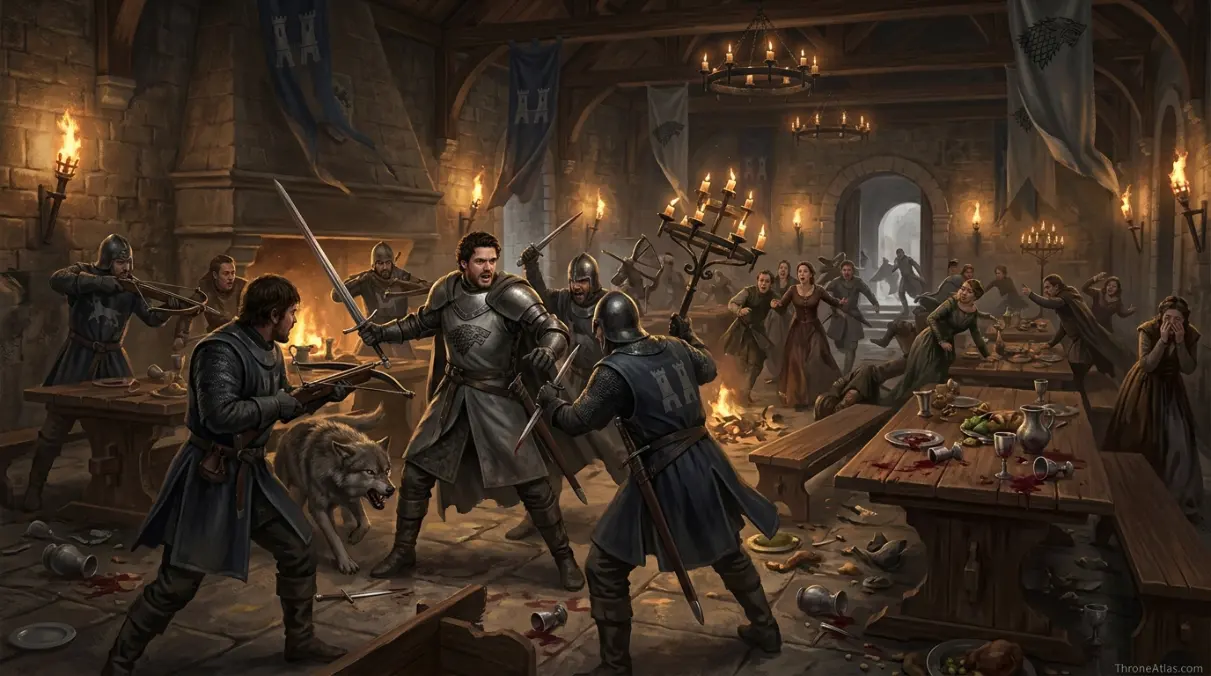
Guest right is the moral geography of the Red Wedding. The bread and salt ritual is meant to transform hostile space into protected space. The horror comes from the fact that the Starks are not simply defeated; they are killed after accepting the cultural rules that should have protected them.
The Great Hall should therefore be treated as a battlefield with invisible boundaries. There are doors, musicians, seating orders, hidden weapons, timing cues and separated allies. The violence feels sudden to the guests, but the map of the room has already been arranged against them. Every exit belongs to the host.
This is why the event continues to dominate fan memory. The Red Wedding is not a fair defeat and not a simple assassination. It is the destruction of an ancient promise inside a room designed for celebration. The map makes the moral violation visible.
Roose Bolton and northern regime change
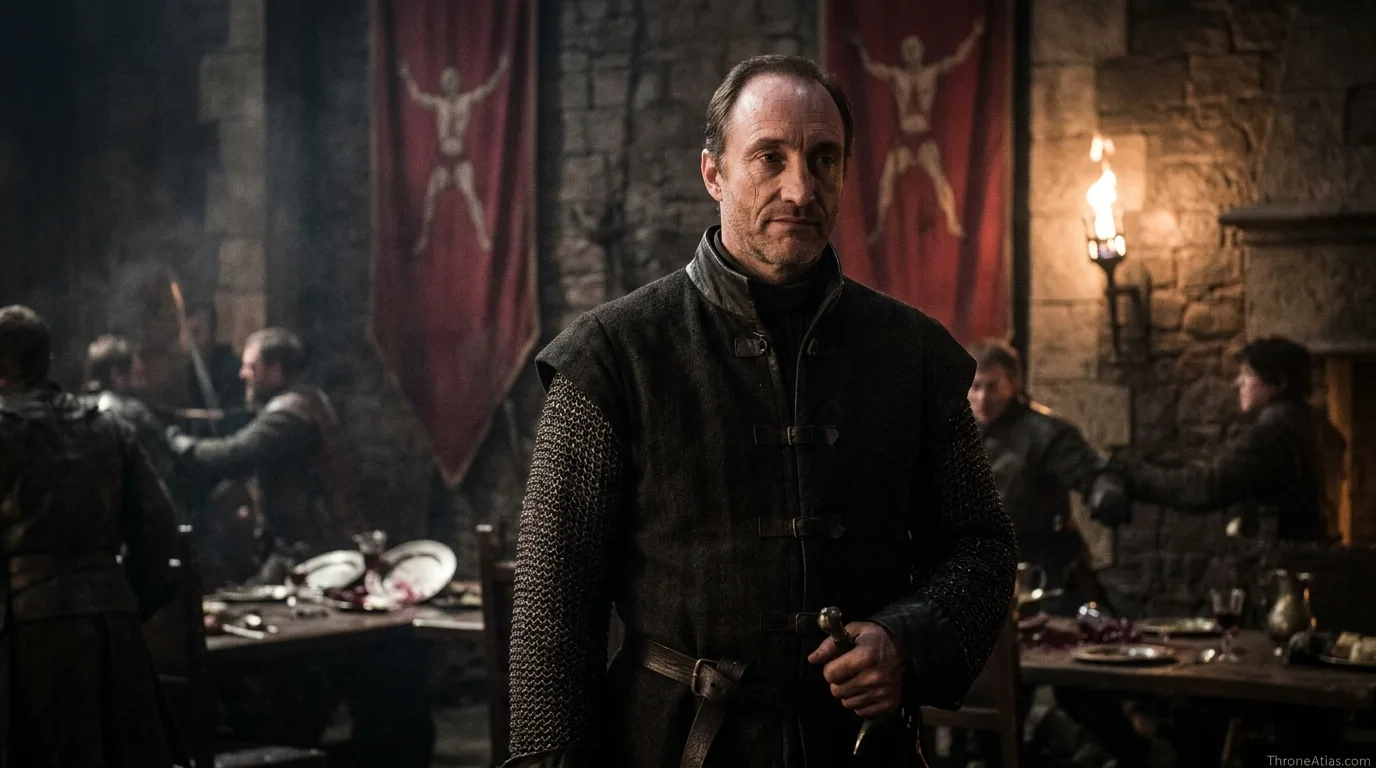
Roose Bolton’s part changes the event from a Frey revenge killing into a political transfer of the North. Without Bolton treason, the massacre is a regional betrayal. With Bolton inside the plot, the Red Wedding becomes a regime-change operation that removes Robb, weakens the Stark name and rewards the Boltons with northern authority.
This is a vital distinction for SEO content because searchers often ask who caused the Red Wedding. The answer is not one person. Walder Frey provides location and grievance. Tywin Lannister supplies strategic approval and reward. Roose Bolton gives the plot its northern replacement. The map lets all three powers meet safely inside a single controlled space.
The result is that the Riverlands stop being Robb’s campaign corridor and become the grave of his cause. Armies can win roads and castles, but if their political agreements fail, geography becomes deadly.
Why the Red Wedding belongs in a map atlas
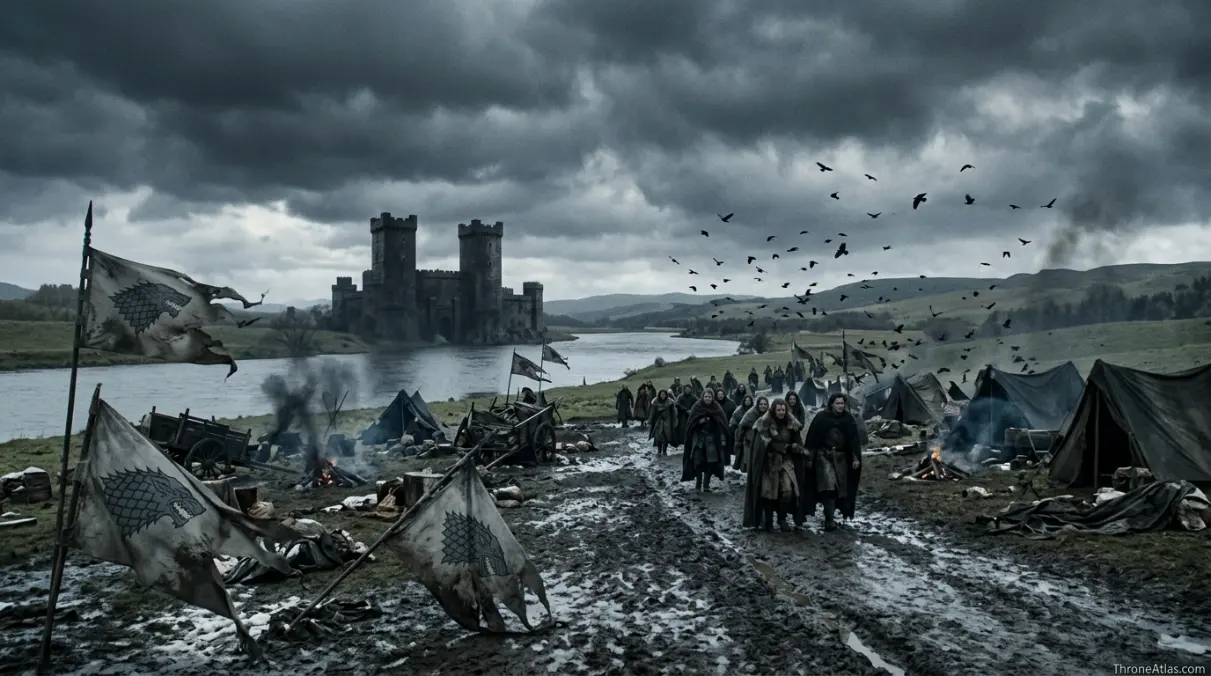
The Red Wedding is one of the strongest examples of why ThroneAtlas needs event maps, not just region maps. Viewers remember the room; the atlas explains the crossing, approach, camps, hall, escape routes and aftershock. Those layers turn an emotional scene into understandable geography.
A 10/10 version should answer where the Twins are, why the Freys mattered, how the bridge shaped the war, why Robb returned, how guest right was violated and what happened to northern power afterward. This page is built to satisfy those questions without flattening the shock of the scene.
The best internal links are Red Wedding, House Frey, House Bolton, Robb Stark Journey Map, Catelyn Stark Journey Map, Riverlands Map and War of the Five Kings Map.
Detailed map reading for Red Wedding Map
The quick route above gives the order, but the real value of this page is the cause-and-consequence logic between map points. A normal recap tells you what happened. A ThroneAtlas map explains why the location made that outcome possible, why the next route opened, and why some choices became almost impossible once characters entered the wrong room, road, crossing or battlefield.
For Red Wedding Map, each stop should be read as a pressure point. Roads control timing, castles control access, rivers control movement, halls control sightlines, islands control isolation, and sacred places control memory. That is why this page is structured as an atlas guide instead of a thin summary.
1. Green Fork Crossing — Strategic choke point
The bridge makes House Frey necessary to northern movement through the Riverlands. In map terms, this point belongs to Riverlands, but its function is larger than place-labeling. It changes leverage, visibility, safety or legitimacy. From here the reader naturally moves toward The Twins, carrying the previous consequence forward instead of treating the event as a disconnected scene.
2. The Twins — Frey power seat
Two towers and a bridge turn geography into toll, insult and leverage. In map terms, this point belongs to Riverlands, but its function is larger than place-labeling. It changes leverage, visibility, safety or legitimacy. From here the reader naturally moves toward Wedding Approach, carrying the previous consequence forward instead of treating the event as a disconnected scene.
3. Wedding Approach — False repair
Robb enters to heal a political wound, not to fight a battle. In map terms, this point belongs to Riverlands road, but its function is larger than place-labeling. It changes leverage, visibility, safety or legitimacy. From here the reader naturally moves toward Guest Quarters, carrying the previous consequence forward instead of treating the event as a disconnected scene.
4. Guest Quarters — Containment zone
Stark allies are separated, softened by hospitality and boxed inside hostile walls. In map terms, this point belongs to Frey castle, but its function is larger than place-labeling. It changes leverage, visibility, safety or legitimacy. From here the reader naturally moves toward Great Hall, carrying the previous consequence forward instead of treating the event as a disconnected scene.
5. Great Hall — Betrayal room
Music, seating and doors convert a feast into a coordinated ambush. In map terms, this point belongs to The Twins, but its function is larger than place-labeling. It changes leverage, visibility, safety or legitimacy. From here the reader naturally moves toward Catelyn’s Table, carrying the previous consequence forward instead of treating the event as a disconnected scene.
6. Catelyn’s Table — Recognition point
Catelyn reads the change before the room fully erupts, making the scene tragic and tactical. In map terms, this point belongs to The Twins, but its function is larger than place-labeling. It changes leverage, visibility, safety or legitimacy. From here the reader naturally moves toward Bolton Signal, carrying the previous consequence forward instead of treating the event as a disconnected scene.
7. Bolton Signal — Northern treason
Roose Bolton’s role turns the massacre from Frey revenge into northern regime change. In map terms, this point belongs to The Twins, but its function is larger than place-labeling. It changes leverage, visibility, safety or legitimacy. From here the reader naturally moves toward Riverlands Aftershock, carrying the previous consequence forward instead of treating the event as a disconnected scene.
8. Riverlands Aftershock — Campaign collapse
News travels outward and breaks the political map Robb built. In map terms, this point belongs to Riverlands / North, but its function is larger than place-labeling. It changes leverage, visibility, safety or legitimacy. From here the reader naturally moves toward Green Fork Crossing, carrying the previous consequence forward instead of treating the event as a disconnected scene.
Why this page is built for search intent
People searching for Red Wedding Map usually want a fast answer first: the main location, the correct order, the central turning point and the final consequence. After that, they want context that a short wiki paragraph cannot provide. This page supports both needs with a quick answer, fact cards, route schematic, location cards, deep explanations, table and FAQ.
The stronger SEO angle is topical completeness rather than repetition. The content uses natural entity coverage: region names, castles, houses, battles, characters, terrain and route logic. That helps the page work as a map hub and not just an isolated article.
How to use this Red Wedding Map on ThroneAtlas
Use this page as the orientation layer before opening the deeper location pages. Start with the quick answer to confirm the place, then use the route schematic to understand order, then scan the table if you only need the map role of each point. If you are building a full reading path, follow the related links into the houses, regional maps and battle or lore pages connected to this event.
The page is intentionally written for map-first readers. That means it avoids treating geography as decoration. Every location is included because it changes the balance of power, the available route, the safety of a character, the meaning of a battle, or the historical memory of Westeros. This is the difference between a normal recap and a useful atlas entry.
For best internal SEO, publish this page with a short URL, descriptive image alt text, one H1, and related links using exact but natural anchors such as “Red Wedding Map,” “Riverlands map,” “King’s Landing map,” “Dragonstone map,” “House Targaryen map,” or the specific battle/location phrase that matches the page topic.
Topical authority notes for Red Wedding Map
The page is also designed to answer the follow-up questions readers usually ask after the first map answer. They want to know how the event connects to nearby regions, which houses gain or lose power, which characters move because of the event, and which later routes are changed by the outcome. For Red Wedding Map, that means the map should not stop at Green Fork Crossing or Riverlands Aftershock. It should show how the consequence travels through surrounding castles, roads, rivers, courts, islands or sacred places.
This is especially important for ThroneAtlas because map pages work best as clusters. A reader who lands on this page should be able to continue naturally into a regional guide, a house guide, a battle guide, a character route or a lore explanation. That internal path increases usefulness for humans and gives search engines clearer entity relationships around Westeros geography.
The content also avoids the common thin-page mistake of repeating the title in every sentence. Instead, it uses supporting entities: the relevant kingdom, controlling house, nearby castle, route pressure, battlefield condition, political consequence and memory layer. These supporting terms make the page feel complete without sounding forced.
For final publication, keep the hero image near the top, retain the round compass card, and do not remove the boxed quick answer. That combination gives the page the same visual identity as the master Westeros page while still allowing each event or lore location to have its own voice. The design rhythm should feel familiar across the site, but the analysis should feel unique to the map.
If this page is being used for programmatic publishing, pair it with two to four exact internal links in the first half of the article and several broader atlas links near the end. The safest anchor style is descriptive rather than generic: “Red Wedding Map route,” “Green Fork Crossing location,” “Riverlands Aftershock consequence,” and the specific region or house name. That keeps the page helpful and prevents the internal link block from feeling pasted on.
Before publishing, compare the page against the surrounding cluster and make sure the opening answer, the first image alt text, the first two H2s, and the related-link anchors all reinforce the same search intent. That final pass is what makes the page feel handcrafted rather than generated in bulk. For Red Wedding Map, the reader should leave with a clear route, a clear consequence, and a clear next page to open.
Location order and story function
The table below condenses the event into a scanner-friendly format for readers who want quick orientation before moving into related maps.
| Location | Map role | Region / route | Story function |
|---|---|---|---|
| Green Fork Crossing | Strategic choke point | Riverlands | The bridge makes House Frey necessary to northern movement through the Riverlands. |
| The Twins | Frey power seat | Riverlands | Two towers and a bridge turn geography into toll, insult and leverage. |
| Wedding Approach | False repair | Riverlands road | Robb enters to heal a political wound, not to fight a battle. |
| Guest Quarters | Containment zone | Frey castle | Stark allies are separated, softened by hospitality and boxed inside hostile walls. |
| Great Hall | Betrayal room | The Twins | Music, seating and doors convert a feast into a coordinated ambush. |
| Catelyn’s Table | Recognition point | The Twins | Catelyn reads the change before the room fully erupts, making the scene tragic and tactical. |
| Bolton Signal | Northern treason | The Twins | Roose Bolton’s role turns the massacre from Frey revenge into northern regime change. |
| Riverlands Aftershock | Campaign collapse | Riverlands / North | News travels outward and breaks the political map Robb built. |
Red Wedding Map Questions
The Red Wedding takes place at the Twins, the bridge-castle of House Frey in the Riverlands.
The Twins control a major crossing over the Green Fork, giving House Frey strategic leverage over armies moving through the Riverlands.
House Frey hosts the trap, Roose Bolton participates in the murder, and Lannister power rewards the betrayal.
Guest right should protect guests under a host’s roof. Its violation makes the Red Wedding a moral and political crime, not just a military event.
Robb’s northern campaign collapses, House Bolton rises, and Stark power is shattered until later restoration.
Related maps, houses, battles and lore routes
ThroneAtlas is an independent fan-made atlas. Game of Thrones, House of the Dragon and related names belong to their respective rights holders. This page is for educational, lore-navigation and fan-reference purposes.