Aegon’s Conquest Map Dragonstone, Blackwater Bay, Field of Fire, Harrenhal & Seven Kingdoms Unification
The dragon-led campaign that forged the Iron Throne and redrew Westeros
Aegon’s Conquest is the founding route of the Iron Throne: an island base, three dragons, broken kingdoms, burned castles, negotiated submission and the one region that refuses complete conquest.
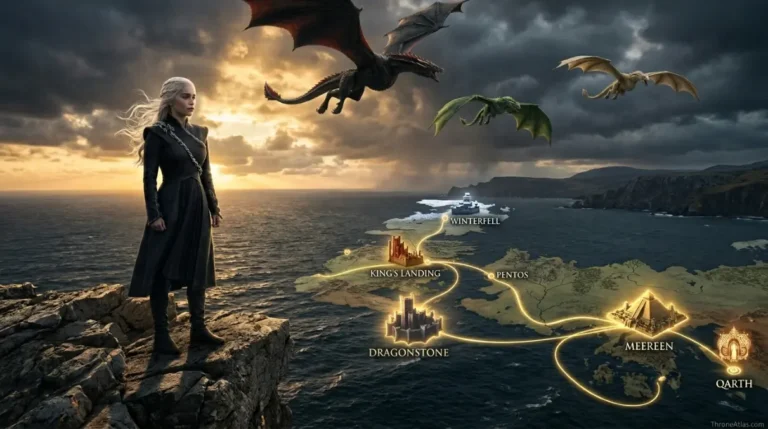
Aegon’s Conquest map begins at Dragonstone, moves to the Blackwater landing and early Crownlands control, then expands through Harrenhal, the Field of Fire, Storm’s End, Oldtown and the attempted conquest of Dorne. Aegon I Targaryen, with Visenya, Rhaenys, Balerion, Vhagar and Meraxes, uses dragons to unify most of Westeros under the Iron Throne. Dorne remains the major exception, proving that geography and resistance can defeat even dragon power over time.
What this Aegon’s Conquest Map explains
The cards below give the fast orientation before the deeper route, table and FAQ sections.
Main points on the Aegon’s Conquest Map
This simplified graphic is designed for reading flow, not exact geographic scale. Use it to understand order, pressure and consequence.
Aegon launches from the island fortress that preserves Valyrian dragon power.
The landing creates the political center that becomes King’s Landing.
Balerion burns the largest castle and changes every lord’s risk calculation.
Three dragons destroy combined armies and prove old battlefield rules have changed.
The Stormlands fall through conquest and alliance restructuring.
Oldtown’s response shows that not every victory requires burning.
Swords of defeated enemies become the physical symbol of unity.
Dorne’s terrain and tactics resist the conquest more effectively than castles.
Complete Aegon’s Conquest Map Guide
A thin map page only lists names. A strong ThroneAtlas page explains how places create pressure, change decisions and connect to the wider atlas. This guide is built to help readers follow the route, understand the stakes at each stop, and continue into connected maps without losing context.
Dragonstone as conquest engine
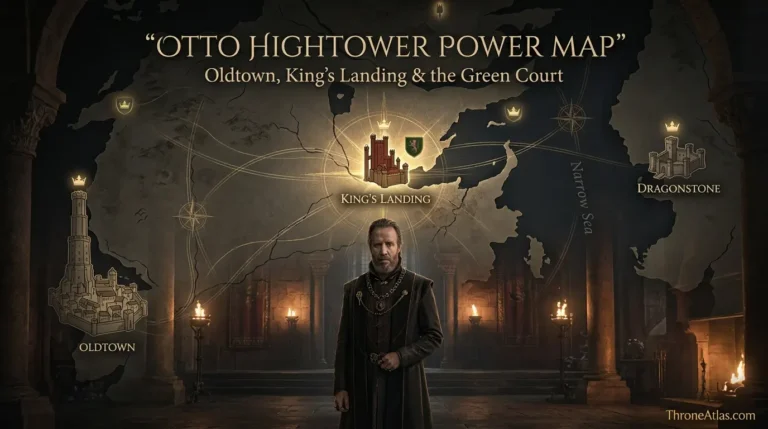
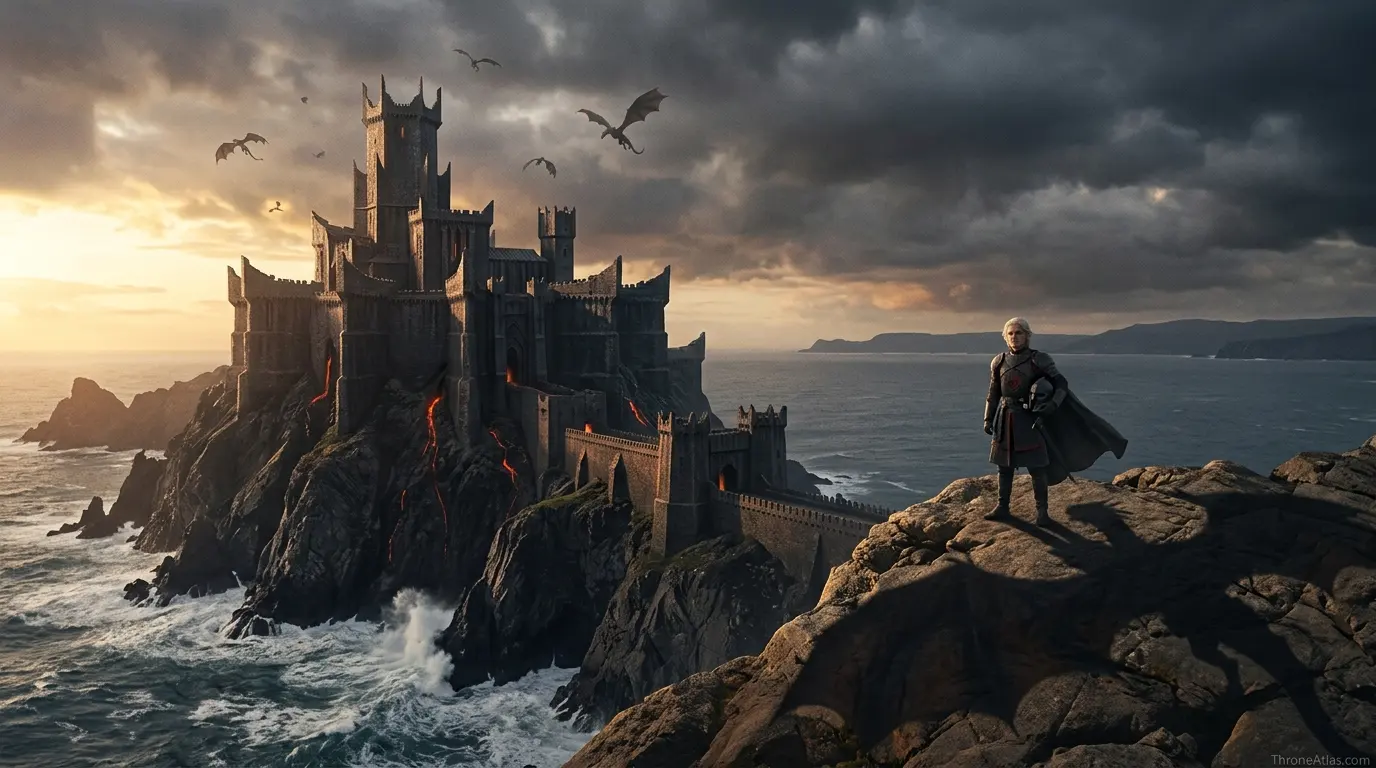
Aegon’s Conquest begins at Dragonstone because Dragonstone preserves what the rest of Westeros does not have: living dragon power tied to a disciplined ruling family. The island is not large, but it is defensible, symbolic and close enough to Blackwater Bay to launch a new political center.
The map lesson is that size is not the same as power. Dragonstone is small beside the Seven Kingdoms, but Balerion, Vhagar and Meraxes transform distance, siege logic and battlefield confidence. Aegon can make kings respond because he brings weapons that redraw the assumptions of war.
For ThroneAtlas, Dragonstone should link into House Targaryen, Blackwater Bay, King’s Landing and Dance of the Dragons pages.
Harrenhal and the end of castle certainty
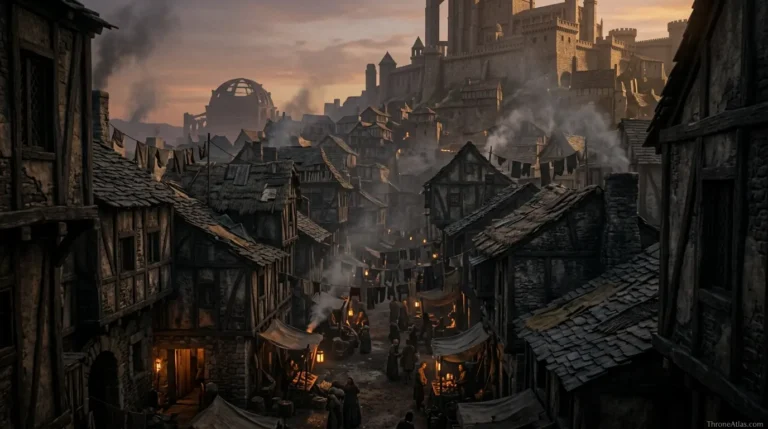
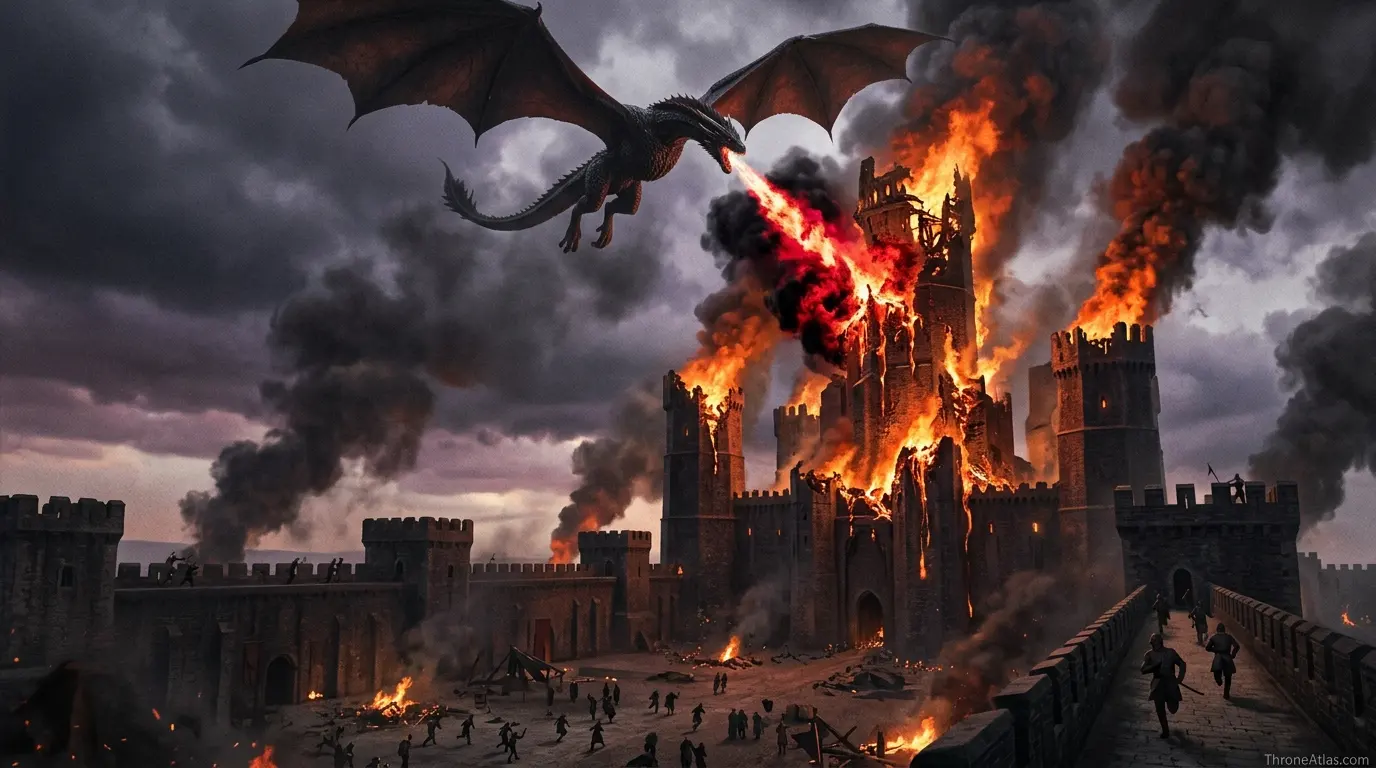
Harrenhal is the perfect map point for explaining dragon warfare. It is the largest castle, built to make ordinary siege logic irrelevant. Aegon’s use of Balerion reverses that assumption in one terrible event. If Harrenhal can burn, every lord has to rethink resistance.
This makes Harrenhal not just a location but a warning sent across the continent. The castle becomes a message written in melted stone. Its fall changes politics before Aegon reaches many places physically, because fear travels faster than armies.
A 10/10 conquest map should treat Harrenhal as both battle event and propaganda geography.
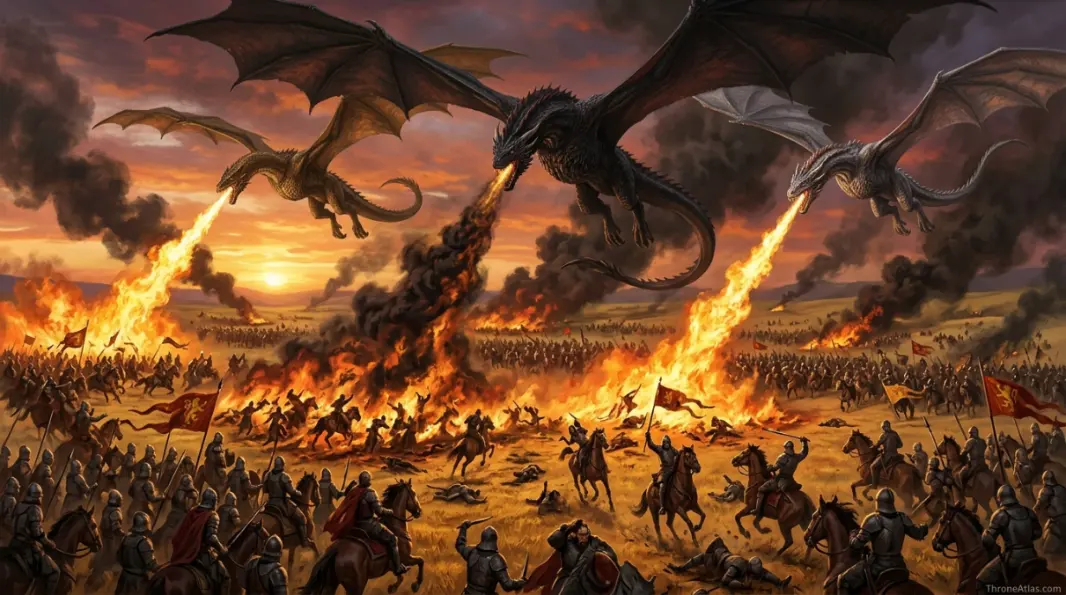
Field of Fire and open-field collapse
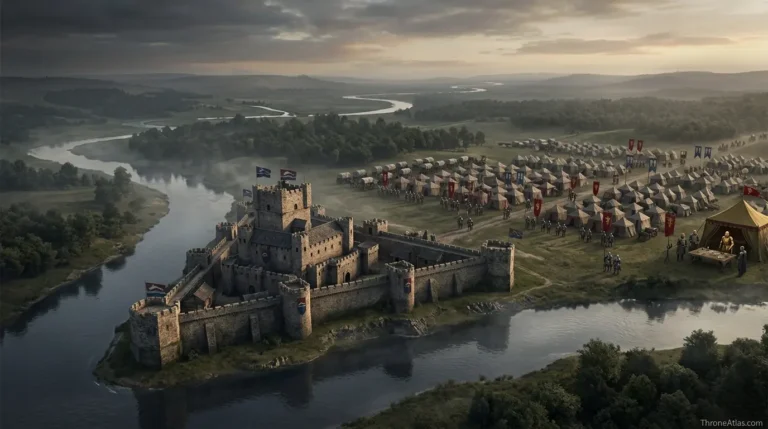
The Field of Fire proves that massed armies do not solve the dragon problem. The Reach and Westerlands can assemble large forces, but numbers on open ground become vulnerable when air power, flame and terror act together.
The battle changes the military map because it shows that old regional strengths have limits. Fertile lands, knightly hosts and great houses can still be destroyed if they fight dragons on terms that dragons favor.
This section should internally link to House Lannister, House Gardener/Tyrell history, The Reach Map and Westerlands content when available.
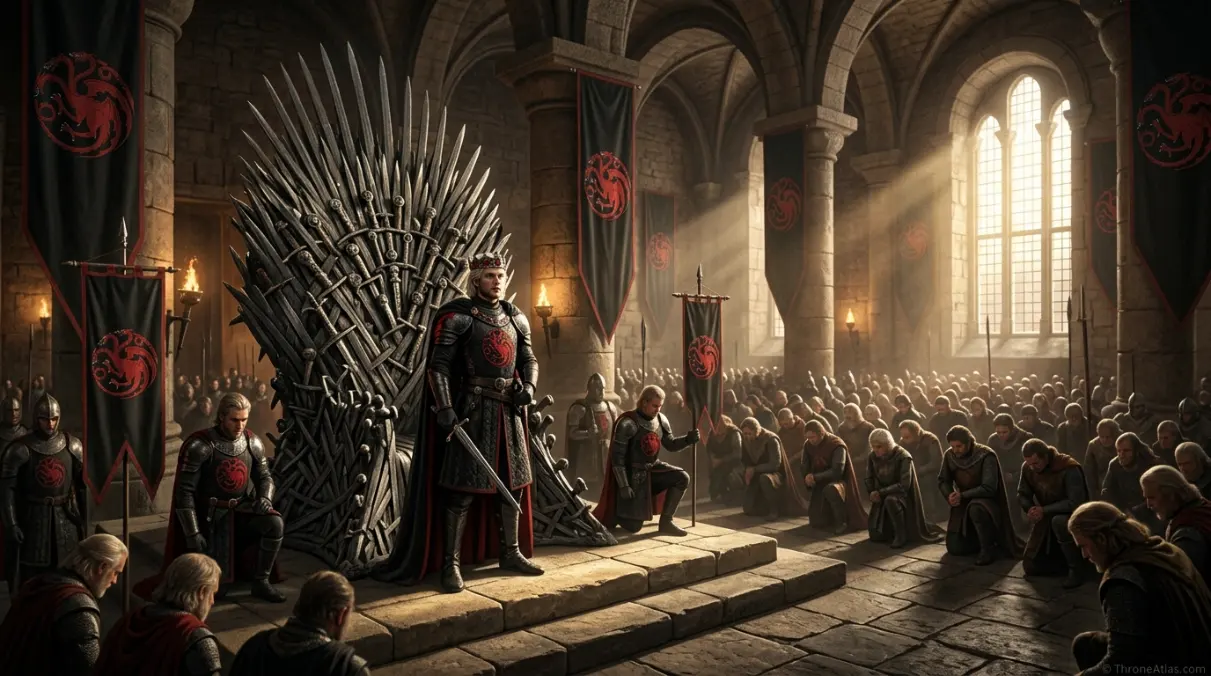
Dorne and the limit of conquest
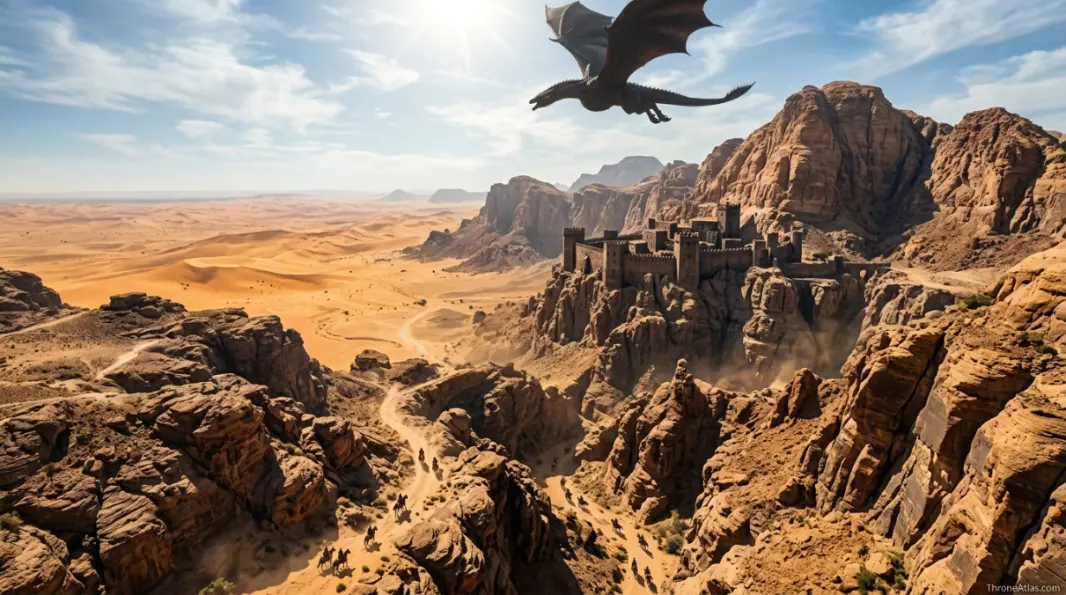
Dorne is the essential final point because it prevents the page from reading like inevitable Targaryen victory. Dornish resistance uses desert distance, dispersed targets and refusal to offer one clean battlefield. Dragons can burn castles, but they cannot force a whole landscape to become a single target.
That is the deepest map lesson of Aegon’s Conquest. Geography can magnify power, but it can also absorb power. Dorne’s survival shows that terrain, tactics and political will can frustrate even the most terrifying weapon in Westeros.
A complete page should therefore end with unity and exception together: the Iron Throne is forged, but the map is not fully conquered.
Detailed map reading for Aegon’s Conquest Map
The quick route above gives the order, but the real value of this page is the cause-and-consequence logic between map points. A normal recap tells you what happened. A ThroneAtlas map explains why the location made that outcome possible, why the next route opened, and why some choices became almost impossible once characters entered the wrong room, road, crossing or battlefield.
For Aegon’s Conquest Map, each stop should be read as a pressure point. Roads control timing, castles control access, rivers control movement, halls control sightlines, islands control isolation, and sacred places control memory. That is why this page is structured as an atlas guide instead of a thin summary.
1. Dragonstone — Targaryen base
Aegon launches from the island fortress that preserves Valyrian dragon power. In map terms, this point belongs to Narrow Sea, but its function is larger than place-labeling. It changes leverage, visibility, safety or legitimacy. From here the reader naturally moves toward Blackwater Landing, carrying the previous consequence forward instead of treating the event as a disconnected scene.
2. Blackwater Landing — Capital seed
The landing creates the political center that becomes King’s Landing. In map terms, this point belongs to Crownlands, but its function is larger than place-labeling. It changes leverage, visibility, safety or legitimacy. From here the reader naturally moves toward Harrenhal, carrying the previous consequence forward instead of treating the event as a disconnected scene.
3. Harrenhal — Dragon terror
Balerion burns the largest castle and changes every lord’s risk calculation. In map terms, this point belongs to Riverlands, but its function is larger than place-labeling. It changes leverage, visibility, safety or legitimacy. From here the reader naturally moves toward Field of Fire, carrying the previous consequence forward instead of treating the event as a disconnected scene.
4. Field of Fire — Open-field proof
Three dragons destroy combined armies and prove old battlefield rules have changed. In map terms, this point belongs to Reach / Westerlands, but its function is larger than place-labeling. It changes leverage, visibility, safety or legitimacy. From here the reader naturally moves toward Storm’s End, carrying the previous consequence forward instead of treating the event as a disconnected scene.
5. Storm’s End — Submission route
The Stormlands fall through conquest and alliance restructuring. In map terms, this point belongs to Stormlands, but its function is larger than place-labeling. It changes leverage, visibility, safety or legitimacy. From here the reader naturally moves toward Oldtown, carrying the previous consequence forward instead of treating the event as a disconnected scene.
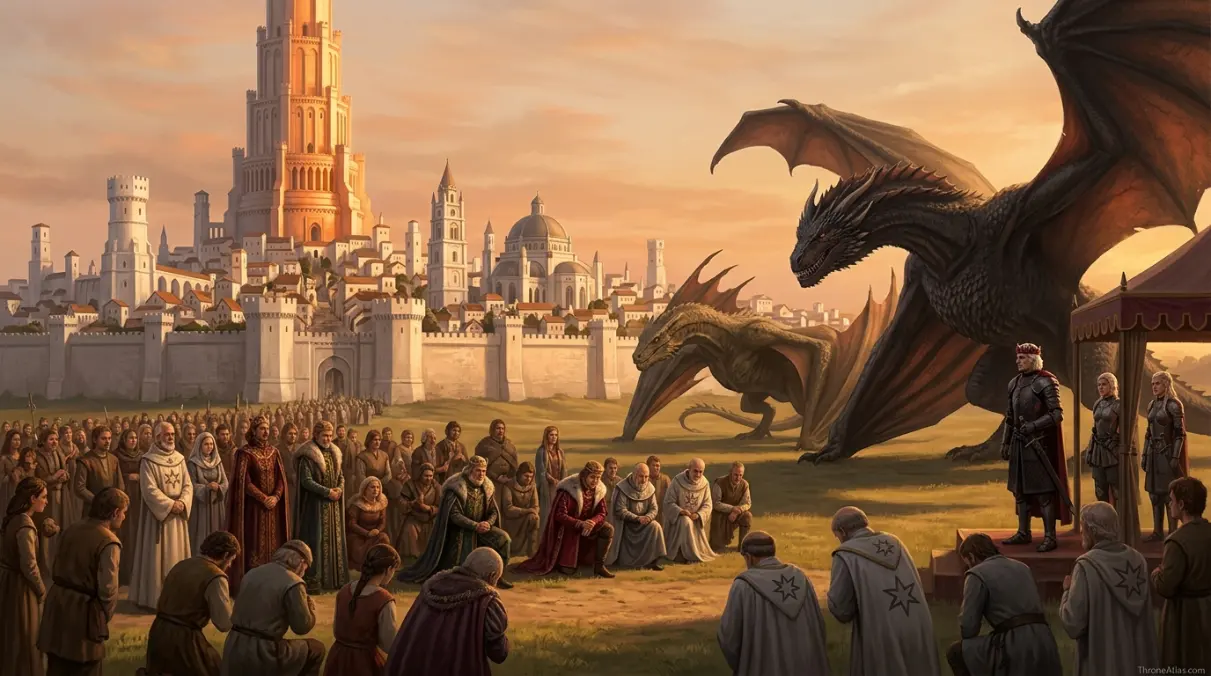
6. Oldtown — Faith and city politics
Oldtown’s response shows that not every victory requires burning. In map terms, this point belongs to Reach, but its function is larger than place-labeling. It changes leverage, visibility, safety or legitimacy. From here the reader naturally moves toward Iron Throne, carrying the previous consequence forward instead of treating the event as a disconnected scene.
7. Iron Throne — Political symbol
Swords of defeated enemies become the physical symbol of unity. In map terms, this point belongs to King’s Landing, but its function is larger than place-labeling. It changes leverage, visibility, safety or legitimacy. From here the reader naturally moves toward Dorne, carrying the previous consequence forward instead of treating the event as a disconnected scene.
8. Dorne — Resistant frontier
Dorne’s terrain and tactics resist the conquest more effectively than castles. In map terms, this point belongs to South, but its function is larger than place-labeling. It changes leverage, visibility, safety or legitimacy. From here the reader naturally moves toward Dragonstone, carrying the previous consequence forward instead of treating the event as a disconnected scene.
Why this page is built for search intent
People searching for Aegon’s Conquest Map usually want a fast answer first: the main location, the correct order, the central turning point and the final consequence. After that, they want context that a short wiki paragraph cannot provide. This page supports both needs with a quick answer, fact cards, route schematic, location cards, deep explanations, table and FAQ.
The stronger SEO angle is topical completeness rather than repetition. The content uses natural entity coverage: region names, castles, houses, battles, characters, terrain and route logic. That helps the page work as a map hub and not just an isolated article.
How to use this Aegon’s Conquest Map on ThroneAtlas
Use this page as the orientation layer before opening the deeper location pages. Start with the quick answer to confirm the place, then use the route schematic to understand order, then scan the table if you only need the map role of each point. If you are building a full reading path, follow the related links into the houses, regional maps and battle or lore pages connected to this event.
The page is intentionally written for map-first readers. That means it avoids treating geography as decoration. Every location is included because it changes the balance of power, the available route, the safety of a character, the meaning of a battle, or the historical memory of Westeros. This is the difference between a normal recap and a useful atlas entry.
For best internal SEO, publish this page with a short URL, descriptive image alt text, one H1, and related links using exact but natural anchors such as “Aegon’s Conquest Map,” “Riverlands map,” “King’s Landing map,” “Dragonstone map,” “House Targaryen map,” or the specific battle/location phrase that matches the page topic.
Topical authority notes for Aegon’s Conquest Map
The page is also designed to answer the follow-up questions readers usually ask after the first map answer. They want to know how the event connects to nearby regions, which houses gain or lose power, which characters move because of the event, and which later routes are changed by the outcome. For Aegon’s Conquest Map, that means the map should not stop at Dragonstone or Dorne. It should show how the consequence travels through surrounding castles, roads, rivers, courts, islands or sacred places.
This is especially important for ThroneAtlas because map pages work best as clusters. A reader who lands on this page should be able to continue naturally into a regional guide, a house guide, a battle guide, a character route or a lore explanation. That internal path increases usefulness for humans and gives search engines clearer entity relationships around Westeros geography.
The content also avoids the common thin-page mistake of repeating the title in every sentence. Instead, it uses supporting entities: the relevant kingdom, controlling house, nearby castle, route pressure, battlefield condition, political consequence and memory layer. These supporting terms make the page feel complete without sounding forced.
For final publication, keep the hero image near the top, retain the round compass card, and do not remove the boxed quick answer. That combination gives the page the same visual identity as the master Westeros page while still allowing each event or lore location to have its own voice. The design rhythm should feel familiar across the site, but the analysis should feel unique to the map.
If this page is being used for programmatic publishing, pair it with two to four exact internal links in the first half of the article and several broader atlas links near the end. The safest anchor style is descriptive rather than generic: “Aegon’s Conquest Map route,” “Dragonstone location,” “Dorne consequence,” and the specific region or house name. That keeps the page helpful and prevents the internal link block from feeling pasted on.
Before publishing, compare the page against the surrounding cluster and make sure the opening answer, the first image alt text, the first two H2s, and the related-link anchors all reinforce the same search intent. That final pass is what makes the page feel handcrafted rather than generated in bulk. For Aegon’s Conquest Map, the reader should leave with a clear route, a clear consequence, and a clear next page to open.
Location order and story function
The table below condenses the event into a scanner-friendly format for readers who want quick orientation before moving into related maps.
| Location | Map role | Region / route | Story function |
|---|---|---|---|
| Dragonstone | Targaryen base | Narrow Sea | Aegon launches from the island fortress that preserves Valyrian dragon power. |
| Blackwater Landing | Capital seed | Crownlands | The landing creates the political center that becomes King’s Landing. |
| Harrenhal | Dragon terror | Riverlands | Balerion burns the largest castle and changes every lord’s risk calculation. |
| Field of Fire | Open-field proof | Reach / Westerlands | Three dragons destroy combined armies and prove old battlefield rules have changed. |
| Storm’s End | Submission route | Stormlands | The Stormlands fall through conquest and alliance restructuring. |
| Oldtown | Faith and city politics | Reach | Oldtown’s response shows that not every victory requires burning. |
| Iron Throne | Political symbol | King’s Landing | Swords of defeated enemies become the physical symbol of unity. |
| Dorne | Resistant frontier | South | Dorne’s terrain and tactics resist the conquest more effectively than castles. |
Aegon’s Conquest Map Questions
It begins at Dragonstone, the Targaryen island fortress in the Narrow Sea.
Balerion, Vhagar and Meraxes are the central dragons.
Harrenhal proves that even the largest castle can fall to dragonfire.
It is the open-field battle where dragon power devastates combined armies from the Reach and Westerlands.
No. Dorne remains the major exception to Aegon’s conquest.
Related maps, houses, battles and lore routes
ThroneAtlas is an independent fan-made atlas. Game of Thrones, House of the Dragon and related names belong to their respective rights holders. This page is for educational, lore-navigation and fan-reference purposes.