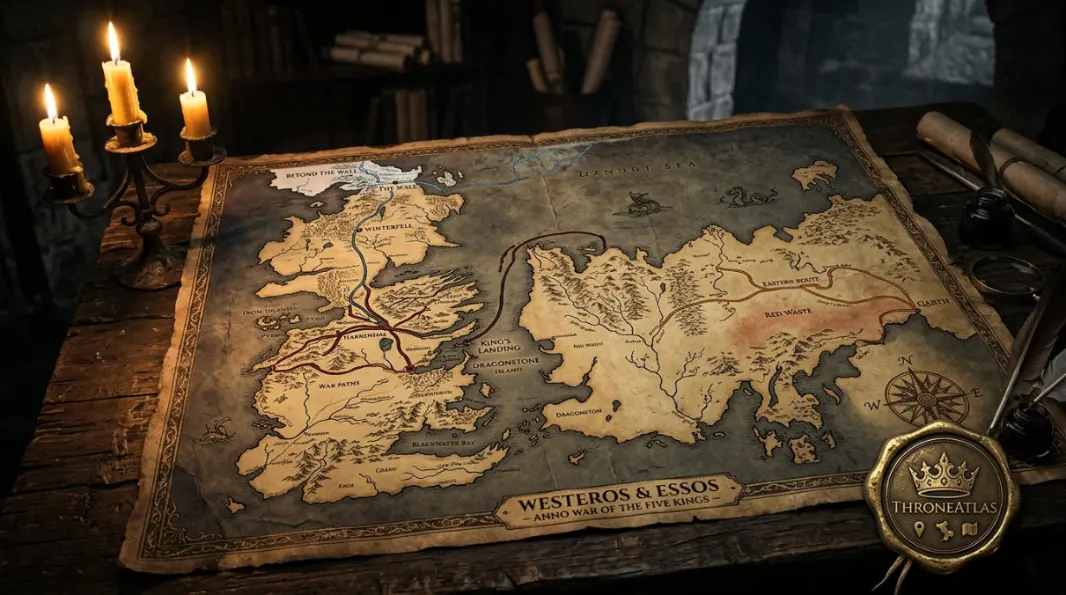
Map of Game of Thrones Season 2 Westeros, Essos, War Routes & Key Locations
King’s Landing · Dragonstone · Harrenhal · Winterfell · Pyke · Qarth · Blackwater Bay
Season 2 is where the map stops being one story and becomes six at once. Stannis sails from Dragonstone toward a throne he’s certain belongs to him. Robb wins battles in the Riverlands while Winterfell goes unguarded. Theon returns to Pyke — and then makes a decision the map never forgets. Arya learns what war looks like from the inside of Harrenhal. Jon crosses beyond the Wall into something the rest of Westeros hasn’t noticed yet. And Daenerys reaches Qarth, thousands of miles from the Iron Throne, still figuring out what she’ll do when she finally gets close.
The map of Game of Thrones Season 2 covers the early War of the Five Kings across Westeros while Daenerys travels deeper into Essos. The 10 key Season 2 locations are King’s Landing, Dragonstone, Harrenhal, Winterfell, Pyke, the Riverlands, Storm’s End, Beyond the Wall, Qarth, and Blackwater Bay. Six major character routes — Stannis, Robb, Theon, Arya, Jon, and Daenerys — define the season’s geography.
The Realm Splits Into Six War Fronts
Season 2 matters because the story stops moving in one direction. Every major arc now occupies a different region of the map — simultaneously and with no single winner.
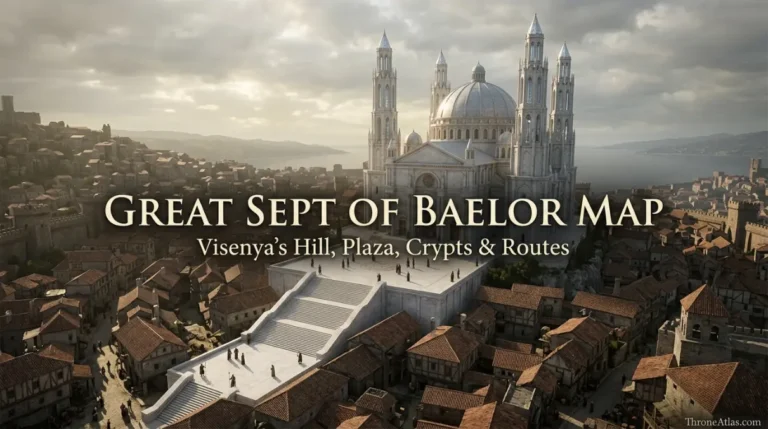
The capital becomes the target of Stannis’s naval campaign and Tyrion’s most desperate defense.
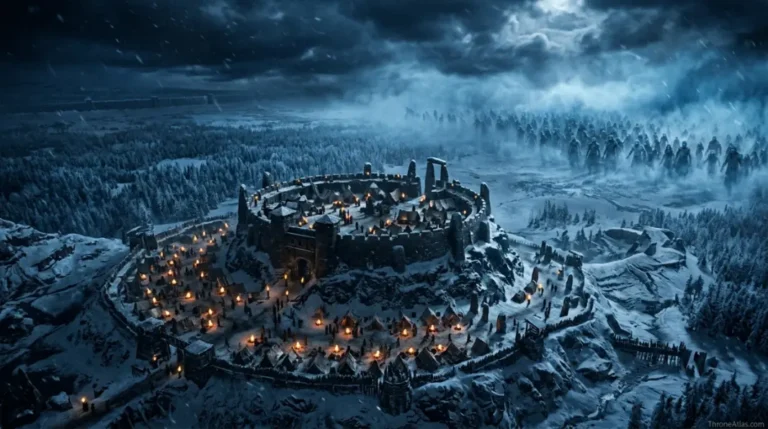
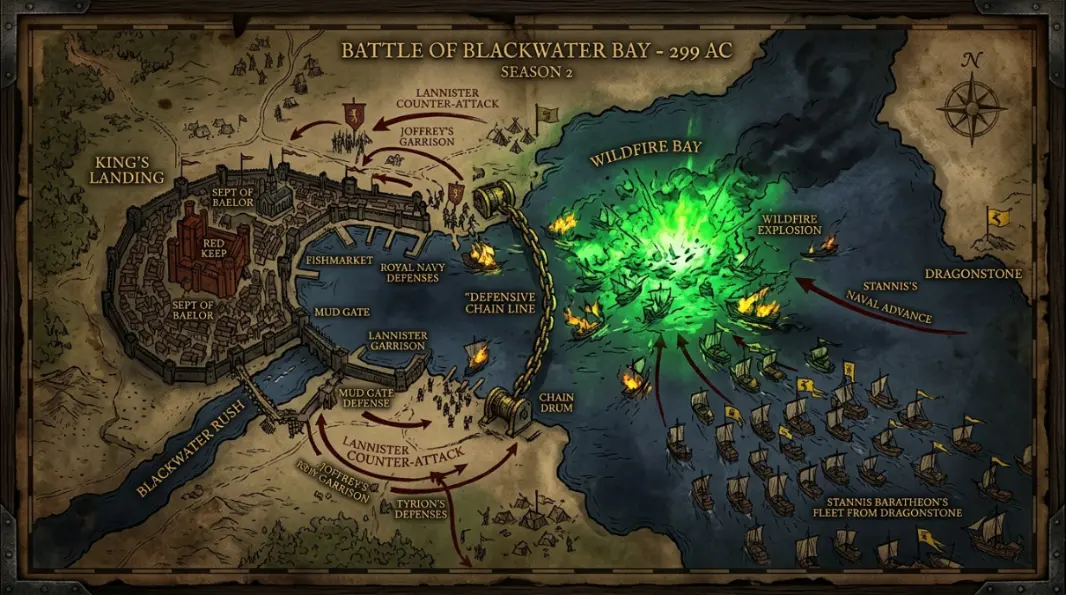
The season’s climax — wildfire, chains, and Tywin Lannister arriving at the last moment.
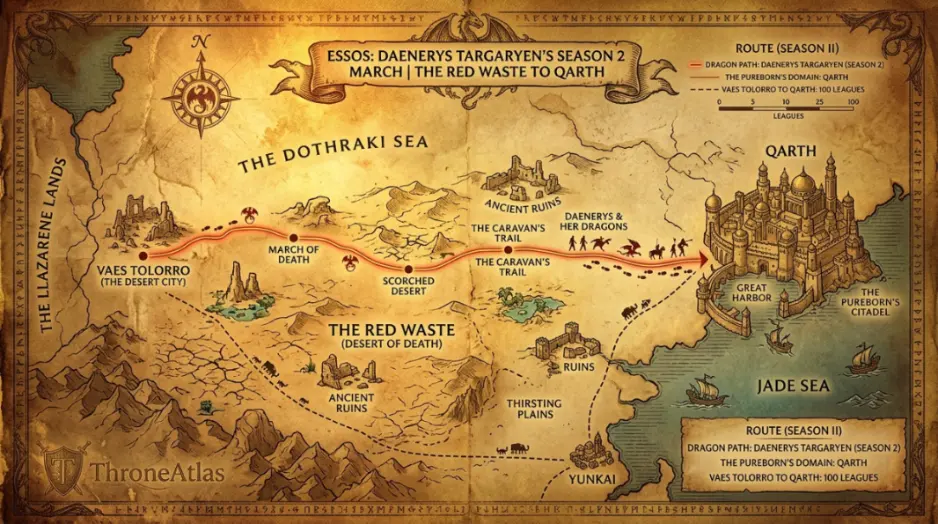
Daenerys’s Season 2 route moves far east, 3,000 miles from the Iron Throne, in survival mode.
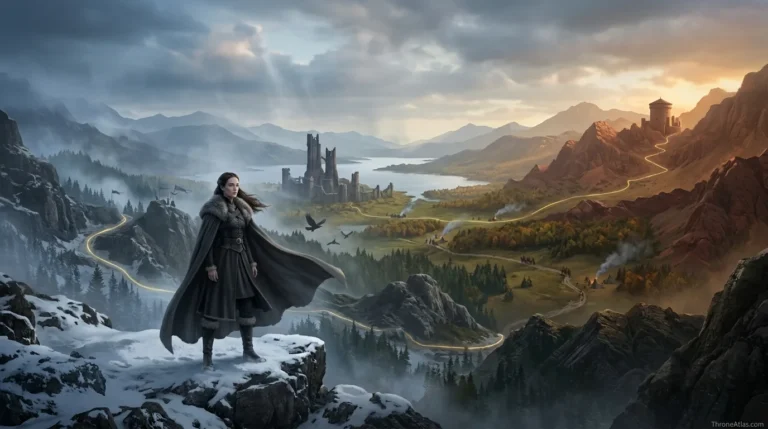
Theon seizes the Stark stronghold while Robb’s army fights 300 miles south in the Riverlands.
Why the Game of Thrones Season 2 Map Matters
The Game of Thrones Season 2 map is the moment the story’s geography becomes impossible to ignore. Season 1 moves characters toward a single political collapse — the execution of Ned Stark at King’s Landing. Season 2 shows what happens after that collapse radiates outward and breaks the realm into pieces. The Iron Throne is no longer a stable center of power. It becomes a magnet, pulling armies, fleets, alliances, and betrayals toward King’s Landing from six different directions.
Here’s the structural shift worth understanding: Season 1 had a spine. Season 2 has a fractured board. Joffrey Baratheon sits in King’s Landing, but Stannis Baratheon claims the throne is rightfully his and launches from Dragonstone. Renly Baratheon gathers strength in the south before Stannis eliminates him. Robb Stark fights brilliantly in the Riverlands while the North quietly unravels behind him. Balon Greyjoy reopens the Iron Islands front. Jon Snow crosses beyond the Wall into a region where politics feel irrelevant. And Daenerys Targaryen reaches Qarth in Essos — thousands of miles from Westeros, but learning exactly what kind of ruler she intends to become.
That is why a proper Season 2 map of Game of Thrones can’t be drawn as a single route. It has to be drawn as a fractured board with six active fronts. Every claimant sees the Iron Throne from a different angle. Every route reveals a vulnerability somewhere else. Every castle that seems secure depends on distance, loyalty, and who isn’t home.
Season 2 Is the First Truly Multi-Route Season
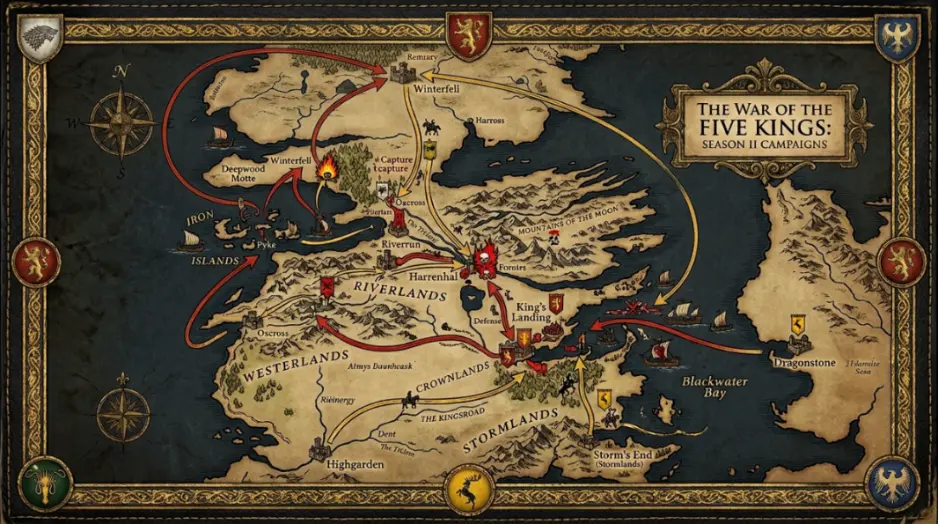
The most important cartographic difference between Season 1 and Season 2 is route complexity. In Season 1, major movement still follows a clear spine: Winterfell to King’s Landing for the Starks, the Wall and North for Jon, and the early Dothraki east for Daenerys. Season 2 multiplies that structure by six. Characters aren’t moving toward one crisis. They’re navigating several crises at once — and most of them don’t know what the others are doing.
Stannis moves by sea, which makes his route faster and more direct than any land march. Arya moves through captivity and disguise, her route determined by who captured her rather than by any plan. Theon moves through identity crisis as much as geography — from Robb’s camp to Pyke, then from Pyke toward Winterfell, carrying a decision that costs him everything. Jon moves into a region that most southern rulers haven’t thought about seriously in generations. Daenerys moves through survival, prophecy, and the dangerous hospitality of Qarth. Tyrion stays in King’s Landing, but his map is defensive: walls, gates, harbor chains, wildfire caches, and political pressure that could collapse at any moment.
For readers using ThroneAtlas, this makes Season 2 one of the richest seasonal map pages because it naturally connects to individual location guides. A reader who arrives at the Season 2 map can move into King’s Landing, Dragonstone, Harrenhal, Winterfell, Pyke, Qarth, the Battle of Blackwater, or any of the six major character journey maps — and each one adds real geographic depth to what they just read.
Main Locations on the Game of Thrones Season 2 Map
These are the 10 places a Season 2 map must show clearly — each one controls a major arc, and each one fails, falls, or shifts during the season.
King’s Landing
King’s Landing is the central prize of Season 2 and the most contested point on the map. Joffrey sits the Iron Throne. Tyrion Lannister, serving as Hand of the King, prepares the city’s walls, harbor chains, and wildfire supply against Stannis’s fleet. Cersei fears the city will fall. Stannis sails toward it. The capital pulls every major political decision in Season 2 toward its gates.
Dragonstone
Dragonstone is Stannis Baratheon’s island fortress and his launch point for the entire season. It sits east of King’s Landing across Blackwater Bay — close enough for a naval strike, far enough to require planning. Dragonstone also introduces Melisandre and the Lord of Light religion, which reshapes Stannis’s decision-making in ways the map alone doesn’t fully explain.
Harrenhal
Harrenhal is the largest castle in Westeros — built by Harren the Black before Aegon Targaryen’s dragons melted its towers in the Conquest. In Season 2, it becomes Arya Stark’s captivity location and a symbol of what happens when enormous power goes to ruin. The castle changes hands multiple times during the war, making it a key Riverlands pressure point connected to Lannister military control.
Winterfell
Winterfell changes completely in Season 2 — not because an army marches on it, but because Robb Stark is gone and Theon Greyjoy is there. Theon captures Winterfell with only a small Ironborn force, which tells you how exposed the Stark home is when its lord fights 300 miles south. That strategic gap is one of Season 2’s most important geographic lessons.
Pyke
Pyke is the seat of House Greyjoy on the Iron Islands, and it brings the Ironborn back into the political map for the first time since Robert’s Rebellion. Theon returns to his father Balon’s world expecting respect and finds contempt instead — which drives the Winterfell decision. On a Season 2 map, Pyke to Winterfell should be marked as one of the season’s most consequential route lines.
Qarth
Qarth is Daenerys Targaryen’s primary Season 2 location in Essos. It sits far east of Westeros — beyond the Red Waste, reached after her khalasar crosses harsh, waterless terrain. Qarth is the wealthiest city Daenerys has seen, which makes it both a lifeline and a trap. Her Season 2 arc in Qarth centers on survival, dragon theft, the Warlocks of Qarth, and the temptation of powerful strangers who offer help with strings attached.
Season 2 War Routes Explained
Stannis Baratheon: Dragonstone to Blackwater Bay
Stannis has the cleanest military route in Season 2. His map line starts at Dragonstone, crosses Blackwater Bay by fleet, and ends at the walls of King’s Landing. It looks simple. Strategically, it’s enormous — if Stannis wins, the throne changes hands and the entire political map resets overnight.
The Battle of Blackwater depends entirely on geography: the harbor approach, the narrowing of the bay, the reach of the city walls, and Tyrion’s wildfire trap. Stannis isn’t marching across half the continent. He’s trying to take the capital through its most exposed side — the water — and Tyrion understands that’s exactly what he’ll do. That shared geographic logic is why the battle plays out the way it does.
Robb Stark: Winning Battles, Losing the North
Robb’s Season 2 route sits mostly in the Riverlands and the western war theater. He wins, repeatedly and convincingly — which is the problem. His map problem isn’t military. It’s geographic. Every victory he achieves pulls him further from Winterfell, and every mile of distance is a mile Theon Greyjoy can exploit. The Season 2 map shows a brilliant commander succeeding everywhere except where it will matter most.
This is one of the season’s most important strategic lessons: battlefield success doesn’t guarantee territorial security. Robb controls the field. He doesn’t control home.
Theon Greyjoy: Pyke to Winterfell
Theon’s route is the shortest in Season 2 by miles and the most devastating by consequence. He moves from Robb’s camp back to Pyke, then from Pyke toward Winterfell. On the map, that’s a relatively modest journey. As a story, it’s a complete collapse of identity, loyalty, and judgment happening in sequence.
Pyke to Winterfell should be drawn as what it actually is: a betrayal line. It transforms the Stark home from a safe northern anchor into a seized castle — and it does so with a small Ironborn force that reveals just how undefended Winterfell was the moment Robb marched south.
Arya Stark: Through the Riverlands and Harrenhal
Arya’s Season 2 route is not a royal route. It’s a survival route — determined by capture, disguise, forced labor, and observation. She moves through the Riverlands in chains and then through Harrenhal as a servant, watching lords and killers from a position of total powerlessness.
Harrenhal is where Arya’s perspective becomes strategically interesting. While kings and claimants fight over the Iron Throne, she sees what the war actually does to the people inside it. That ground-level view of the conflict — the bodies, the cruelty, the bureaucracy of violence — is something no war map typically shows.
Jon Snow: Beyond the Wall
Jon’s route moves away from the political map and into the unknown north. Beyond the Wall sits outside the jurisdiction of the War of the Five Kings — which is precisely the point. Whereas Stannis and Robb fight over who should rule Westeros, Jon encounters the wildling armies of Mance Rayder and begins to understand that a threat exists north of the Wall that makes the southern war feel like a distraction.
That contrast is essential to reading the Season 2 map correctly. The show is not just asking who should rule Westeros. It’s also asking whether Westeros has noticed what’s coming from the north — and Season 2 makes clear that the answer, so far, is no.
Daenerys Targaryen: The Eastern Route to Qarth
Daenerys’s Season 2 route stays far from Westeros. Her arc begins east of the Dothraki Sea, crosses the Red Waste — an empty, lethal stretch of land where horses and people die — and arrives in Qarth. The city is wealthy, alien, and dangerous. Her story in Season 2 is not yet about invasion. It’s about survival, identity, and what dragons actually mean in a world that hasn’t seen them in 150 years.
On a Season 2 map, her route should feel warm, eastern, and isolated — separated from the red war lines of Westeros by thousands of miles of ocean and land. That distance isn’t incidental. It shows how much still has to happen before she can come home.
Why Blackwater Bay Is the Season 2 Map’s Climax
Even though Season 2 covers six simultaneous arcs, Blackwater Bay is where they converge into a single decisive moment. The Bay is the geographic chokepoint that determines whether Stannis wins or loses the season. His entire claim comes down to whether his fleet can enter the harbor, breach the city walls, and put him on the Iron Throne before Tywin Lannister arrives from the west.
A good Blackwater map should show Dragonstone as the launch point, the bay’s narrow mouth as the approach corridor, the city walls as the defensive line, and the wildfire trap as the turning point that destroys Stannis’s vanguard. It should also show that King’s Landing survives because geography, timing, and Tyrion’s planning align just enough — and because Tywin rides in exactly when the city is about to fall.
Daenerys and the Essos Side of the Season 2 Map
Daenerys’s Season 2 map is often underweighted because the War of the Five Kings dominates every conversation about the season. But her Essos route matters because it shows the exact opposite of what’s happening in Westeros. In the west, armies fight over a throne that already exists. In the east, Daenerys is building something from almost nothing — three dragons, a small khalasar, and a claim that nobody in Qarth is required to respect.
Qarth should be mapped as both refuge and trap. It’s wealthy enough to promise help and dangerous enough to teach Daenerys that wealth doesn’t mean safety. The House of the Undying, the Warlocks, and the theft of her dragons make clear that surviving Qarth requires judgment, not just dragons. Her map line in Season 2 should feel distant and warm, eastern and isolated — separate from Westeros’s red war lines but directly connected to the return arc that will define later seasons.
Best Reading Order for Season 2 Map Pages
The best way to explore the Game of Thrones Season 2 map on ThroneAtlas is to start with the Game of Thrones Maps hub, then move to King’s Landing Map and Dragonstone Map. That gives you the season’s political and military center. From there, read the Battle of Blackwater Map to understand how Stannis’s route ends.
After that, explore the split arcs: Harrenhal and Arya Stark’s route for Riverlands survival, Winterfell and Theon Greyjoy’s route for northern betrayal, Beyond the Wall and Jon Snow’s route for the threat the south ignores, and Qarth with Daenerys Targaryen’s journey for the full Essos picture.
Season 2 Route Lines to Map First
These six route overlays are what transform a location map into a Season 2 story map — each one carries a different military and emotional arc.
Stannis Route
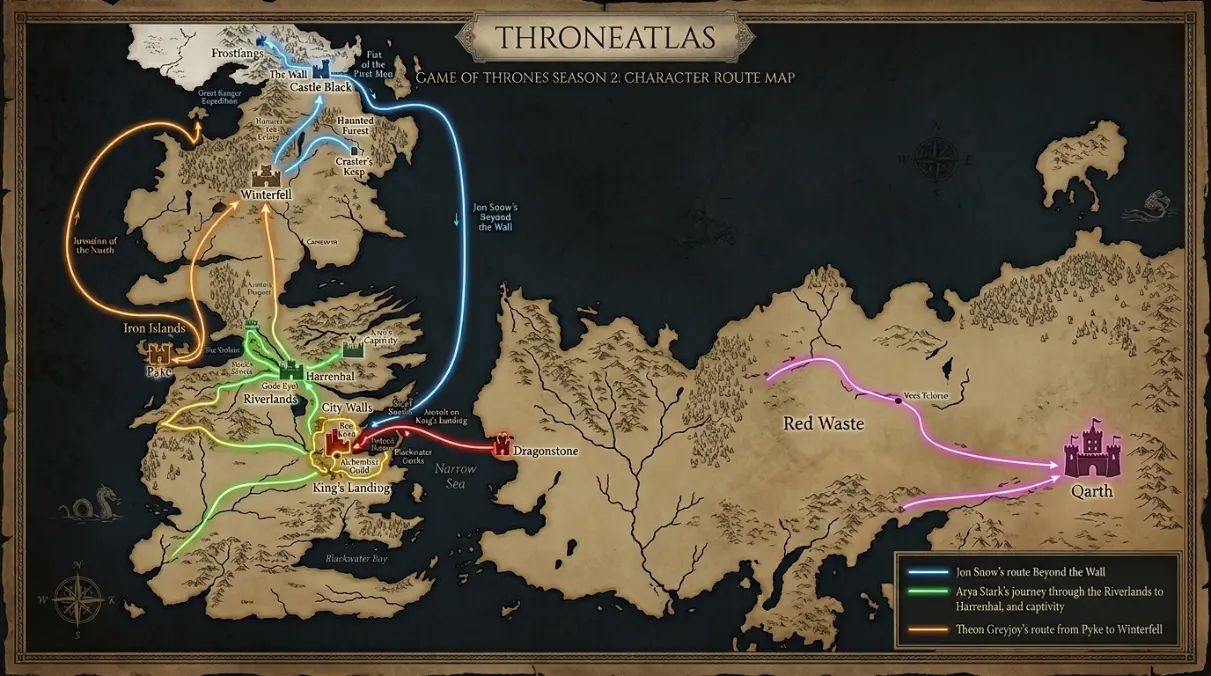
Dragonstone → Blackwater Bay → King’s Landing. The season’s main military line: a sea-borne assault on the capital that comes within minutes of succeeding — and fails because of wildfire, harbor chains, and Tywin’s timing.
Theon Route
Robb’s camp → Pyke → Winterfell. A short route with enormous consequences. Theon moves from ally to enemy in the space of one season, turning the Stark home into a seized castle and himself into a prisoner of his own choices.
Arya Route
King’s Landing escape paths → Riverlands → Harrenhal. Not a royal route but a ground-level war route — captivity, disguise, labor, and the lethal education of watching powerful men from a position of total powerlessness.
Jon Route
Castle Black → Beyond the Wall → Fist of the First Men. Jon’s route separates the supernatural northern threat from the political war map entirely — and begins to show the audience what the show is really about.
Daenerys Route
Red Waste → Qarth → House of the Undying. The Season 2 route that stays farthest from Westeros — 3,000 miles of survival, dragon theft, Warlock prophecy, and the slow realization that getting home will take much longer than expected.
Robb Route
Northern army → Riverlands → western front. Robb wins every battle he fights — and loses the war’s most important location anyway. His route proves that battlefield brilliance and territorial security are two completely different things.
What Should a Game of Thrones Season 2 Map Include?
A complete map of Game of Thrones Season 2 must include King’s Landing, Dragonstone, Blackwater Bay, Harrenhal, the Riverlands, Winterfell, Pyke, the Iron Islands, Beyond the Wall, Storm’s End, and Qarth. It should also show route lines for six characters: Stannis Baratheon (Dragonstone to King’s Landing by sea), Robb Stark (Riverlands war front), Arya Stark (Harrenhal and Riverlands survival), Theon Greyjoy (Pyke to Winterfell), Jon Snow (Beyond the Wall), and Daenerys Targaryen (Red Waste to Qarth in Essos).
The stronger map interpretation is that Season 2 is the season of competing centers, not just the Battle of Blackwater. King’s Landing is the prize. Dragonstone is the claimant base. Harrenhal is the Riverlands pressure point. Winterfell is the vulnerable home. Pyke is the Ironborn origin. Beyond the Wall is the hidden danger. Qarth is the distant eastern test. Each one controls a different arc. Each one matters for a different reason.
Key Takeaways — Season 2 Map
- The map of Game of Thrones Season 2 covers 10 major locations across Westeros and Essos simultaneously.
- The Battle of Blackwater is the season’s geographic climax — Stannis attacks King’s Landing by sea from Dragonstone.
- Daenerys Targaryen is in Essos during Season 2, specifically Qarth, reached after crossing the Red Waste.
- Harrenhal is the season’s key Riverlands location — Arya Stark’s captivity site and a Lannister military hub.
- Theon Greyjoy’s route from Pyke to Winterfell represents the season’s most consequential betrayal on the map.
- Jon Snow’s route beyond the Wall introduces a supernatural threat that the War of the Five Kings ignores entirely.
- Season 2 is the first season where the map shows six active war fronts operating simultaneously with no single victor.
Map of Game of Thrones Season 2 — Frequently Asked Questions
The 10 most important Game of Thrones Season 2 locations are King’s Landing, Dragonstone, Harrenhal, Winterfell, Pyke, the Riverlands, Storm’s End, Beyond the Wall, Qarth, and Blackwater Bay. Of these, King’s Landing is the political center, Dragonstone is Stannis’s claimant base, Harrenhal is the Riverlands power point, and Qarth is Daenerys’s primary Essos location during Season 2.
The main battle in Game of Thrones Season 2 is the Battle of Blackwater, fought at Blackwater Bay near King’s Landing. Stannis Baratheon launches a naval assault from Dragonstone, but Tyrion Lannister’s defense — using a wildfire chain trap and harbor chains — destroys most of Stannis’s fleet. Tywin Lannister then arrives with reinforcements from the west, ending the battle and saving the city.
Daenerys is in Essos during Season 2. After her khalasar crosses the deadly Red Waste, she arrives in Qarth — a wealthy eastern city far from Westeros. Her Season 2 arc in Qarth involves surviving the city’s political dangers, dealing with the Warlocks of Qarth and the theft of her dragons, and eventually escaping aboard the ship Balerion with her khalasar intact.
Harrenhal is important in Season 2 for two reasons. First, it is Arya Stark’s captivity location — the castle where she serves as a servant and witnesses war from ground level. Second, Harrenhal functions as a major Riverlands military asset that changes hands multiple times during the War of the Five Kings. Its strategic position in the Riverlands makes it central to Lannister military control of the region.
A complete Game of Thrones Season 2 map should show six route lines: Stannis Baratheon from Dragonstone to Blackwater Bay by sea; Theon Greyjoy from Pyke to Winterfell; Arya Stark through the Riverlands and Harrenhal; Jon Snow from Castle Black northward beyond the Wall; Robb Stark across the Riverlands and western war front; and Daenerys Targaryen from the Red Waste toward Qarth in eastern Essos.
Qarth sits thousands of miles east of King’s Landing — separated by the Narrow Sea, the Dothraki Sea, and the Red Waste. In practical terms, the distance means Daenerys’s Season 2 route in Essos is entirely separate from the War of the Five Kings in Westeros. She has no direct awareness of, or influence on, the battles for King’s Landing happening while she fights to survive in Qarth.
Season 1 has a single geographic spine: Winterfell to King’s Landing for the Starks, the Wall and North for Jon Snow, and the early Dothraki arc for Daenerys. Season 2 replaces that spine with six simultaneous war fronts across Westeros and Essos. Characters no longer move toward one crisis — they navigate separate crises at once, often unaware of what the others are doing. That multi-route complexity is what makes Season 2 the most geographically layered season on the map.
Related Season 2 Map Pages
Season 2 Places
Character Routes
ThroneAtlas is an independent fan-made map and lore reference site. It is not affiliated with, endorsed by, or connected to HBO, Warner Bros., George R. R. Martin, Game of Thrones, House of the Dragon, or A Song of Ice and Fire. All character names, place names, and trademarks belong to their respective owners.