Westeros Before Aegon’s Conquest Map: The Seven Independent Kingdoms
Before the Iron Throne existed, Westeros was a continent of independent crowns. This atlas reconstructs the political map Aegon Targaryen faced and shows which kingdoms, dynasties and borders were transformed by conquest.
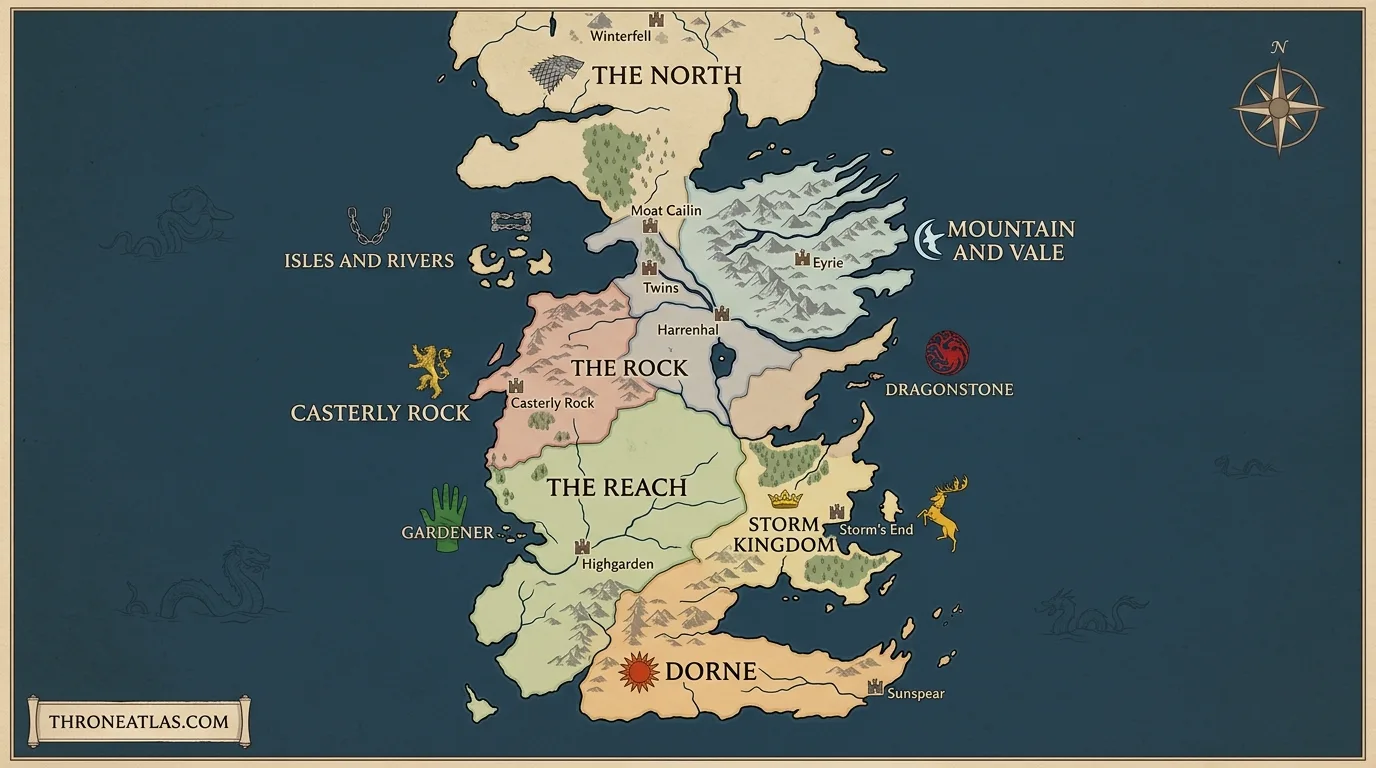
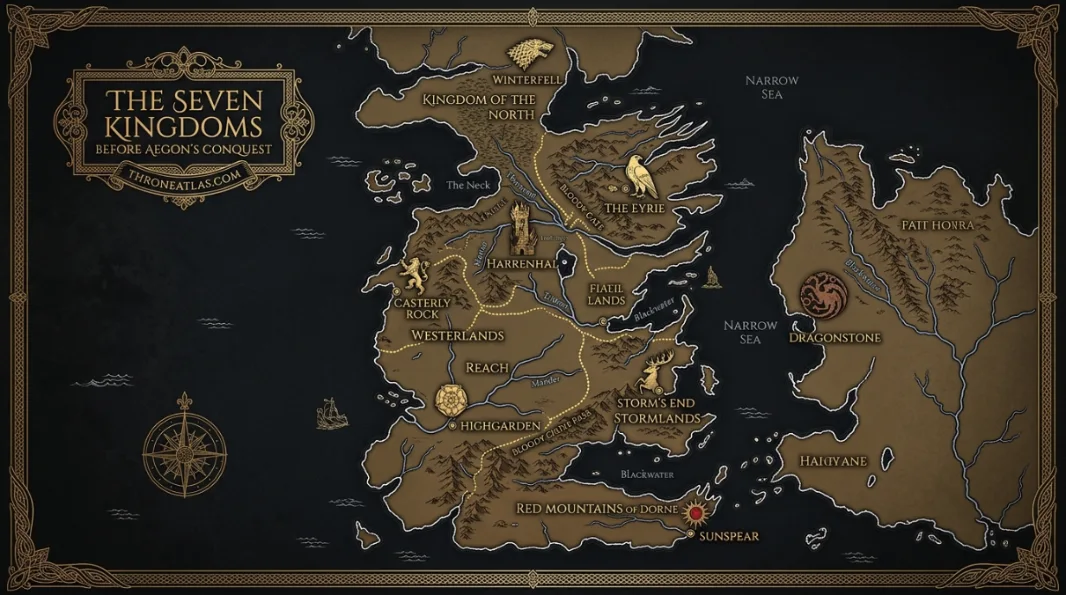
Before Aegon’s Conquest, Westeros was divided among seven independent kingdoms: the North under House Stark, Mountain and Vale under House Arryn, Isles and Rivers under House Hoare, Rock under House Lannister, Reach under House Gardener, Storm Kingdom under House Durrandon, and Dorne under House Martell. The Crownlands were not a separate ancient kingdom; they emerged as the Targaryen royal domain after conquest.
Westeros Before Aegon’s Conquest Map at a Glance
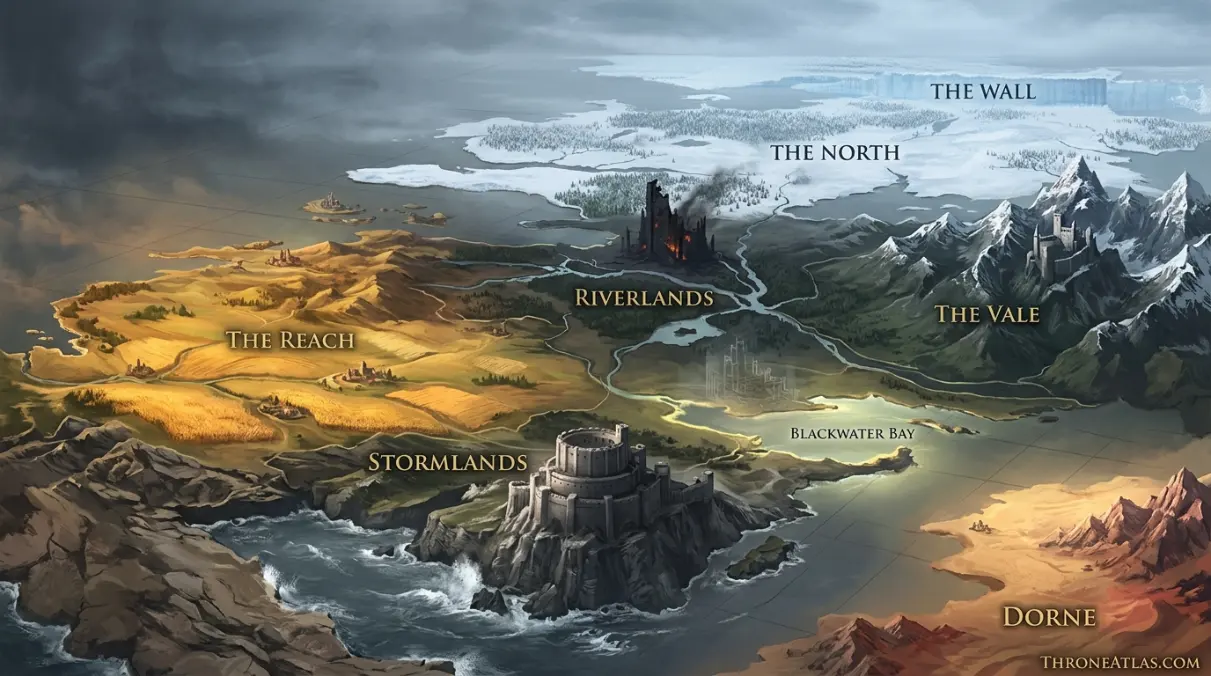
This visual map is the fast geographic reference for the guide below. It is designed to show the places, routes, borders, strongholds or battle zones that matter most to this topic before you move into the deeper lore and strategy.
In This Guide
- Visual Map at a Glance
- What Westeros Looked Like Before Aegon’s Conquest
- The Kingdom of the North: Stark Rule from Winterfell
- The Kingdom of Mountain and Vale: House Arryn
- The Kingdom of the Isles and Rivers: House Hoare
- The Kingdom of the Rock: House Lannister
- The Kingdom of the Reach: House Gardener Before the Tyrells
- The Storm Kingdom: House Durrandon
- Dorne: The Kingdom Aegon Did Not Conquer
- Dragonstone and the Lands That Become the Crownlands
- How Aegon Redrew the Political Map
Westeros Before Aegon’s Conquest Map: The Seven Independent Kingdoms: What Matters Most
Seven crowns
The continent was politically divided; “Seven Kingdoms” originally referred to real independent realms.
No Crownlands kingdom
The later Crownlands are a Targaryen-era royal domain, not one of the seven pre-Conquest crowns.
Riverlands difference
The Riverlands were under House Hoare with the Iron Islands, not an independent Tully kingdom.
Reach difference
House Gardener ruled from Highgarden; House Tyrell rose after the Gardeners were destroyed.
Stormlands difference
House Durrandon held the storm crown; House Baratheon rose during the Conquest.
North continuity
House Stark lost its crown but remained the dominant northern dynasty.
Dorne exception
Dorne resisted conquest and entered the realm much later by marriage.
New capital
King’s Landing was created by the new Targaryen order rather than inherited from an old kingdom.
Places to Plot on the Map
| Location | Region / Zone | Why It Matters | Map Reading |
|---|---|---|---|
| North | Winterfell | King Torrhen Stark and House Stark. | Independent northern kingdom |
| Mountain & Vale | The Eyrie | House Arryn under young King Ronnel. | Independent kingdom |
| Isles & Rivers | Harrenhal / Iron Islands | Harren Hoare rules Riverlands and Ironborn lands. | One kingdom later split |
| Rock | Casterly Rock | King Loren I Lannister. | Independent kingdom |
| Reach | Highgarden | King Mern IX Gardener. | Gardener dynasty before Tyrell rise |
| Storm Kingdom | Storm’s End | Argilac Durrandon. | Durrandon dynasty before Baratheons |
| Dorne | Sunspear | Princess Meria Martell. | Remains unconquered |
| Dragonstone | Narrow Sea | Aegon, Visenya and Rhaenys Targaryen. | Targaryen launch point; not a kingdom of mainland Westeros |
What Westeros Looked Like Before Aegon’s Conquest
Immediately before Aegon I Targaryen’s invasion, Westeros was divided among seven independent kingdoms rather than one realm ruled from King’s Landing. The Starks, Arryns, Hoares, Lannisters, Gardeners, Durrandons and Martells held separate crowns, laws, armies and rival border systems.
The familiar political map of Game of Thrones is a product of conquest. It is easy to look backward and assume the great regions were always provinces waiting to be united under the Iron Throne. They were not. A northern king did not answer to a southern capital. The Riverlands were not governed by House Tully as an independent kingdom. The Reach was not ruled by House Tyrell. The Crownlands did not exist as a traditional kingdom at all.
This earlier map helps explain why Aegon’s achievement was so disruptive. He was not merely replacing seven rulers with one administrator. He was forcing independent political cultures into a new hierarchy and then creating institutions that had to make that hierarchy feel permanent. Some kingdoms submitted, some were destroyed, some were transformed through new dynasties, and Dorne remained outside the conquered realm for much longer.
For readers, the pre-Conquest map is one of the fastest ways to understand later regional identity. “The North remembers” makes more sense when the North had kings for thousands of years. Dornish exceptionalism makes more sense when Dorne resisted conquest. Riverlands vulnerability makes more sense when the region had repeatedly been ruled by outsiders before Aegon ever arrived.
The Kingdom of the North: Stark Rule from Winterfell
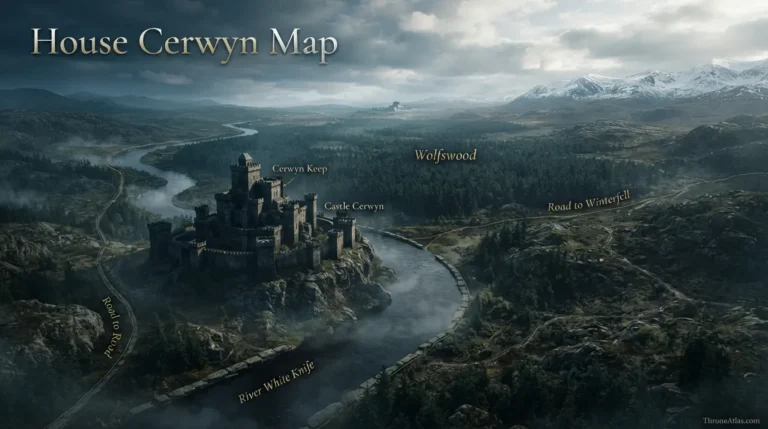
The North was an independent kingdom under House Stark, ruled from Winterfell by Torrhen Stark at the time of Aegon’s invasion. Its enormous size, harsh climate, old-gods culture and southern choke point at the Neck made it geographically distinct long before it became a region of the Seven Kingdoms.
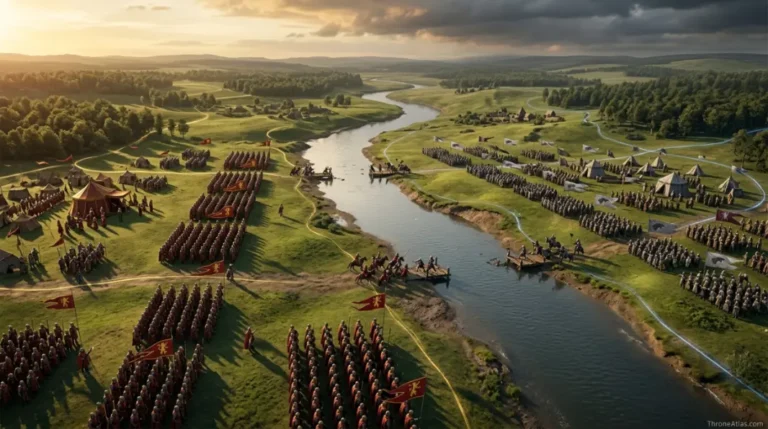
The Stark kingdom is the clearest example of geography protecting continuity. Armies approaching from the south must contend with the Neck and Moat Cailin before they can reach the open distances of the North. Once beyond that gateway, an invader faces a vast territory where supply becomes harder and local lords know the environment better than outsiders.
Torrhen Stark ultimately chooses submission rather than testing those advantages against dragons. His decision earns him the later title “the King Who Knelt,” but the map shows why it was not simply cowardice. The North could resist ordinary armies in ways that had protected it for generations. Dragons changed the calculation. A fortress designed to stop men cannot guarantee safety from aerial fire.
The political result is unusual: House Stark survives as the dominant northern dynasty, loses its crown, and becomes Warden of the North under the Targaryen monarchy. The regional identity remains strong because the conquest changes the top of the hierarchy more than it erases the old kingdom beneath it.
The Kingdom of Mountain and Vale: House Arryn
The Vale was the Kingdom of Mountain and Vale under House Arryn, centered on the Eyrie and protected by formidable mountain approaches. At the Conquest, young King Ronnel Arryn’s realm was governed under the influence of his mother, Sharra Arryn, and ultimately submitted to Visenya Targaryen without a destructive mountain campaign.
The Vale’s map is a defensive fantasy made real. Mountain passes restrict movement, the Bloody Gate controls the principal approach into the interior, and the Eyrie occupies an almost absurdly difficult position for an enemy to reach. Against conventional warfare, those features give the Arryn kings a strong reason to trust geography.
Visenya and Vhagar demonstrate how dragons rewrite that confidence. Air power can bypass defenses built to channel men and horses. The famous image of a Targaryen dragon reaching the Eyrie communicates the conquest’s central military innovation better than a dozen battle diagrams: old defensive systems still matter, but they no longer define the limits of attack.
House Arryn retains regional authority under the new order. As with the Starks, Aegon benefits from preserving an established dynasty that can govern local society on his behalf. Conquest therefore produces both dramatic breaks and pragmatic continuity.
The Kingdom of the Isles and Rivers: House Hoare
Before the Conquest, the Iron Islands and much of the Riverlands were united under House Hoare as the Kingdom of the Isles and Rivers. Harren the Black ruled from newly completed Harrenhal, making the central river country subject to an Ironborn dynasty rather than to House Tully.
This is the pre-Conquest fact that most radically changes a modern viewer’s mental map. In later eras, the Iron Islands and Riverlands feel like completely separate political regions. Under Harren Hoare, they belong to one crown. The arrangement is geographically awkward but historically understandable: Ironborn power had expanded onto the mainland, and the Riverlands had long been contested by stronger neighbors.
Harrenhal was built as a statement that this rule would last. Its enormous walls and towers represented accumulated labor, wealth and coercion. Then Aegon and Balerion demonstrated that the largest conventional castle in Westeros could become a trap when attacked from the air. The burning of Harrenhal destroys House Hoare’s position in a single catastrophic lesson.
Afterward, the map is reorganized. House Tully rises as the leading riverlord under Targaryen authority, while the Iron Islands are separated under their own lordly structure. The conquest does not merely change a king; it splits a kingdom into political units that later readers take for granted.
The Kingdom of the Rock: House Lannister
The Westerlands formed the Kingdom of the Rock under House Lannister, ruled by King Loren I from Casterly Rock. Wealth from the western hills and mines supported a powerful monarchy, while the Rock itself offered one of the continent’s most formidable natural fortresses.
The Lannister kingdom is a useful reminder that money and defensible terrain do not automatically produce strategic independence. Loren joins with Mern IX Gardener of the Reach to field an enormous combined army against Aegon. On a conventional map, that alliance looks rational: two wealthy neighboring kingdoms can mass manpower beyond what the invader has landed.
The Field of Fire changes the map’s logic. Dragons turn numerical concentration into vulnerability when thousands of men are packed into terrain that can burn. Mern dies and House Gardener ends; Loren survives and submits. That survival allows House Lannister to retain Casterly Rock and regional lordship beneath the Iron Throne.
The Westerlands therefore experience conquest through defeat but not dynastic extinction. Their wealth remains structurally important to the united realm, and Casterly Rock continues to symbolize a regional power base older than Targaryen rule itself.
The Kingdom of the Reach: House Gardener Before the Tyrells
The Reach was an independent kingdom under House Gardener of Highgarden, not House Tyrell. King Mern IX Gardener dies during the Field of Fire, and the extinction of the ruling line creates the political opening through which the Tyrells rise as Lords Paramount of the Reach under Aegon.
This is one of the clearest examples of conquest creating a “great house” map familiar to later audiences. House Tyrell exists before Aegon, but not as the crowned dynasty of the Reach. Their elevation is part of the new regime. That matters because older Reach houses can remember lineages, claims and status that predate Tyrell supremacy.
Highgarden itself survives as a seat of regional power. The dynasty changes while the geographic center remains. This is a recurring Targaryen strategy: use existing castles and administrative networks where possible rather than rebuilding an entire realm from nothing.
The Reach’s agricultural wealth makes it indispensable regardless of who holds the title. A united monarchy needs food, roads and southern manpower. That means Aegon cannot treat the region only as defeated territory; it must become a productive component of the new realm. The map of grain is as important as the map of crowns.
The Storm Kingdom: House Durrandon
The Stormlands belonged to the Storm Kings of House Durrandon, with Argilac the Arrogant ruling from Storm’s End at the start of the Conquest. After his defeat and death, Orys Baratheon takes Storm’s End and marries Argella Durrandon, creating the Baratheon dynasty that later inherits much of the storm kings’ heraldry and authority.
House Baratheon is therefore another post-Conquest great-house arrangement rather than the ancient royal family of the region. Storm’s End is much older than the Baratheon name. The castle anchors continuity while marriage and conquest transform the dynasty associated with it.
Geography makes the Stormlands a difficult coastal kingdom, with the great fortress commanding a symbolic and strategic position near Shipbreaker Bay. Argilac’s conflict with Aegon cannot be separated from border politics and the question of who controls lands between established kingdoms. The Conquest turns those frontier rivalries into a struggle over the entire continent.
Orys’s victory shows Aegon’s pragmatic state-building again. Instead of erasing every local identity, the new regime creates a house that can inherit Durrandon symbols and rule from the same famous seat. Later generations experience the Baratheons as ancient Stormlands power even though the dynastic transition belongs directly to the Conquest.
Dorne: The Kingdom Aegon Did Not Conquer
Dorne was an independent principality under House Martell, ruled by Princess Meria Martell from Sunspear. Its deserts, mountains, dispersed settlements and willingness to avoid conventional set-piece warfare helped it resist Aegon’s attempt to force the same submission achieved elsewhere.
Dorne is the map’s great exception. The Red Mountains restrict northern approaches, distance stretches invading supply lines, and the interior does not offer the same kind of single decisive target as a centralized kingdom that can be broken by burning one king in one castle. Dornish strategy uses those geographic realities instead of trying to defeat dragons on the dragons’ preferred terms.
This resistance explains why “Seven Kingdoms” becomes politically complicated. Aegon adopts a title claiming all seven kingdoms even while Dorne remains outside his effective control. The phrase survives later as a traditional name even as the administrative map becomes more complex than seven simple units.
Dorne eventually joins the realm through marriage generations later, preserving a distinct princely style and legal-cultural identity. That later peaceful incorporation makes more sense when the reader sees the first Conquest map: Dorne is not simply another conquered province delayed by a few battles. It follows a different path into the monarchy.
Dragonstone and the Lands That Become the Crownlands
Dragonstone is Aegon’s pre-Conquest base, but the Crownlands do not yet exist as one of the ancient independent kingdoms. The territory around Blackwater Bay is divided among local lords and influenced by neighboring powers; after the conquest, Aegon creates a royal domain centered on his new capital and nearby loyal houses.
This distinction is essential for anyone comparing a pre-Conquest map to a Game of Thrones map. There is no crowned “King of the Crownlands” whom Aegon defeats. The region as later understood is a product of the monarchy itself. King’s Landing does not yet exist as the giant capital city viewers know.
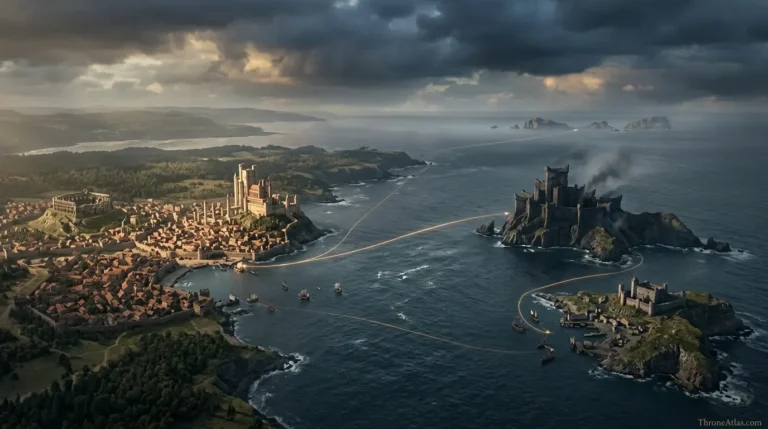
Dragonstone, by contrast, already gives the Targaryens a secure island seat close to Westeros. Its position in the Narrow Sea lets Aegon observe eastern Westeros, gather forces and launch a mainland campaign without beginning from complete exile. The island is geographically small but strategically disproportionate.
After landing, the establishment of King’s Landing creates a new political center where none of the old seven kingdoms previously had their capital. That choice is brilliant statecraft: rather than ruling from Winterfell, Highgarden or Casterly Rock and appearing to privilege one conquered kingdom, the Targaryens build a royal city associated directly with the new order.
How Aegon Redrew the Political Map
Aegon’s conquest replaces seven independent crowns with one monarchy, but he does not erase regional geography. Instead, old kingdoms become lord-paramount regions, some ruling dynasties survive, others are replaced, the Isles and Rivers are separated, and the Crownlands emerge as a new royal heartland around King’s Landing.
The result is a hybrid map. House Stark and House Arryn keep ancient regional dominance without crowns. House Lannister survives after military defeat. House Martell remains independent for the time being. House Gardener disappears and House Tyrell rises. House Durrandon disappears and House Baratheon rises. House Hoare disappears, allowing a new Riverlands order under House Tully and a separate Iron Islands settlement.
That hybrid structure is why later politics can reactivate older identities so easily. The Iron Throne sits above systems that existed long before it. When central authority weakens, regions remember their own interests, rivalries and histories. Robert’s Rebellion and the War of the Five Kings are not happening on blank administrative provinces; they are happening on the fossilized borders of former kingdoms.
In that sense, the pre-Conquest map never disappears. It remains underneath every later Westeros map like an older parchment layer. Understanding it makes the entire political saga easier to read.
The Independent Kingdoms Before the Conquest
Continue Exploring ThroneAtlas
Westeros Before Aegon’s Conquest Map: The Seven Independent Kingdoms: FAQs
How many kingdoms were in Westeros before Aegon’s Conquest?
Seven independent kingdoms dominated the political map immediately before the Conquest: North, Mountain and Vale, Isles and Rivers, Rock, Reach, Storm Kingdom and Dorne. Their borders do not perfectly match the later regional map because the Conquest reorganized several territories.
Was the Riverlands one of the seven independent kingdoms?
The Riverlands were part of Harren Hoare’s Kingdom of the Isles and Rivers at the time of Aegon’s invasion. House Tully became the leading river dynasty only after Harrenhal fell and the Targaryens reorganized the region.
Who ruled the Reach before House Tyrell?
House Gardener ruled the Reach from Highgarden as kings. King Mern IX and his heirs died in the Field of Fire, after which Aegon elevated House Tyrell to govern the Reach under the Iron Throne.
Who ruled the Stormlands before House Baratheon?
House Durrandon ruled the Storm Kingdom. Argilac the Arrogant died during the Conquest, and Orys Baratheon took Storm’s End, married Argella Durrandon and established the Baratheon line as regional rulers.
Did the Crownlands exist before Aegon?
Not as one of the ancient independent kingdoms. The Crownlands were formed around the new Targaryen monarchy, Blackwater Bay, King’s Landing and loyal nearby houses after the conquest.
Where did Aegon live before the Conquest?
Aegon Targaryen and his sisters were based on Dragonstone, the Targaryen island seat in the Narrow Sea. Its position close to eastern Westeros made it an effective launch point for invasion.
Why did Dorne remain independent?
Dornish geography and strategy made conquest unusually costly. Mountain approaches, desert distances, dispersed resistance and refusal to offer the kind of decisive conventional battle dragons could dominate helped Dorne resist Aegon’s campaign.
Which pre-Conquest kings kept their houses after surrender?
House Stark, House Arryn and House Lannister remained major regional dynasties after losing royal status. Other ruling lines such as Hoare, Gardener and Durrandon were destroyed or replaced in the political restructuring.
Was King’s Landing already a city before Aegon?
No. King’s Landing grew from Aegon’s mainland foothold into the new royal capital. Building a fresh capital helped the Targaryens create a center associated with their monarchy rather than with one former kingdom.
Why is the realm still called the Seven Kingdoms later?
The name preserves the historical memory of the seven independent realms Aegon claimed to unite. Later administrative geography includes more than seven familiar regions, but the traditional political title continues.
The Geography Behind the Story
Before Aegon’s Conquest, Westeros was divided among seven independent kingdoms: the North under House Stark, Mountain and Vale under House Arryn, Isles and Rivers under House Hoare, Rock under House Lannister, Reach under House Gardener, Storm Kingdom under House Durrandon, and Dorne under House Martell. The Crownlands were not a separate ancient kingdom; they emerged as the Targaryen royal domain after conquest. The deeper value of this page is not memorizing names. It is seeing how roads, rivers, coasts, castles, distance, food, dragons, armies, and old political borders determine what characters can realistically do next. That is the layer ThroneAtlas is built to make visible.