Maegor’s Holdfast Map: Royal Apartments, Moat & Red Keep Layout
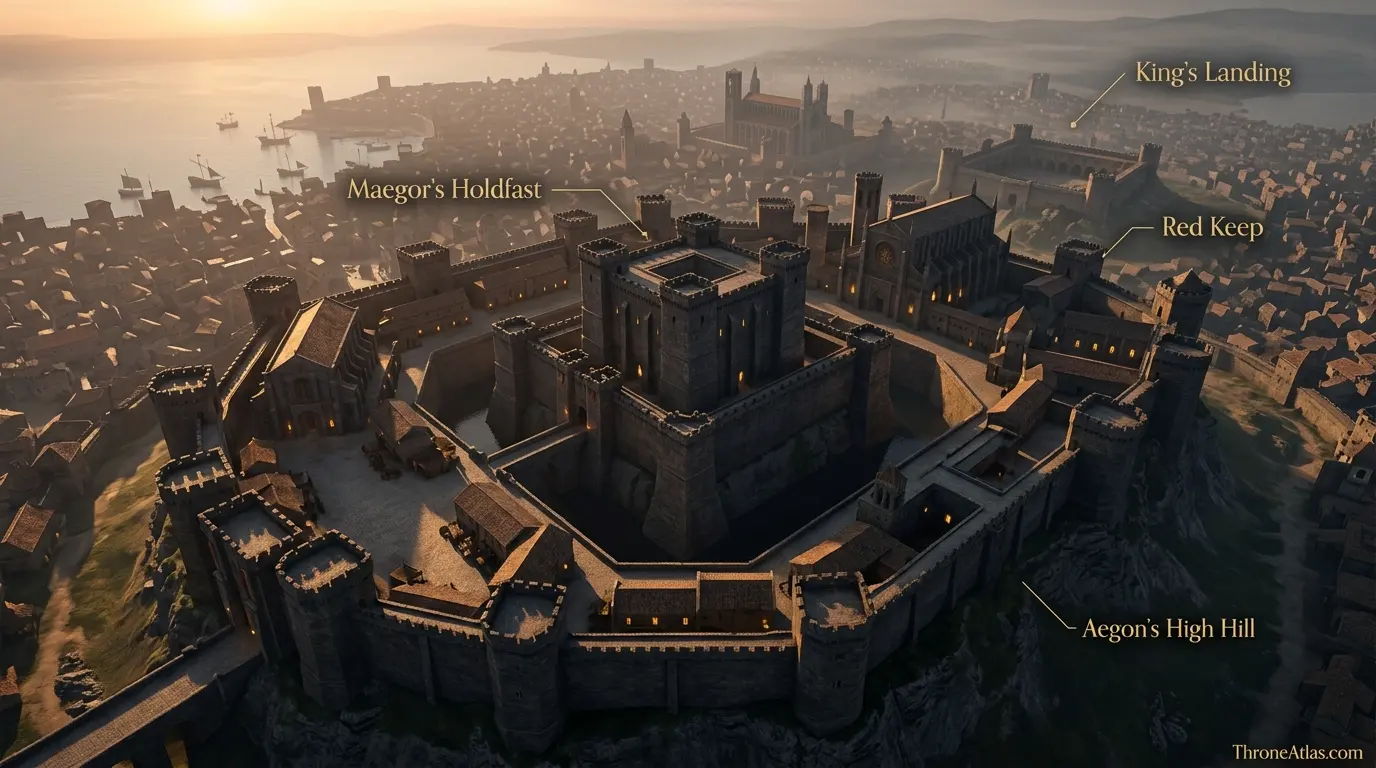
A castle-within-a-castle atlas of the Red Keep’s strongest inner fortress—Maegor’s Holdfast, its thick walls, dry moat and spikes, guarded drawbridge, royal apartments and Queen’s Ballroom.
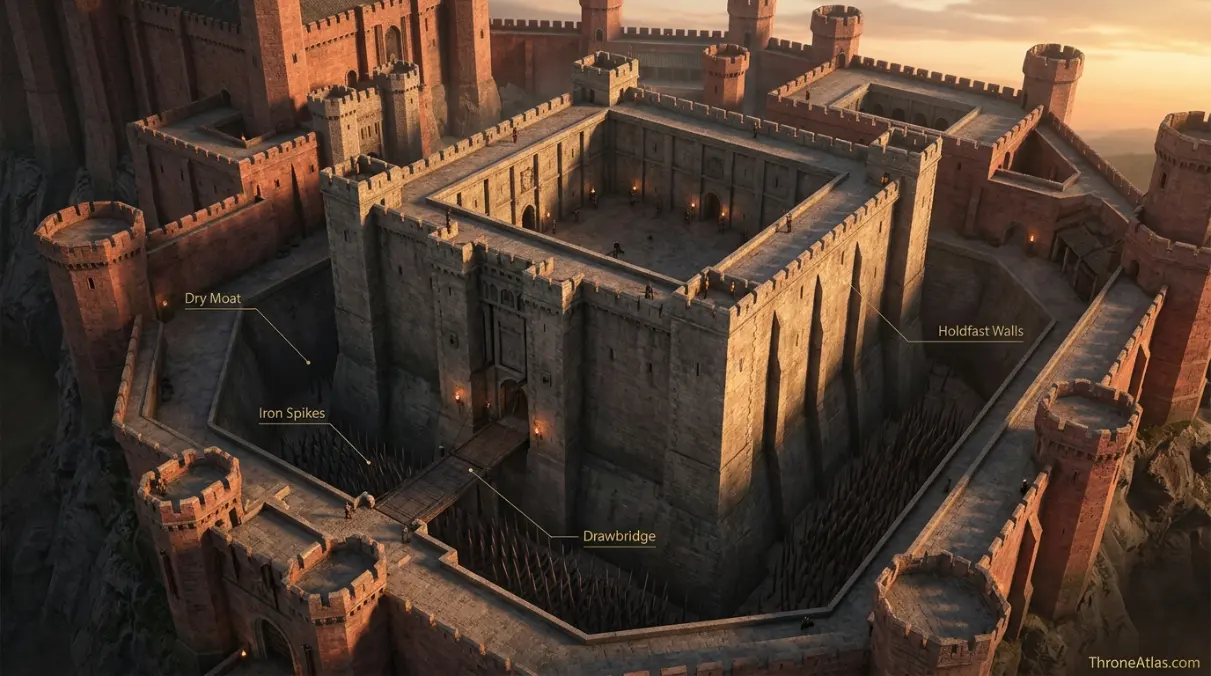
Maegor’s Holdfast is the strongest inner fortress of the Red Keep in King’s Landing. It is a massive square castle-within-a-castle surrounded by a dry moat lined with iron spikes and normally entered across a guarded drawbridge. The royal apartments and Queen’s Ballroom are inside, making the holdfast both the monarchy’s private residence and its final defensive refuge.
Maegor’s Holdfast Map — The Fortress Inside the Fortress
This page uses nested scale: King’s Landing → Red Keep → Maegor’s Holdfast → royal rooms. The defensive meaning is easiest to understand when each ring is seen inside the next.
Moat, Drawbridge, Royal Apartments & Queen’s Ballroom
Tap a marker to reveal why that place matters. Marker positions are interpretive unless the canon confidence note says otherwise.
Canon Confidence & What This Map Claims
The holdfast’s nested position inside the Red Keep, thick walls, dry moat, spike defenses, drawbridge, royal apartments and Queen’s Ballroom are described clearly. Exact room-to-room floor plans remain incomplete and should be visualized schematically.
In This Guide
- Visual Atlas & Map
- Canon Confidence
- Map Index
- Where Is Maegor’s Holdfast?
- Dry Moat, Iron Spikes and Drawbridge: How the Defense Works
- Royal Apartments: Private Power Inside Public Power
- The Queen’s Ballroom and the Holdfast as a Court Space
- Maegor’s Holdfast During the Battle of Blackwater and Later Crises
- Secret Passages, Maegor and the Limits of Mapping
- Cartographer Field Notes
- Direct Answers
- Source & Canon Basis
- FAQs
Maegor’s Holdfast Map: What Matters Most
It is inside the Red Keep
Maegor’s is not a separate castle elsewhere in King’s Landing.
Defense is layered
Walls, a dry moat, iron spikes and a controlled drawbridge create an inner refuge.
The royal family lives here
Royal apartments make the fortress residential as well as military.
The Queen’s Ballroom is inside
A smaller ceremonial space compared with the Red Keep’s great public halls.
Access can be closed quickly
The drawbridge lets defenders isolate the holdfast from the rest of the castle.
Kingsguard presence matters
A guarded crossing turns architecture into controlled royal access.
Secret escape is part of the lore
A reported hidden egress exists, but its exact geometry should not be over-mapped.
The map explains court behavior
When danger rises, moving a ruler into Maegor’s is a geographic security decision, not just a dramatic gesture.
Places, Zones & Connections to Plot
| Place | Zone | Why It Matters | How to Read It on the Map |
|---|---|---|---|
| Maegor’s Holdfast | Heart of Red Keep | Strongest inner fortress and royal residential core. | Read it as a secure island of stone inside a larger castle complex. |
| Dry moat | Around holdfast | Defensive gap separating the inner fortress from surrounding Red Keep ground. | A physical security ring that channels all normal entry. |
| Iron spike bed | Moat floor | Makes crossing the dry moat dangerous without using the bridge. | Turns “dry” moat into an active defense rather than empty space. |
| Drawbridge | Main entrance | Controlled route in and out of the holdfast. | The key movement choke point for guards, courtiers and royal evacuation. |
| Royal apartments | Inside holdfast | Private living quarters of king and royal family. | Explains why the strongest place is also the most politically sensitive residence. |
| Queen’s Ballroom | Inside holdfast | Smaller ceremonial hall used for court functions. | Shows that Maegor’s mixes defense, domestic life and ceremony. |
| Red Keep inner yard / structures | Outside moat | Wider castle complex including towers, halls and council spaces. | Necessary scale reference: leaving Maegor’s does not mean leaving the Red Keep. |
| Aegon’s High Hill | King’s Landing | High ground supporting the Red Keep above the capital. | Final outer scale connecting inner fortress to city geography. |
Where Is Maegor’s Holdfast?
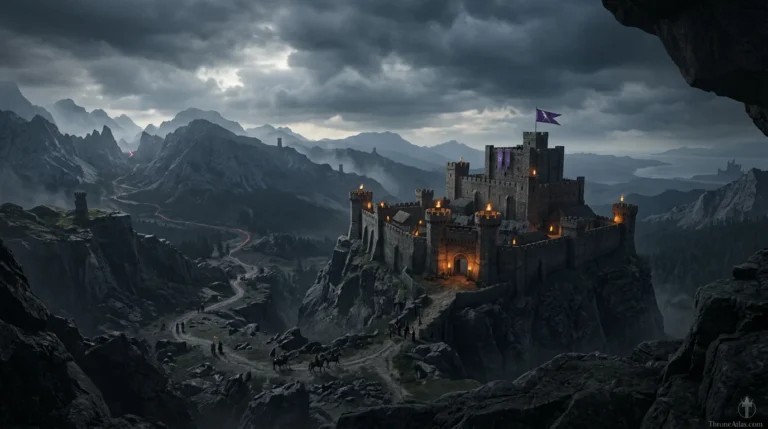
Maegor’s Holdfast sits inside the Red Keep on Aegon’s High Hill in King’s Landing, forming the castle’s strongest inner defensive core.
That nested location is the first thing a map must make clear. A reader searching for “Maegor’s Holdfast map” can easily imagine another fortress somewhere in the capital because the name sounds like a standalone castle. In reality the scale is much tighter: it is a fortified residence inside an already fortified royal complex.
Think of the geography as concentric security. King’s Landing surrounds Aegon’s High Hill. The Red Keep crowns the hill. Maegor’s Holdfast sits within the Red Keep behind another defensive barrier. Each inward step reduces public access and increases royal control.
This is why the dedicated Red Keep map and this page should interlink rather than compete. The Red Keep page owns the whole complex; Maegor’s owns the inner security architecture and rooms most closely associated with the royal family.
Dry Moat, Iron Spikes and Drawbridge: How the Defense Works
Maegor’s is separated from the rest of the Red Keep by a dry moat lined with iron spikes, and the normal entrance is a drawbridge that can be guarded or raised.
A dry moat can sound less formidable than one filled with water until the spikes are added. The purpose is not to stop boats; it is to make an unauthorized crossing extremely dangerous while channeling legitimate movement through one controlled point.
The drawbridge therefore becomes the most important marker on the plan. In ordinary times it is simply the route between royal residence and wider court. In crisis it becomes a security switch: raise or guard the bridge and the king’s immediate space is separated from people already inside the Red Keep.
This helps explain scenes where rulers retreat into Maegor’s. They are not merely going “back to their room.” They are moving behind a second defensive system. The map turns that decision into something the user can understand instantly.
Royal Apartments: Private Power Inside Public Power
The royal apartments are located within Maegor’s Holdfast, so the monarchy’s most private domestic space occupies the most defensible part of the Red Keep.
That arrangement is politically sensible. The king’s bedchamber and family rooms are places where a ruler is physically vulnerable. Positioning them inside the strongest internal fortification reduces the number of approaches guards must protect.
It also changes court access. A petitioner can enter the Red Keep without entering the king’s private residence. A councilor may work in another tower. A feast may use a larger hall. The castle therefore contains gradients of access, and Maegor’s sits near the most restricted end.
For narrative analysis, this helps explain why who is “inside Maegor’s” can matter. Physical proximity to the royal family is a form of political access, while exclusion across the drawbridge can be a visible statement of distrust or reduced influence.
The Queen’s Ballroom and the Holdfast as a Court Space
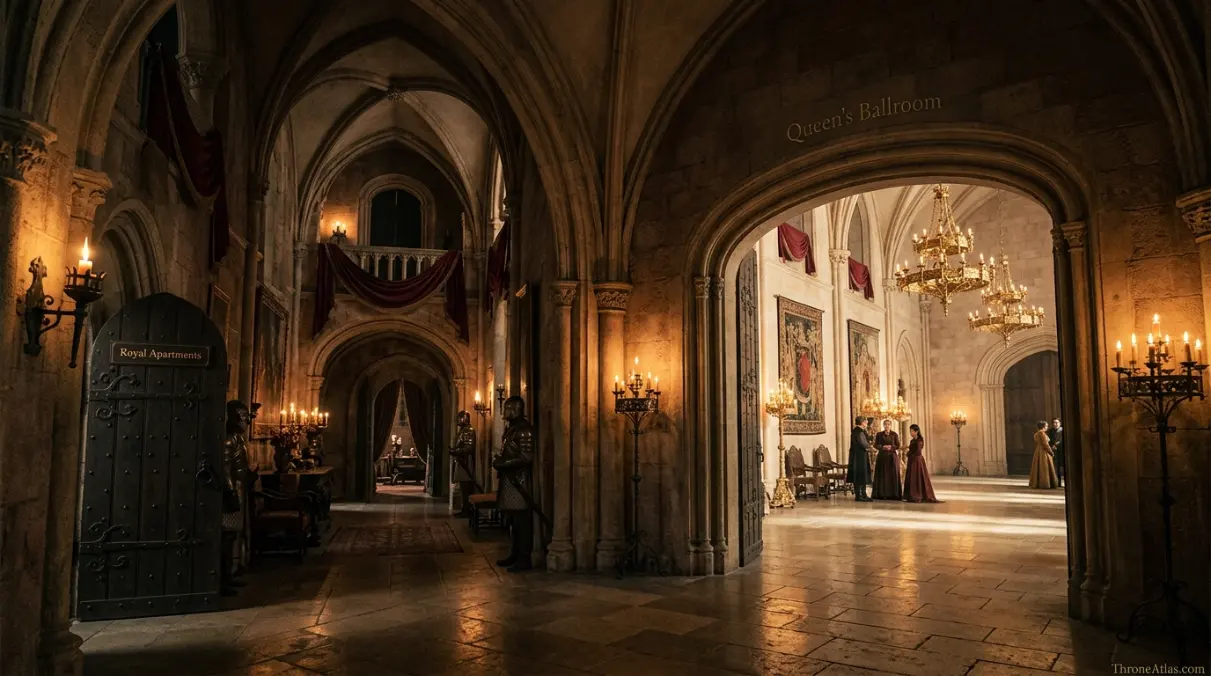
Maegor’s Holdfast contains the Queen’s Ballroom, showing that the inner fortress is not only a bunker; it is also a place where controlled court life and ceremony can continue.
The ballroom is smaller than the Red Keep’s great public halls, which fits the building’s intimate function. It allows gatherings close to the royal apartments without opening the most secure residential zone to the entire court.
That distinction matters on a floor-plan style map. “Ceremonial” does not always mean “public.” A small royal event, gift presentation or reception may happen within an inner layer of the castle, while a grand feast uses a larger hall elsewhere.
The result is a mixed-use fortress. Maegor’s combines bedroom, family residence, guarded refuge and courtly entertainment. That complexity makes it more interesting than a simple square labeled “keep.”
Maegor’s Holdfast During the Battle of Blackwater and Later Crises
During moments of danger, Maegor’s functions as the Red Keep’s refuge, allowing the royal household to withdraw behind the moat and drawbridge while fighting or unrest continues elsewhere.
The Battle of Blackwater is the clearest strategic example. As the defense of King’s Landing becomes uncertain, the security of the king is a separate problem from the security of the city. A ruler can be pulled away from the battlefield and placed inside the most defensible residential zone.
Later political crises use the same geography differently. Tommen’s protection, Cersei’s confinement and movements of the royal household all gain meaning from the fact that Maegor’s can both protect and imprison. Strong security architecture does not care whether the person inside feels safe or trapped.
That dual function is worth highlighting because it is a recurring theme in the saga: castles protect power but also restrict it. The stronger the walls, the easier it becomes to control who can reach the person behind them.
Secret Passages, Maegor and the Limits of Mapping
The lore includes a secret egress associated with Maegor’s Holdfast, but its exact path is not a complete public blueprint, so ThroneAtlas should mark the concept without inventing a detailed tunnel network.
The Red Keep is famous for hidden passages, many associated with the ruthless construction history under Maegor I. That encourages fan maps to connect every room with elaborate tunnels. The temptation is understandable but not evidentially sound.
A better visual uses a dashed “reported secret egress” symbol and a confidence label. That tells the reader the lore matters while preserving uncertainty about where the path runs and how it relates to other hidden routes.
More detail is not always better. Reliable detail, clearly separated from reconstruction, gives readers a more trustworthy picture of the holdfast than an invented floor plan ever could.
How Each Marker Changes the Map
These notes are deliberately practical. They explain what each point does to movement, power, trade, defense, religion or social life instead of repeating a list of place names.
Maegor’s Holdfast
On the atlas, Maegor’s Holdfast should not be treated as an isolated pin. Its position in Heart of Red Keep matters because Strongest inner fortress and royal residential core.. The practical map-reading question is therefore Read it as a secure island of stone inside a larger castle complex.. That relationship is more useful than pretending the world has modern surveyed coordinates.
Dry moat
Dry moat earns a place on this map for a different reason from a famous capital or battlefield. In Around holdfast, Defensive gap separating the inner fortress from surrounding Red Keep ground.. When following characters, fleets, merchants or armies, read this point through the lens of A physical security ring that channels all normal entry.; it explains what can realistically happen around it.
Iron spike bed
A good map gives Iron spike bed context, not just a label. Here the relevant geographic frame is Moat floor. Makes crossing the dry moat dangerous without using the bridge.. For route and strategy purposes, the important takeaway is Turns “dry” moat into an active defense rather than empty space., which is why this location connects naturally to the surrounding markers.
Drawbridge
The cartographic value of Drawbridge comes from its relationship with the wider Main entrance network. Controlled route in and out of the holdfast.. In practical terms, The key movement choke point for guards, courtiers and royal evacuation.. That makes the point meaningful even when the source material never provides exact mileage or a street-by-street survey.
Royal apartments
On the atlas, Royal apartments should not be treated as an isolated pin. Its position in Inside holdfast matters because Private living quarters of king and royal family.. The practical map-reading question is therefore Explains why the strongest place is also the most politically sensitive residence.. That relationship is more useful than pretending the world has modern surveyed coordinates.
Queen’s Ballroom
Queen’s Ballroom earns a place on this map for a different reason from a famous capital or battlefield. In Inside holdfast, Smaller ceremonial hall used for court functions.. When following characters, fleets, merchants or armies, read this point through the lens of Shows that Maegor’s mixes defense, domestic life and ceremony.; it explains what can realistically happen around it.
Red Keep inner yard / structures
A good map gives Red Keep inner yard / structures context, not just a label. Here the relevant geographic frame is Outside moat. Wider castle complex including towers, halls and council spaces.. For route and strategy purposes, the important takeaway is Necessary scale reference: leaving Maegor’s does not mean leaving the Red Keep., which is why this location connects naturally to the surrounding markers.
Aegon’s High Hill
The cartographic value of Aegon’s High Hill comes from its relationship with the wider King’s Landing network. High ground supporting the Red Keep above the capital.. In practical terms, Final outer scale connecting inner fortress to city geography.. That makes the point meaningful even when the source material never provides exact mileage or a street-by-street survey.
Fast Answers About the Map
Inside the Red Keep on Aegon’s High Hill in King’s Landing.
A heavily fortified castle-within-a-castle containing the royal apartments and Queen’s Ballroom.
Normally by crossing a guarded drawbridge over the dry moat.
No. It is a dry moat made dangerous by iron spikes.
The royal family uses apartments inside the holdfast, including the king’s chambers.
The major defensive and residential features are canon-based; a complete room-by-room architectural blueprint is not available.
What This Atlas Is Based On
The major defensive relationships are unusually well described, but the surviving descriptions do not support a complete architectural blueprint.
- A Song of Ice and Fire: The strongest room, moat, drawbridge and royal-apartment descriptions.
- Fire & Blood: Maegor-era Red Keep history and the fortress’s dynastic context.
- The World of Ice & Fire: Capital and Red Keep history used for wider architectural context.
- HBO adaptations: Useful for visual comparison only; sets are not treated as a complete book-canon blueprint.
Continue Exploring ThroneAtlas Maps
Maegor’s Holdfast Map FAQs
Is Maegor’s Holdfast inside the Red Keep?
Yes. It is an inner fortress within the Red Keep itself.
Why is it called Maegor’s Holdfast?
It is named for King Maegor I Targaryen and reflects the highly defensive character associated with his completion of the Red Keep.
How thick are the walls?
The written lore describes exceptionally thick walls around the holdfast; the important map point is that this is the strongest inner defensive zone of the castle.
What surrounds Maegor’s Holdfast?
A dry moat lined with iron spikes separates it from the surrounding Red Keep complex.
What is the only normal entrance?
The drawbridge is the primary controlled route across the moat into the holdfast.
Are the royal apartments inside?
Yes. The king and royal family have private apartments within Maegor’s Holdfast.
What is the Queen’s Ballroom?
A smaller ceremonial and gathering space inside the holdfast, distinct from the larger halls elsewhere in the Red Keep.
Does Maegor’s have secret passages?
The lore refers to a secret egress associated with Maegor’s, but its exact geometry should not be treated as a fully mapped public blueprint.
Why is Maegor’s important during attacks?
It lets the royal household retreat behind a second layer of defenses even after an enemy or riot threatens the wider city or castle.
Is this map based on the books or HBO set?
The structural description prioritizes published lore. Screen-specific layouts can be added as adaptation notes without being presented as identical to book canon.
The Inner Fortress Explains Royal Security
Maegor’s Holdfast is best understood as nested geography: royal apartments inside a square fortress, inside a moat and drawbridge barrier, inside the Red Keep, on Aegon’s High Hill, inside King’s Landing. That layered design explains how the same place can function as residence, court, refuge and confinement.