House Swann Map: Stonehelm, the Slayne & Eastern Dornish Marches
A frontier-house atlas of Stonehelm and the river, watchtowers, marches and coastal approaches that make House Swann one of the Stormlands’ important southern anchors.
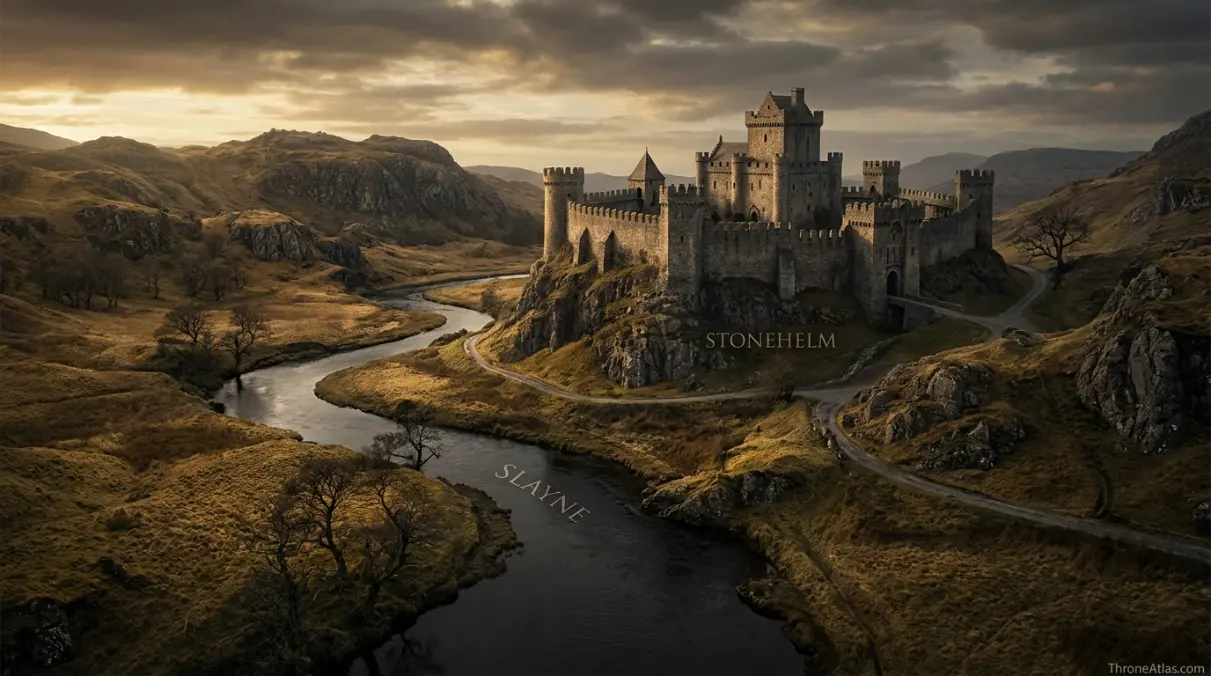
House Swann is seated at Stonehelm in the southern Stormlands, near the Slayne and the eastern Dornish Marches. The castle is associated with the Red Watch and a landscape facing both the Sea of Dorne and the historic frontier with Dorne, making House Swann strategically important despite being far from King’s Landing.
Stonehelm at the Meeting Point of River, March and Sea
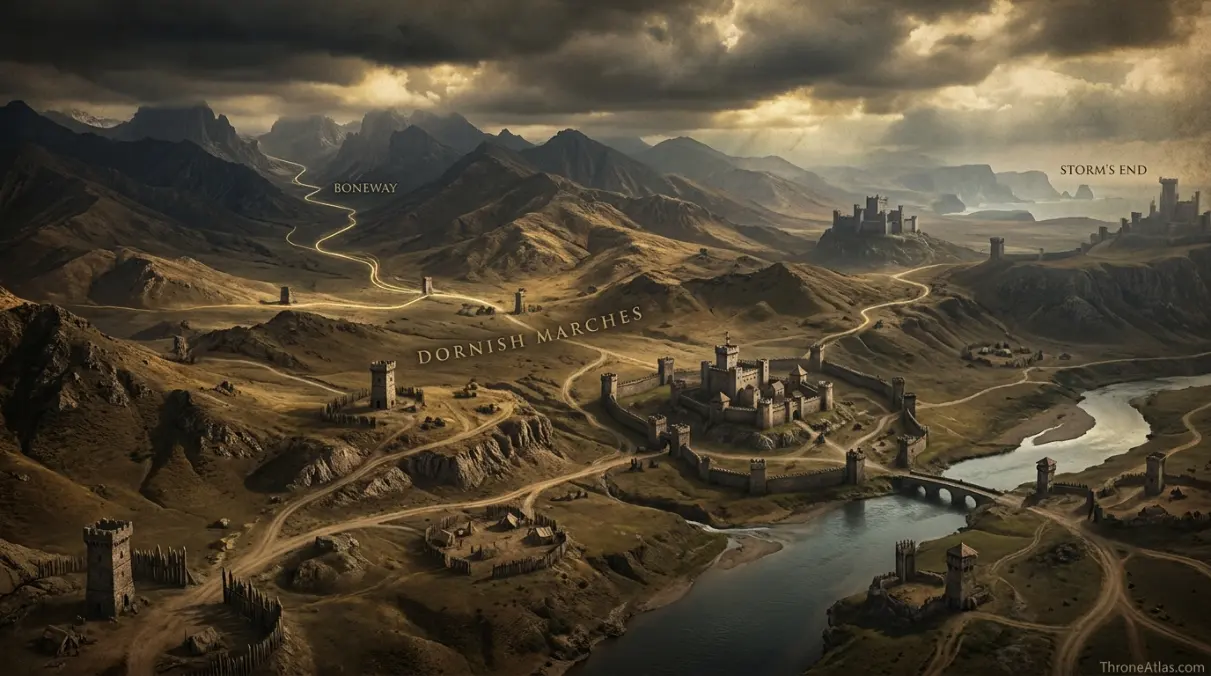
The House Swann atlas is built around Stonehelm, then expands outward to the Slayne, Red Watch, Sea of Dorne and the Dornish Marches. Storm’s End provides the regional political anchor, while the Boneway direction shows how the house fits into the long military geography between Dorne and the Stormlands.
Canon Confidence & What This Map Claims
ThroneAtlas separates confirmed geography from useful reconstruction so a clean digital map never appears more certain than the underlying source.
Read the Map From Anchors to Story
- Visual Atlas
- Canon Confidence
- Key Takeaways
- Locations & Route Table
- Stonehelm Is a Frontier Castle Before It Is a House Label
- The Slayne: A Natural Line Through Swann Country
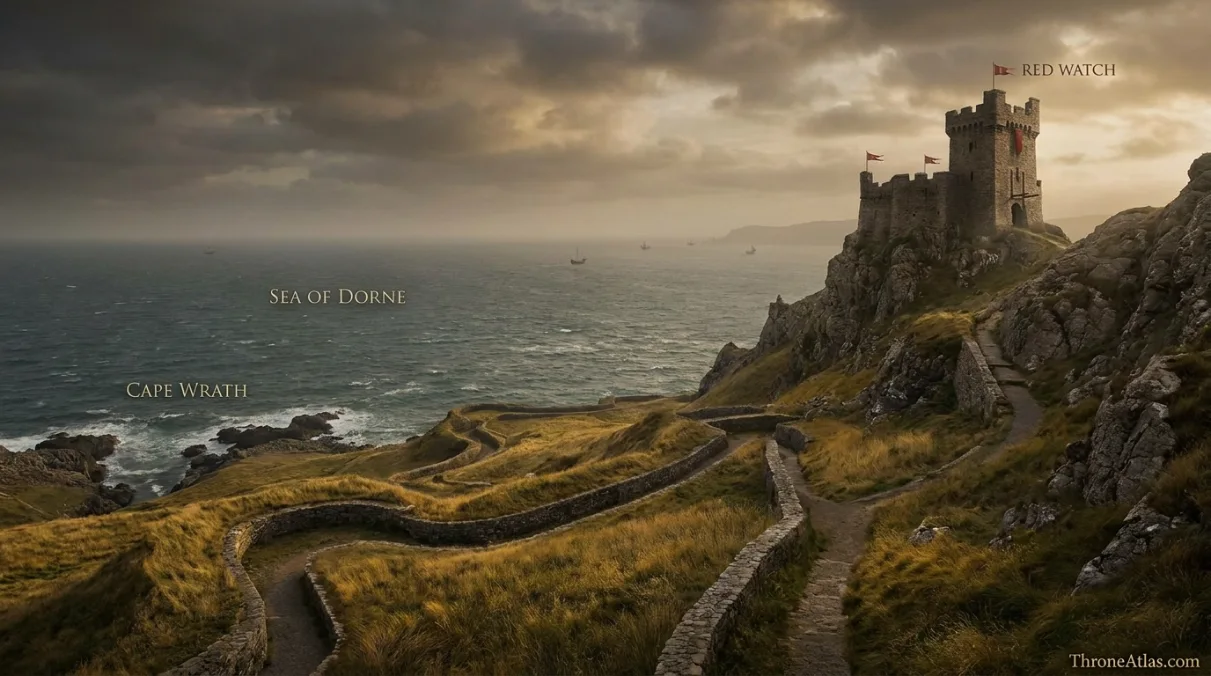
- Red Watch, Sea of Dorne and the Southern Horizon
- The Dornish Marches as a War Zone, Not a Perfect Border
- House Swann in the War of the Five Kings
- How to Read House Swann Territory Without Overclaiming
- Fast Answers
- Sources & Method
- FAQs
Why Stonehelm Is a Frontier Seat
River and frontier overlap
The Slayne gives Stonehelm a natural geographic line within a region shaped by military borders.
The Dornish Marches define house identity
Generations of conflict made marcher geography part of the Swanns’ political culture.
Stonehelm is not isolated inland
The nearby Sea of Dorne and Cape Wrath place the seat within a wider coastal system.
Watch positions matter
A frontier seat benefits from observation as much as walls, especially where raiding and invasion routes are historic concerns.
Storm’s End remains the regional anchor
House Swann’s local strength exists within the larger political structure of the Stormlands.
The Boneway is relevant without being Swann property
Regional routes help explain threats and movement even when they lie beyond the house’s direct holdings.
War tests divided loyalties
Members of House Swann can appear on different sides while the seat remains a stable geographic anchor.
Exact marcher borders are fuzzy
The frontier is best mapped as a zone of strategic interaction, not a modern international boundary line.
Places, Routes & Strategic Connections
| Map Anchor | Type | Why It Matters |
|---|---|---|
| Stonehelm | Castle | The ancestral seat of House Swann and the central political anchor of the map. |
| Slayne | Water | The river associated with Stonehelm and an important natural line through the southern Stormlands. |
| Red Watch | Watch | A watch position associated with the Stonehelm landscape and the house’s frontier character. |
| Sea of Dorne | Water | The coastal water south and east of the marches, widening House Swann’s geography beyond inland roads. |
| Cape Wrath | Region | The neighboring southeastern Stormlands region connecting Swann territory to other marcher and coastal houses. |
| Dornish Marches | Frontier | The historic frontier zone between Dorne and the kingdoms to its north. |
| Storm’s End | Political | The principal Stormlands seat under which marcher houses fit into the wider regional order. |
| Boneway Direction | Route | A directional anchor toward one of the great routes through the Red Mountains into Dorne. |
Stonehelm Is a Frontier Castle Before It Is a House Label
To understand House Swann, begin with Stonehelm rather than the family tree. The castle lies in the southern Stormlands near the historic Dornish frontier, and that position shapes what the house is expected to do. Marcher lords exist where geography repeatedly produces military contact. Their castles guard approaches, watch rivers and roads, and maintain readiness in regions where peace has often been temporary.
Stonehelm’s association with the Slayne adds a strong natural feature to that military setting. Rivers can be obstacles, supply routes, sources of water and convenient lines for defining movement. Even without a fully surveyed local plan, the presence of the Slayne means the castle belongs to a landscape structured by more than roads.
The Dornish Marches are equally important. The term does not refer to one narrow strip with a perfectly fixed border. It describes a broader frontier culture and territory shaped by long conflict between Dorne and its northern neighbors. Houses such as Swann, Caron, Dondarrion and others become meaningful partly because they occupy this contested belt.
The map therefore avoids treating Stonehelm as an isolated castle icon. It shows the seat in relation to river, coast, mountains and Stormlands authority. The result explains why House Swann can matter in wars even when it does not command a metropolis or one of the Seven Kingdoms.
A frontier house’s power is often positional. The value lies in being where movement must be watched. Stonehelm’s location gives House Swann that kind of importance.
The Slayne: A Natural Line Through Swann Country
The Slayne is one of the most useful anchors on a House Swann map because rivers make fictional geography easier to understand. They create direction and constraint. A castle near a river occupies a different strategic environment from one surrounded only by open plains.
For local communities, the Slayne provides water and supports settlement. For travelers and armies, it may slow movement or channel it toward crossings. For defenders, a river can provide a partial barrier. None of those functions requires the river to be enormous; even a modest watercourse can matter when roads are few and forces move on foot or horseback.
Stonehelm’s relationship with the river also helps orient the southern Stormlands. Rather than memorizing the castle as a name, readers can place it along a natural feature within the marcher zone. That makes neighboring regions easier to understand as well.
The map does not pretend to know every bend or ford. Published fantasy maps often simplify rivers, and the prose rarely gives engineering-level measurements. What matters is the relationship: House Swann’s seat sits within the Slayne system, and that system is part of a frontier geography extending toward Dorne.
This becomes useful when reading campaigns. A force moving through the marches has to consider rivers alongside mountain passes and castles. Supply wagons prefer predictable routes. Scouts care about crossings. Local lords know which approaches are practical in different seasons.
So the Slayne is not decorative blue ink. It is one of the physical structures that helps explain why Stonehelm occupies a meaningful position.
Red Watch, Sea of Dorne and the Southern Horizon
House Swann’s geography does not end at the Slayne. The southern and eastern horizon opens toward the Sea of Dorne and the wider coastal landscape around Cape Wrath. This matters because frontier defense is not only about mountain passes. Sea movement can also bring trade, messages, raiders or military forces.
The Red Watch is valuable as a conceptual anchor because it reinforces the house’s role in observation. Watchtowers are simple structures, but in premodern warfare they multiply warning time. Seeing movement early allows a lord to close a gate, summon riders or send a raven before danger reaches the castle.
The combination of watch, river and coast gives Stonehelm a layered defensive setting. Inland approaches can be observed and constrained; the river creates another natural line; coastal routes add both opportunity and vulnerability.
This also distinguishes House Swann from houses deeper in the marcher interior. The Swanns inhabit a region where the Dornish frontier and maritime world overlap. That means the house’s strategic imagination has to face more than one direction.
The Sea of Dorne marker on this atlas is therefore not a claim that House Swann rules the sea. It provides regional context. A map becomes misleading when every nearby feature is treated as possession. The sea, Cape Wrath and Boneway direction are surrounding systems that influence Stonehelm without necessarily belonging to it.
That distinction is especially important for house maps. The goal is not to color everything visible with one sigil. It is to show the environment in which the house makes political and military decisions.
The Dornish Marches as a War Zone, Not a Perfect Border
The Dornish Marches are among the best examples in Westeros of a frontier that should be mapped as a zone rather than a line. Centuries of raids, invasions, castle-building and shifting control made the region culturally and militarily distinct. A single crisp border would hide that history.
House Swann belongs to this marcher world. Its neighbors and peers developed reputations around defense against Dornish incursions, and Dornish houses developed their own strategies for operating through mountains and dry southern terrain. Conflict repeatedly flowed through passes such as the Boneway and Prince’s Pass, but it also affected valleys, river routes and lesser roads.
Stonehelm sits toward the eastern side of that larger frontier system. The position links it more naturally with the Sea of Dorne and Cape Wrath than with some marcher castles farther west. That variation matters. “Dornish Marches” is not one uniform landscape.
The atlas therefore marks a broad frontier zone and a directional relationship toward the Boneway without claiming that House Swann owns the famous pass. This is both more accurate and more useful. It lets readers see the strategic network without confusing influence with possession.
During peaceful periods, marcher houses still carry the institutional memory of conflict. Castles remain fortified; noble identities remain tied to old rivalries; roads remain the same roads armies once used.
Geography outlives treaties. That is the essential point. A frontier may quiet politically, but the mountains, rivers and approaches that made it dangerous do not move.
House Swann in the War of the Five Kings
The War of the Five Kings shows why a house map and a character-loyalty map are not the same thing. Members of the same noble family can make different choices while the ancestral seat remains fixed. House Swann becomes a useful example of divided service and complicated allegiance.
Stonehelm does not move when banners change. The castle, Slayne and marcher roads remain the geographic base from which family power is understood. Individual knights, however, can serve claimants whose armies operate far away.
This distinction prevents a common oversimplification in fan maps: coloring an entire house permanently for one faction based on one character’s service. Medieval-style politics are messier. Hostages, court positions, oaths, family strategy and local survival can pull relatives in different directions.
For Stonehelm itself, the practical concern is protecting the seat and maintaining influence in a volatile Stormlands. Renly Baratheon’s claim initially commands broad regional support. Stannis later contests that support. Lannister victory at Blackwater reshapes the political landscape again.
The Swanns therefore sit within overlapping loyalties: regional ties to Storm’s End, marcher obligations, and service at royal courts. A map cannot resolve those loyalties into one permanent color.
Instead, the stable map gives readers a reference point. No matter where a Swann knight appears in the narrative, Stonehelm explains where the family’s land, title and long-term interests remain rooted.
How to Read House Swann Territory Without Overclaiming
The strongest parts of this atlas are the fixed anchors: Stonehelm, the Slayne, the broad Dornish Marches setting, and the house’s place within the Stormlands. These are enough to answer most geographic questions.
The weakest evidence concerns exact territorial edges. Westerosi lordships do not come with digital cadastral files. Neighboring houses may control villages, fields or lesser castles whose boundaries are never described. Drawing a sharp Swann border around all of them would create visual certainty unsupported by the text.
That is why nearby features are categorized by function. Storm’s End is a political anchor. Cape Wrath is a region. The Boneway is a directional route. The Sea of Dorne is maritime context. None is automatically colored as Swann possession.
The same caution applies to the Red Watch. It can be mapped as part of the Stonehelm landscape without inventing exact tower dimensions or a line-of-sight radius.
This approach keeps the house page useful for both casual readers and lore-focused users. A casual reader learns where House Swann is. A deeper reader sees why the seat matters strategically. Neither is misled by a decorative border pretending to be official.
Good atlas design is therefore selective. It shows the relationships the story needs: seat, river, frontier, sea and regional authority. Where the books leave uncertainty, the map leaves room for it too.
Fast Answers About the Map
House Swann is from Stonehelm in the southern Stormlands.
Stonehelm is the ancestral seat of House Swann.
Stonehelm is associated with the Slayne.
Yes. House Swann is part of the broader Dornish Marches frontier tradition.
It lies in the southern Stormlands near the historic frontier with Dorne.
It is a watch position associated with the Stonehelm landscape and the house’s defensive frontier role.
No. The Boneway is a wider regional route toward Dorne; it is shown for strategic context.
Not precisely. Major anchors are established, while fine territorial boundaries remain uncertain.
What This Atlas Is Based On
- George R. R. Martin’s A Song of Ice and Fire novels for House Swann characters, Stonehelm and marcher political context.
- The World of Ice & Fire for Stormlands, Dornish Marches and regional history.
- Published Westeros maps for Stonehelm’s southern Stormlands position and nearby regional anchors.
- Exact local borders and small-route geometry are left approximate where the canon does not define them.
Continue Exploring ThroneAtlas Maps
House Swann Map FAQs
Where is Stonehelm on the map?
Stonehelm is in the southern Stormlands near the Slayne and the eastern side of the Dornish Marches.
Which house rules Stonehelm?
Stonehelm is the ancestral seat of House Swann.
What is House Swann’s sigil?
House Swann is associated with paired black and white swans, a visual identity echoed by the family name.
Is House Swann loyal to Storm’s End?
House Swann belongs to the Stormlands political order, though individual loyalties become complicated during civil war.
What are the Dornish Marches?
They are the historic frontier lands between Dorne and the kingdoms to its north, shaped by centuries of conflict.
What river runs near Stonehelm?
The Slayne is the river associated with Stonehelm.
Is Stonehelm on the coast?
It is part of the southern Stormlands environment influenced by nearby coastal waters and the Sea of Dorne, though the castle should not be simplified into a harbor-city map.
Why is the Red Watch important?
It reflects the need for observation and early warning in a historically contested frontier region.
Does the map show exact Swann borders?
No. The atlas emphasizes established anchors and treats finer territorial edges as uncertain.
Why is House Swann important geographically?
Its seat occupies a strategic southern Stormlands position where marcher defense, river geography and coastal routes interact.
Why This Geography Matters
House Swann’s map is a frontier map. Stonehelm anchors the family, the Slayne structures local movement, and the Dornish Marches give the house its long military context. Nearby coast and regional routes broaden that story without turning every surrounding feature into Swann territory.