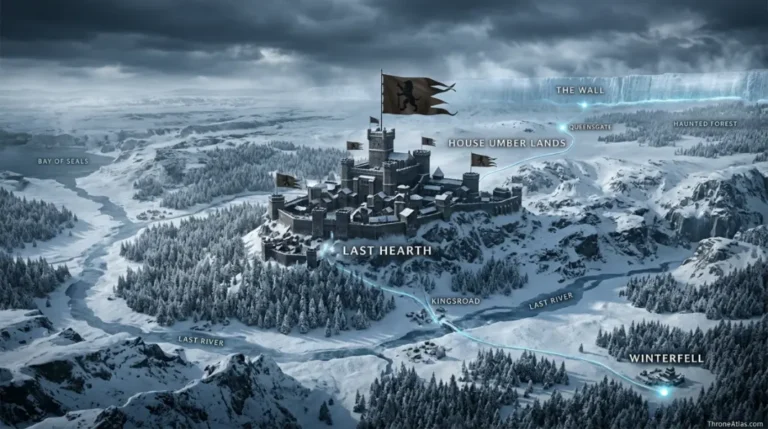
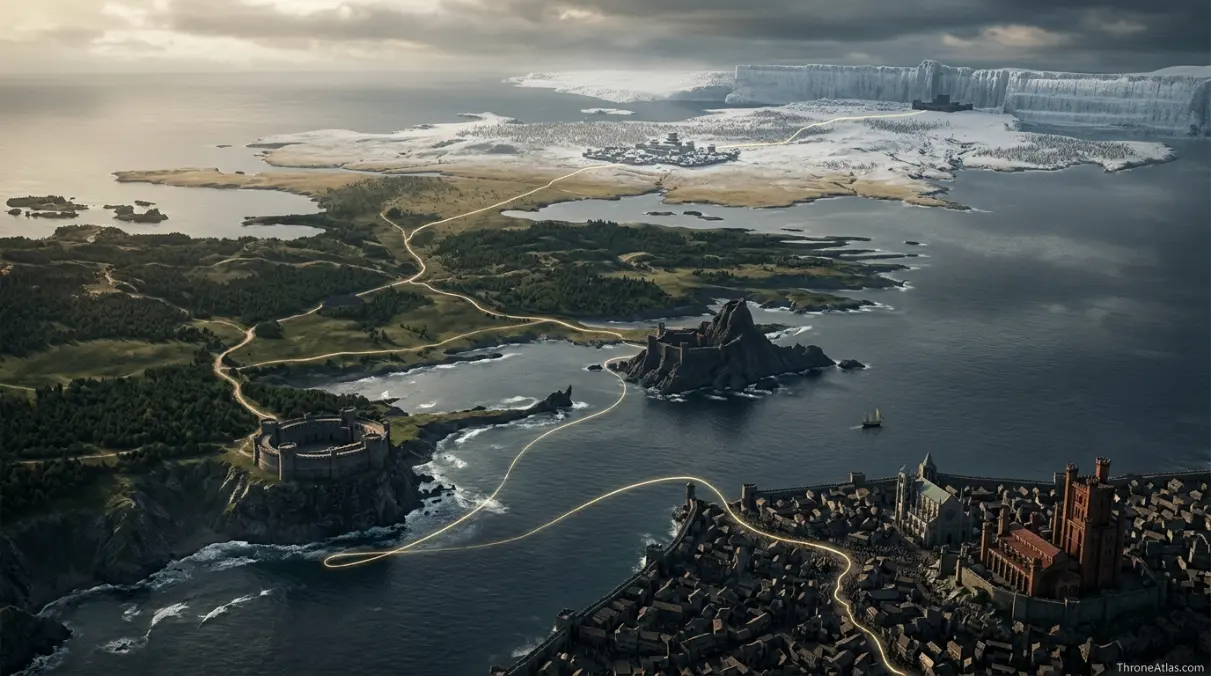
Davos Seaworth Journey MapFlea Bottom, Dragonstone, Blackwater & the Wall
King’s Landing, Stormlands, Dragonstone, Blackwater Bay, the Wall, the North · Smuggler route, envoy path, conscience map
Davos Seaworth journey map — A smuggler-to-counselor route atlas tracing Davos from lowborn survival through royal service, war, conscience, and northern diplomacy.
The Davos Seaworth journey map follows the Onion Knight from Flea Bottom and smuggling routes to Dragonstone, the Battle of Blackwater, Castle Black, Winterfell, and later counsel beside Jon and Daenerys. His route matters because Davos reads maps through supply, ships, ordinary people, and conscience rather than bloodlines.
Page Index
Davos Seaworth Journey Map at a Glance
Key route details before the full character map breakdown.
Davos Seaworth Journey Map: What the Route Really Shows
The Davos Seaworth journey map is more than a list of places visited by Davos Seaworth. It is a geographic reading of how power, loyalty, survival, ambition, and public reputation move across Westeros and Essos. A character route becomes useful when it explains why one place changes the next place. This page follows the route through King’s Landing, Stormlands, Dragonstone, Blackwater Bay, the Wall, the North, then connects those locations to nearby castles, houses, battles, and wider political pressure.
Davos is one of the clearest examples of social movement becoming geographic movement. He begins outside noble power, enters it through smuggling and loyalty, survives it through honesty, and keeps reading the map as a sailor rather than a lord. His stops are not only famous places; they are tests of whether practical sense can survive royal obsession.
The most important thing to understand is that Davos Seaworth does not move through neutral space. Every stop has a ruler, a road, a gate, a debt, a witness, a rumor, or a cost. The route therefore works like a map of consequences. A decision made in one hall may echo at a castle hundreds of leagues away. A meeting in a court can change a battlefield. A crossing, prison, feast, sermon, council room, or harbor can become the hinge of the route.
Visual Map Guide
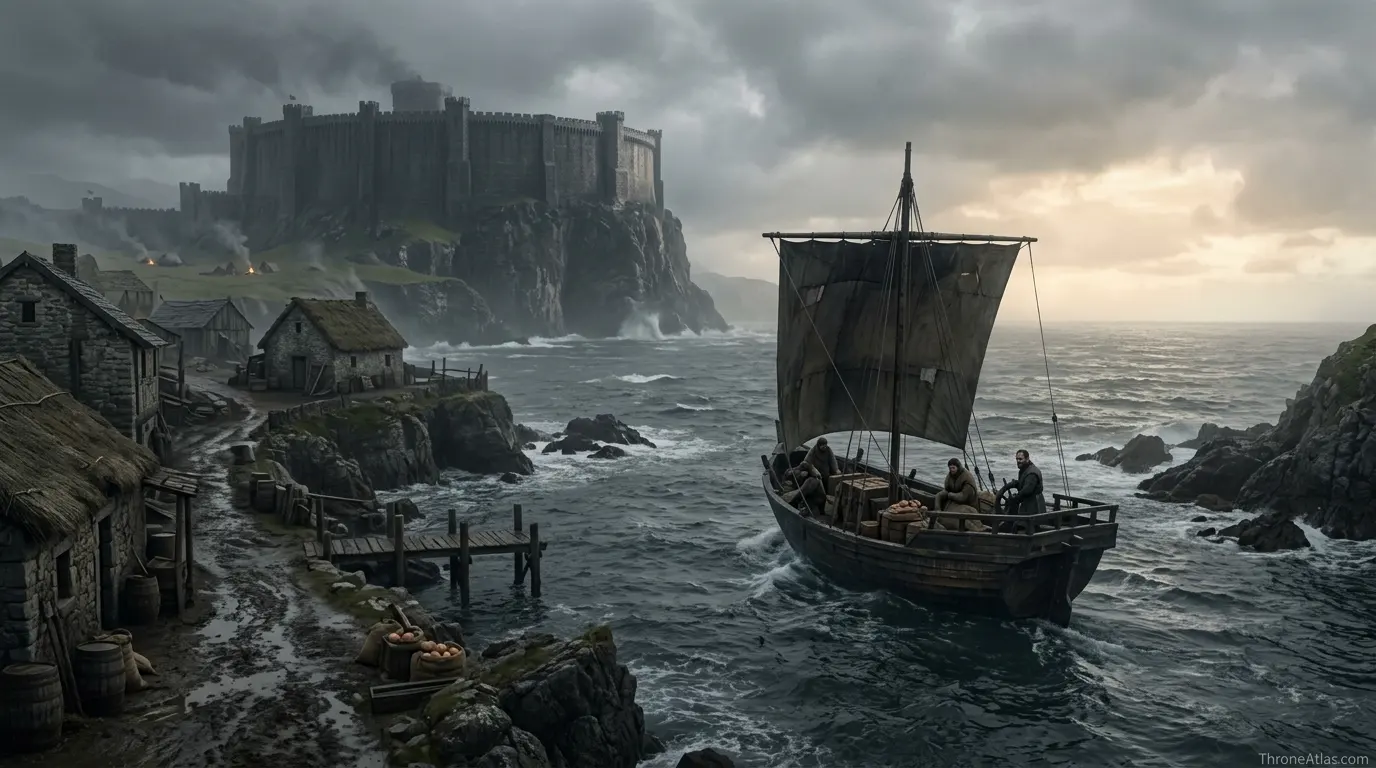
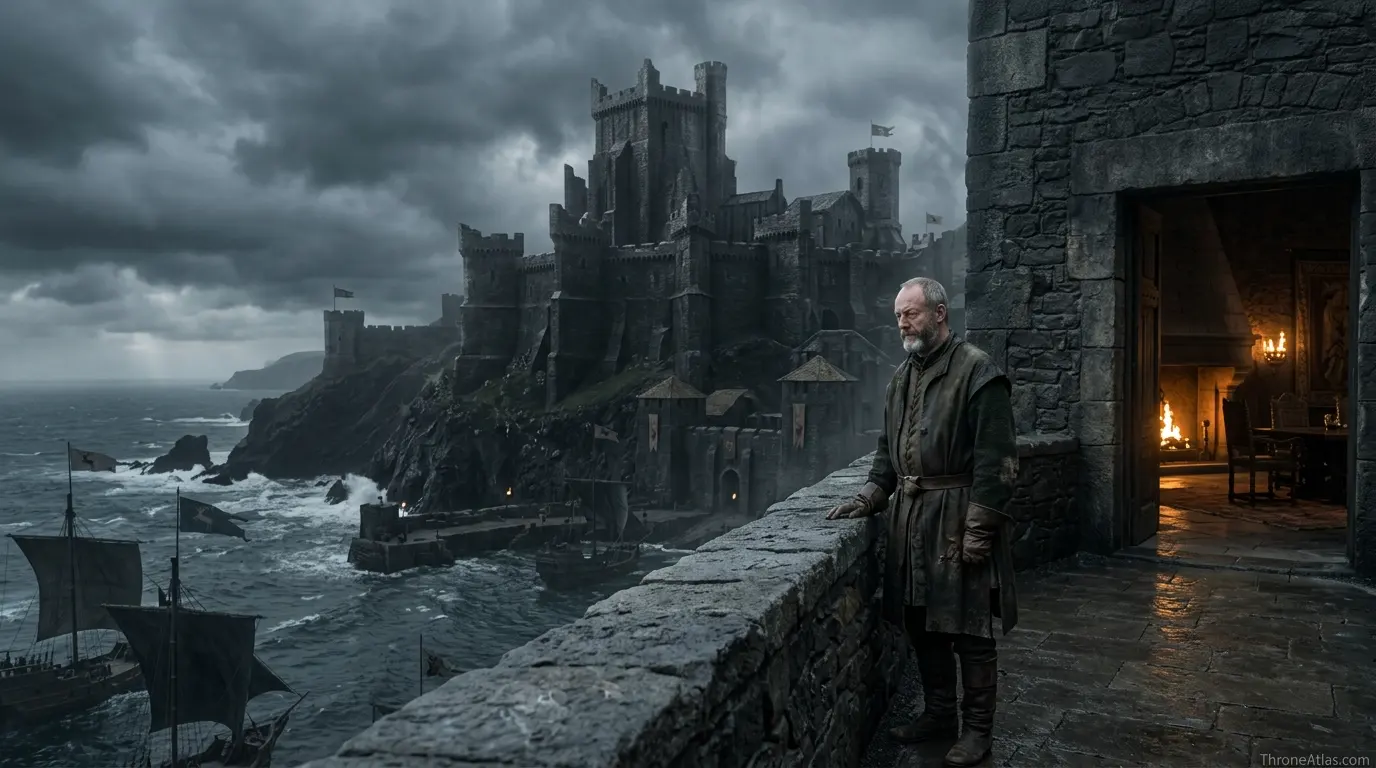
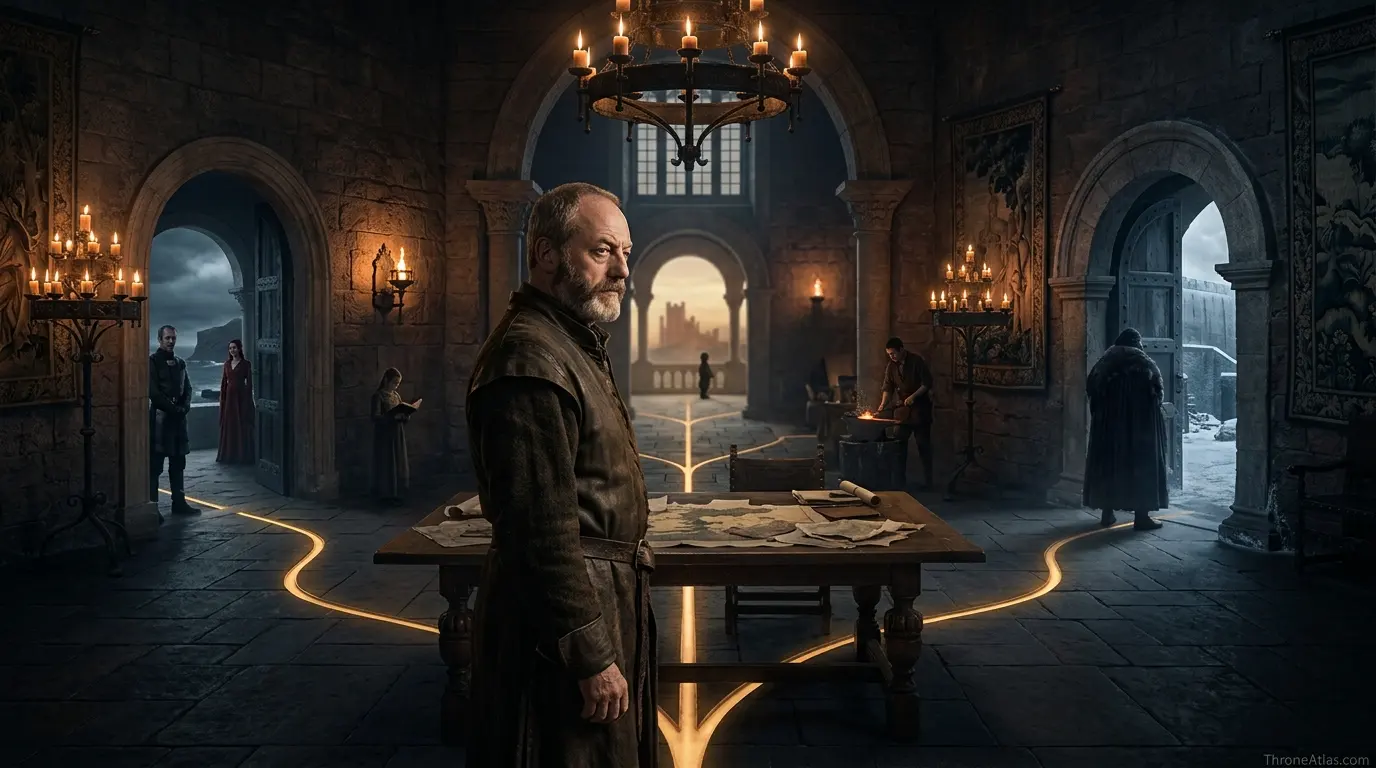
The visual guide below reduces the route to its clearest movement pattern. It is not meant to replace the full map; it shows the backbone of the journey so readers can understand the order of pressure. Start at the first stop, follow the curved route lines, and notice how each point changes the type of power available to Davos Seaworth.
A strong character map should answer four questions: where the character begins, which place changes the route, where the character gains or loses influence, and which location carries the consequence forward. For Davos Seaworth, those answers are tied to Flea Bottom, Storm’s End, Dragonstone, Blackwater Bay, and the later route only makes sense when those early map pressures are understood.
Journey Route and Location Logic
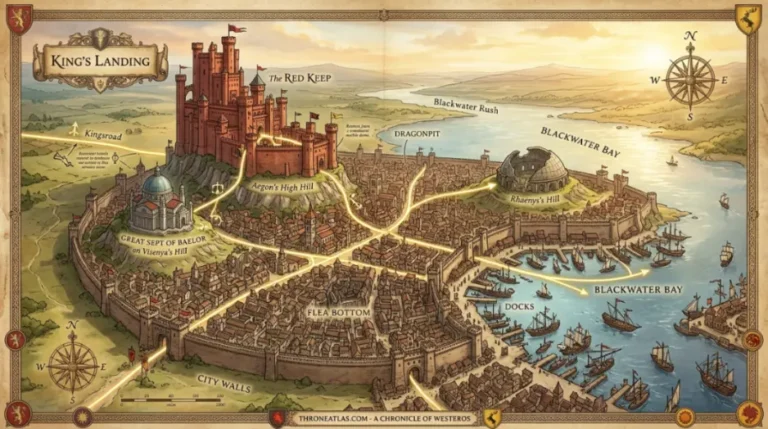
The route begins in poverty and sea craft, reaches Dragonstone through service to Stannis, crosses the Blackwater in disaster, then moves north as Davos becomes a bridge between claimants, commanders, and ordinary survival.
- Flea Bottom: Lowborn Origin — Davos’s early life explains why he sees the capital from below rather than from the Red Keep.
- Storm’s End: Smuggler’s Deed — His onion run during siege gives him title, loyalty, and permanent debt to Stannis.
- Dragonstone: Counsel Seat — The island becomes his court school, prison, and moral battleground.
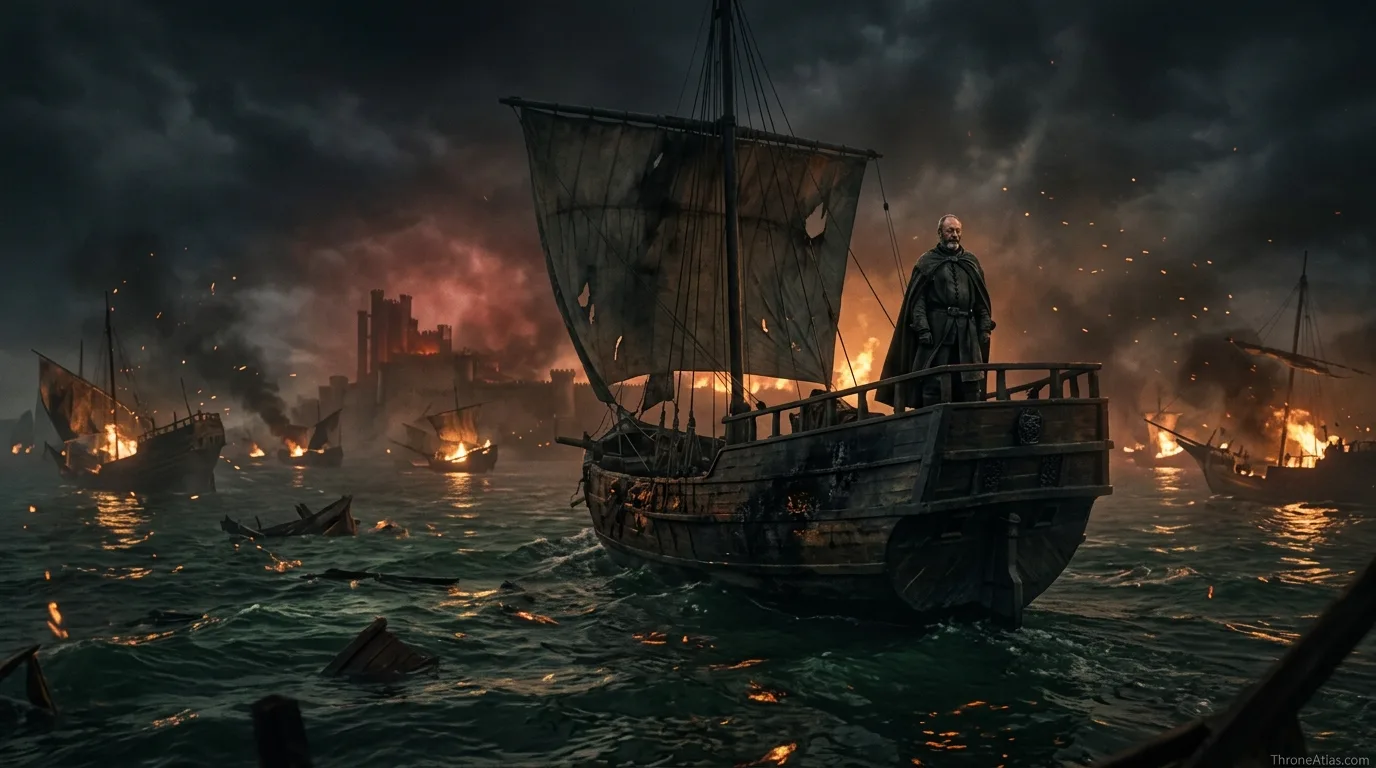
- Blackwater Bay: Fire and Loss — The battle burns his fleet, sons, and illusions about clean war.
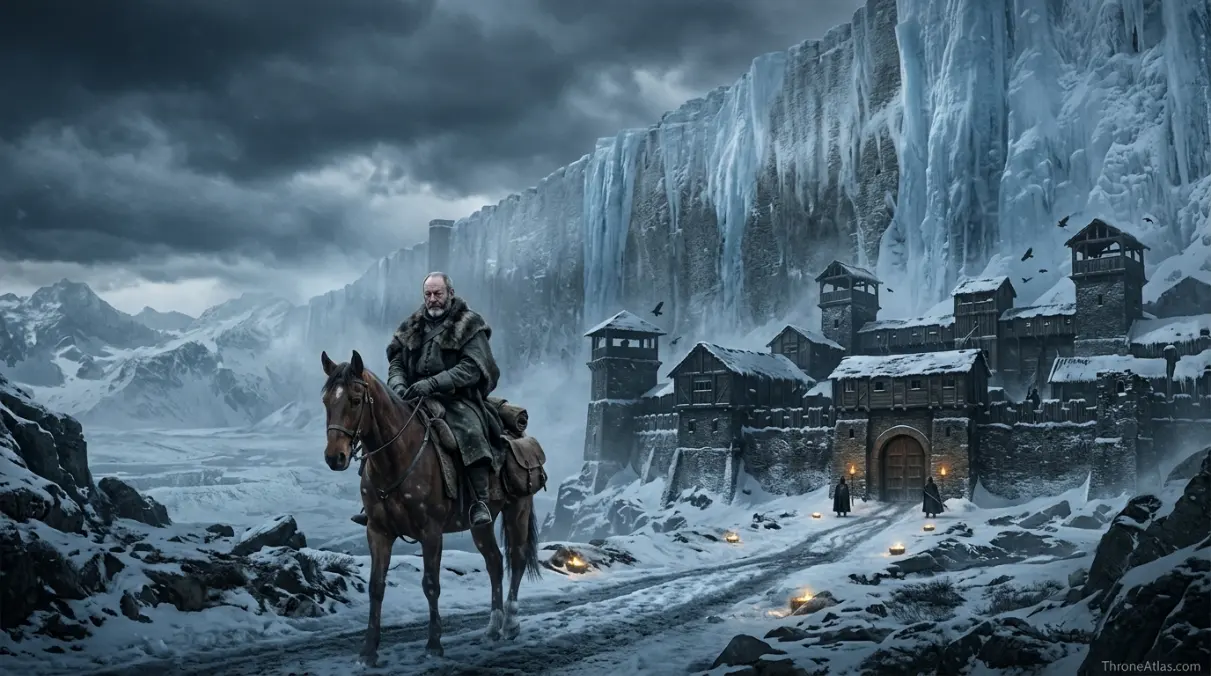
- Castle Black: Northern Envoy — Davos helps connect Stannis, Jon Snow, and the wider northern survival map.
These stops also show why this page belongs beside the location and house maps instead of standing alone. A route page explains motion, but the nearby maps explain why the motion matters. The castle pages show local power. The battle pages show what the movement causes. The house pages show why certain doors open or close. Together, they turn the route into a readable atlas path.
Route Sequence and Turning Points
The sequence below breaks the route into map stages. A stage may be a physical journey, a political rise, a loss of protection, a public victory, a hidden maneuver, or a retreat into a new alliance. Reading the sequence this way prevents the page from becoming a simple biography. It keeps geography at the center.
| Stage | Route Event | Map Meaning |
|---|---|---|
| 1 | Davos rises from smuggling to knighthood through Storm’s End. | A hidden supply route creates a noble identity. |
| 2 | He serves Stannis on Dragonstone despite court contempt and religious tension. | Dragonstone tests whether loyalty requires obedience. |
| 3 | The Blackwater defeat nearly kills him and strips away family certainty. | The sea battle makes personal cost visible. |
| 4 | He returns as a blunt advisor who challenges Melisandre and protects Edric in the book route. | Davos’s route gains moral authority after loss. |
| 5 | At the Wall, Davos becomes a northern negotiator and witness to larger threats. | The Wall shifts him from Baratheon loyalist into realm-wide advisor. |
| 6 | He continues as counsel in the final wars because he can speak plainly to power. | His final position is earned through survival and honesty, not birth. |
Notice how the route changes whenever Davos Seaworth enters a new power environment. A northern castle, a royal capital, a free city, a river crossing, a war camp, a citadel, a harbor, or a sacred site all create different rules. Characters who survive the game do not only survive swords; they survive rooms, roads, courts, ships, and the political meaning attached to each place.
Power Network, Allies, and Rivals
A character map should identify the people around the route, because movement in Westeros rarely happens alone. Companions, patrons, informers, captors, rivals, sworn shields, advisors, priests, bankers, and family members all change the shape of the path. For this route, the strongest network figures are connected to access, trust, leverage, and regional pressure.
Stannis Baratheon
Gives Davos status and purpose, while also forcing him to oppose cruel decisions.
Melisandre
Creates the central moral conflict around prophecy, sacrifice, and royal desperation.
Shireen Baratheon
Represents the innocence Davos tries to protect inside a harsh claimant route.
Jon Snow
Becomes a later leader Davos can support because the Wall changes the war map.
Tyrion Lannister
Opposes Davos at Blackwater, where clever city defense beats naval assault.
Gendry
Connects Davos to escape routes, royal blood, and practical rescue work.
The network also explains why the same location can mean different things at different times. King’s Landing can be a court, a prison, a stage, or a trap. Dragonstone can be a refuge, a claim, or a launch point. The Wall can be exile, duty, prophecy, or survival. A good route map shows those changing meanings without flattening them into simple travel pins.
Houses, Claims, and Regional Stakes
The houses most connected to this page are House Seaworth, House Baratheon, House Stark, House Targaryen, Night’s Watch, House Lannister. Their presence matters because noble houses are territorial engines. They control castles, roads, armies, titles, marriages, food, ships, wards, prisoners, and the social meaning of loyalty. When Davos Seaworth moves near one of these houses, the map becomes political.
House Seaworth
House Seaworth shapes this page because its territory, claim, patronage, marriage tie, or rivalry changes how Davos Seaworth moves through the map.
House Baratheon
House Baratheon shapes this page because its territory, claim, patronage, marriage tie, or rivalry changes how Davos Seaworth moves through the map.
House Stark
House Stark shapes this page because its territory, claim, patronage, marriage tie, or rivalry changes how Davos Seaworth moves through the map.
House Targaryen
House Targaryen shapes this page because its territory, claim, patronage, marriage tie, or rivalry changes how Davos Seaworth moves through the map.
Night’s Watch
Night’s Watch shapes this page because its territory, claim, patronage, marriage tie, or rivalry changes how Davos Seaworth moves through the map.
House Lannister
House Lannister shapes this page because its territory, claim, patronage, marriage tie, or rivalry changes how Davos Seaworth moves through the map.
House Seaworth is minor, but that is exactly why the route works. Davos can enter great-house spaces without believing their myths. House Baratheon gives him loyalty, House Stark gives him later northern relevance, and House Targaryen brings him into the final war councils.
Major Turning Points on the Map
The turning points in this route are not only dramatic scenes. They are changes in access. A gate opens, a title is granted, a ruler dies, a secret becomes dangerous, a ship leaves port, a battle redirects loyalty, or a powerful person loses the protection of place. That is why maps are so useful for character pages: they show when the world around the character changes shape.
The onion run at Storm’s End creates his social ascent. Blackwater transforms his loyalty into grief. Castle Black expands his route beyond Stannis. His later counsel shows that a lowborn smuggler can become one of the safest readers of the realm’s map.
For readers building a mental map, the important move is to connect each turning point to a location. Once the event is tied to a place, the wider network becomes easier to follow. The route can then be compared with nearby battle maps, house maps, and castle pages.
Book and Show Map Notes
The books give Davos more envoy work, especially around White Harbor and northern politics. The show compresses that into a clearer path from Stannis to Jon and Daenerys. Both versions keep the same essence: Davos moves through power while remembering hunger, ships, and children.
The atlas approach keeps those differences clear by focusing on stable location logic: which places are essential to the route, which places are emphasized differently, and which movements change the reader’s understanding of power. That method lets book readers and show viewers share the same map without pretending every version uses the same pacing.
Common Map Mistakes
Common mistakes usually happen when a reader remembers a famous quote, a single scene, or a final title and forgets the route that made it possible. The points below help keep the map accurate when adding image captions, building route diagrams, or linking this page to nearby atlas entries.
- Treating Davos as only Stannis’s sidekick rather than a route expert shaped by coasts, sieges, and lowborn survival.
- Forgetting Storm’s End, the map event that creates the Onion Knight identity.
- Mapping him only through battles and missing his envoy, prison, rescue, and counsel routes.
A reliable route map should make these mistakes harder to repeat. It should show beginning, pressure, turning point, and consequence in one readable path. That is the difference between a decorative map and a useful ThroneAtlas route guide.
Cartographer Reading Notes
The best way to read this page is to separate movement into three layers. The first layer is physical geography: roads, seas, castles, gates, districts, rivers, islands, camps, and borders. The second layer is political geography: who controls those places and what the character can or cannot do there. The third layer is memory: how later characters remember that movement and use it to judge loyalty, guilt, claim, wisdom, or betrayal.
For Davos Seaworth, all three layers matter. The physical route explains the visible journey. The political route explains which doors open or close. The memory route explains why the character remains important after leaving a place. That is why this guide includes both route sequence and network analysis.
When final page images are selected, the best visual set should include one wide route map, one close-up of the most important castle or city, one symbolic image for the character’s power shift, and one related-location image that sends readers deeper into the atlas. This gives the page visual clarity without repeating the same scene.
The final test is simple: after reading this page, a visitor should be able to explain where Davos Seaworth begins, which location changes the route, which houses shape the choices, and which page to open next. If those four answers are clear, the map is doing real atlas work.
Location Deepening: How to Read Each Stop
A high-value route page should never treat a stop as a dot with a label. A stop has at least four layers: the visible place, the authority that controls it, the emotional pressure attached to it, and the consequence that leaves with the character. This is especially important for Davos Seaworth, because the route is shaped by changing access. The same road can feel like escape in one chapter and duty in another. The same castle can be a sanctuary, a prison, a court, or a battlefield depending on who controls the gate.
The first layer is the visible place. This includes the castle, road, harbor, district, island, camp, field, or institution a reader can identify on a map. The second layer is authority: who has guards, ravens, ships, coin, oaths, food, or legal command in that place. The third layer is emotional pressure, because characters do not arrive as empty travelers. They bring fear, debt, ambition, love, grief, shame, faith, or loyalty. The fourth layer is consequence, which is the reason the route continues after the scene ends.
For Davos Seaworth Journey Map, the most useful reading is to follow those four layers in order. Begin with the physical stop. Ask who controls it. Ask what Davos Seaworth needs there. Then ask what changes after departure. If nothing changes, the stop is decorative. If a title, secret, alliance, grief, rescue, betrayal, or public image leaves with the character, the stop belongs on the main route.
This method also helps separate major route anchors from minor travel references. A map can include many places, but the article should prioritize locations that change the route. That keeps the page focused and prevents the reader from getting lost in every possible movement. The aim is not to list every road; the aim is to show the places that explain the character’s power.
Best Reading Path After This Page
After finishing this route, the strongest next step is to open one location page, one house page, one battle or event page, and one related character route. That four-page path gives the reader a complete atlas loop. The location page explains ground. The house page explains authority. The battle or event page explains conflict. The related route explains how another character experiences the same map from a different angle.
For Davos Seaworth, the route is especially useful when compared with the people listed in the power network section. Allies and rivals often pass through the same regions but read them differently. One person may see King’s Landing as opportunity while another sees danger. One person may see the Wall as exile while another sees duty. Comparing those readings makes the wider ThroneAtlas structure stronger because it turns separate pages into a shared geography.
The page also works as a bridge for readers who arrive from search, social posts, Pinterest images, or a direct map query. A visitor may only want to know where the route goes, but the guide should gently show why the route matters. That is why the quick answer, fast facts, route board, image captions, network cards, and related links all point toward the same goal: clearer map understanding.
When the page is published with final artwork, image captions should stay specific. A useful caption names the route, the place, and the reason the image matters. A weak caption only repeats the title. For this page, the best image set should help readers understand sequence: beginning, pressure, turning point, consequence, and next route.
That final image strategy matters because ThroneAtlas is a map-first site. Readers come for place clarity, not just lore retelling. The content should therefore reward scanning, support deep reading, and make every internal link feel like a sensible next step in the atlas.
Follow the Wider Character Map
Use these related maps to move from this route into nearby locations, houses, battles, and lore paths.
Houses & Power
More Atlas Paths
Davos Seaworth Journey Map Questions
Clear answers to common reader questions about the character route, key locations, and connected houses.
The Davos Seaworth journey map follows Davos Seaworth through King’s Landing, Stormlands, Dragonstone, Blackwater Bay, the Wall, the North, showing the places, alliances, reversals, and power centers that define the route.
Davos matters because he connects lowborn experience to high politics, turning practical travel knowledge into royal counsel.
The most important stops are Flea Bottom, Storm’s End, Dragonstone, Blackwater Bay, Castle Black. Each stop changes the route from travel into political meaning.
The strongest house links are House Seaworth, House Baratheon, House Stark, House Targaryen, Night’s Watch, House Lannister. These houses explain why the route affects more than one region.
Yes. The books give him deeper northern envoy material, while the show makes his advisor role more direct.
Treating Davos as only Stannis’s sidekick rather than a route expert shaped by coasts, sieges, and lowborn survival.
Explore the Full Westeros Route Atlas
Place this character route beside the main map hub, related locations, house pages, and battle maps to follow how movement turns into power across the realm.
ThroneAtlas is an independent fan-made atlas resource. It is not affiliated with HBO, Warner Bros., or George R. R. Martin. All names and references are used for commentary, research, and educational fan mapping.