Renly Baratheon Journey Map: King’s Landing, Highgarden, Bitterbridge & Storm’s End
A political journey map showing how Renly escaped the capital, built a Reach alliance and marched with overwhelming strength before his campaign ended outside Storm’s End.
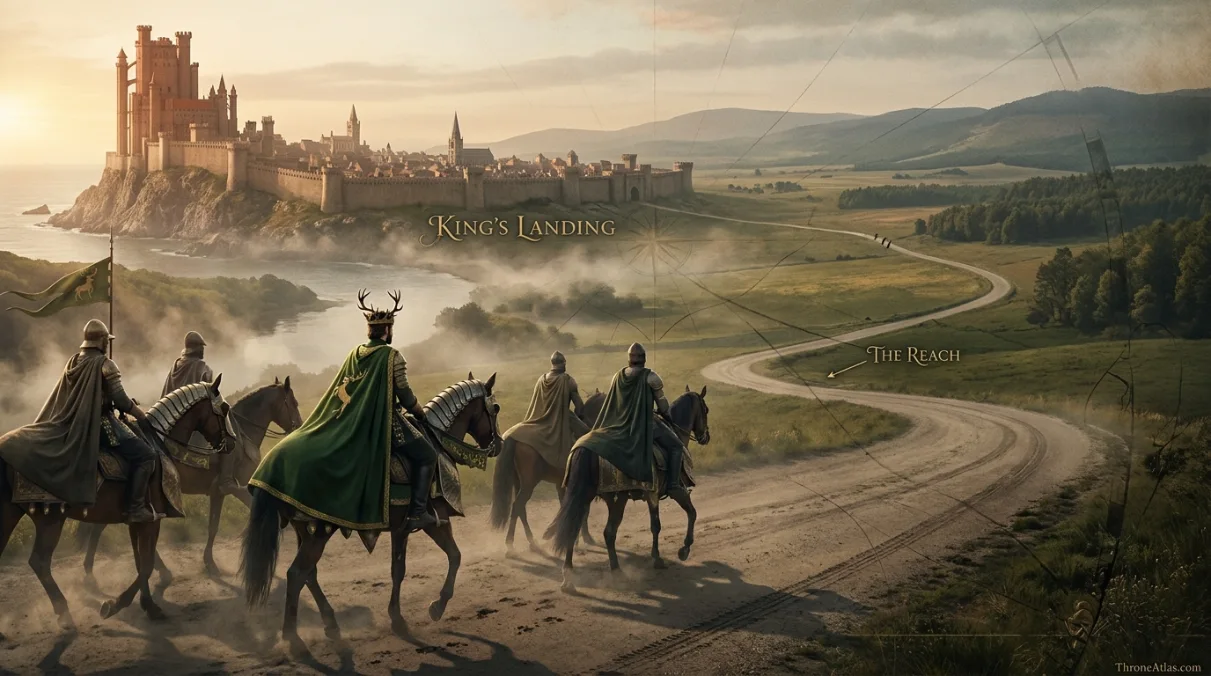
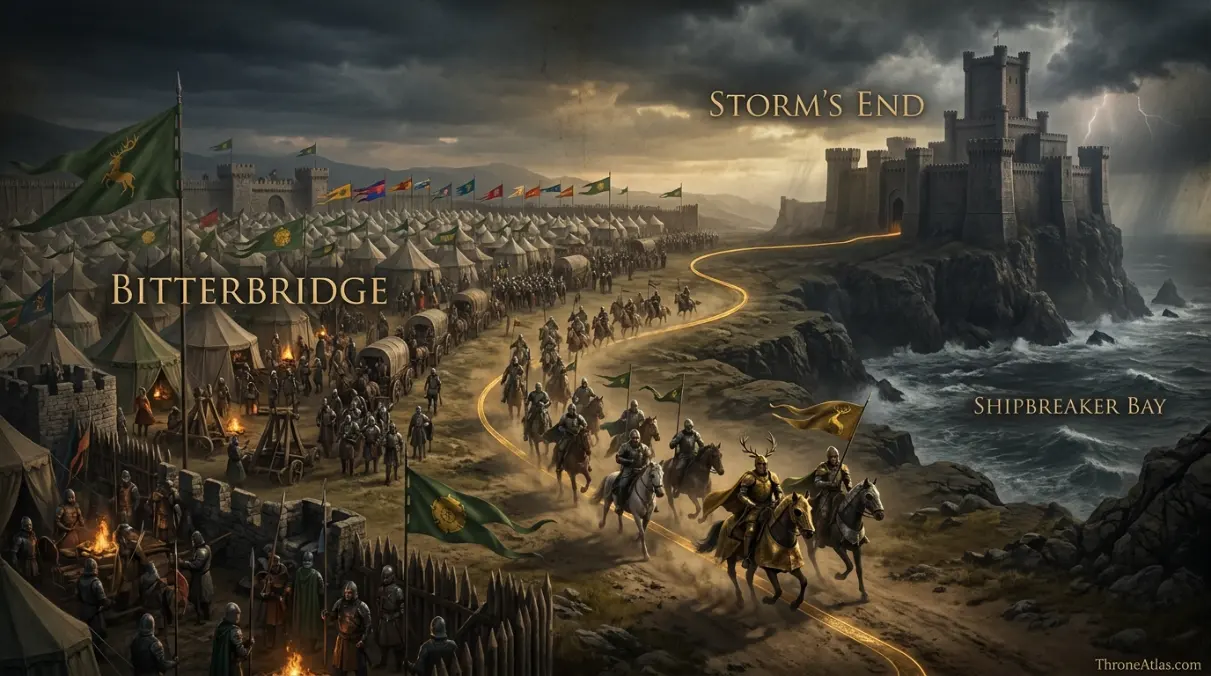
Renly Baratheon leaves King’s Landing after Robert’s death, travels into the Reach, marries Margaery Tyrell at Highgarden and gathers a huge host. His army advances slowly along the roseroad and camps at Bitterbridge. When Stannis besieges Storm’s End, Renly takes his cavalry east to confront him, but Renly is killed before the planned battle.
From Escape Route to Royal Progress
The map divides Renly’s journey into two tempos. From King’s Landing through Highgarden and Bitterbridge, movement is political and deliberately measured. From Bitterbridge toward Storm’s End, the pace changes as Renly takes cavalry to answer Stannis’s siege.

Canon Confidence & What This Map Claims
ThroneAtlas separates confirmed geography from useful reconstruction so a clean digital map never appears more certain than the underlying source.
Read the Map From Anchors to Story
- Visual Atlas
- Canon Confidence
- Key Takeaways
- Locations & Route Table
- Leaving King’s Landing: Renly’s First Strategic Success
- Highgarden: Marriage Turns a Claim Into a Coalition
- The Roseroad: Why Renly Moves Slowly
- Bitterbridge: The Coalition at Maximum Visibility
- Storm’s End: The Journey Ends Before the Battle Begins
- After Renly: How the Same Roads Carry New Alliances
- Fast Answers
- Sources & Method
- FAQs
Renly’s Route Is a Campaign of Political Momentum
Leaving King’s Landing preserves freedom of action
Renly avoids being trapped in the capital after Robert’s death.
Highgarden transforms his claim
The Tyrell marriage supplies wealth, food, prestige and an enormous Reach host.
The roseroad becomes political theatre
Renly does not rush; the slow progress demonstrates confidence and lets support gather.
Bitterbridge is the coalition on display
The camp shows the scale and diversity of the nobles backing him.
Storm’s End creates a personal strategic crisis
Stannis attacks the Baratheon seat and challenges Renly’s claim directly.
Cavalry movement changes the tempo
Renly leaves the slower main host and rides east with mounted strength.
Death stops the route before battle
The campaign ends through assassination, not battlefield defeat.
The coalition’s geography survives Renly
After his death, Reach forces and Baratheon loyalties redirect toward different claimants.
Places, Routes & Strategic Connections
| Map Anchor | Type | Why It Matters |
|---|---|---|
| King’s Landing | Start | Renly leaves the capital after Robert’s death rather than remain under Lannister control. |
| Highgarden | Alliance | The Tyrell alliance is consolidated here through Renly’s marriage to Margaery. |
| Roseroad Axis | Route | The major route connecting the Reach with King’s Landing and structuring Renly’s royal progress. |
| Bitterbridge | Camp | The great camp where Catelyn Stark encounters Renly’s enormous host. |
| Reach Host | Army | The slower main army whose size gives Renly political theatre and military weight. |
| Storm’s End | Destination | The Baratheon seat besieged by Stannis and the destination of Renly’s rapid cavalry movement. |
| Shipbreaker Bay | Water | The harsh maritime setting around Storm’s End and the final stage of Renly’s campaign. |
| Broken Return Path | Event | Renly’s death ends the planned battle and leaves his coalition to fragment and realign. |
Leaving King’s Landing: Renly’s First Strategic Success
Renly’s claim begins with movement. After Robert Baratheon dies, King’s Landing becomes dangerous for anyone who cannot control the court, the gold cloaks or the succession. Renly recognizes that staying in the capital would leave him vulnerable to Lannister power.
His departure is therefore more than escape. It preserves political freedom. Outside the city, he can use his connections in the Reach, his Baratheon identity and his relationship with the Tyrells to build a power base far larger than anything he could command inside the Red Keep.
This is the first reason a journey map is useful. The succession crisis is often discussed as competing legal claims, but claims need geography. Joffrey has the capital. Stannis has Dragonstone and later his own supporters. Renly heads toward the Reach, where population, food and noble strength can turn personal ambition into an army.
The road away from King’s Landing therefore marks a shift from court politics to coalition politics. Once Renly is beyond Lannister control, Cersei cannot simply order his arrest. He has space to negotiate and gather support.
The move also takes him toward Highgarden, one of the richest and most influential seats in Westeros. That destination is not accidental. Renly’s existing relationship with the Tyrell circle means the Reach is the natural place to transform his popularity into a royal project.
On the atlas, King’s Landing is therefore a start marker rather than a home base. Renly’s campaign becomes possible because he leaves the most important city in the realm and builds power elsewhere.
Highgarden: Marriage Turns a Claim Into a Coalition
Highgarden is the political engine of Renly’s rise. His marriage to Margaery Tyrell does more than create a family alliance. It connects his claim to the resources of the Reach: great houses, fertile lands, cavalry, grain and enormous manpower.
This is one of the clearest examples in the series of marriage changing geography. A claimant from the Stormlands gains a political center deep in the Reach. His banners can now draw support from houses whose own seats stretch across the region.
The alliance also creates a visual contrast with Stannis. Stannis’s strength is narrower and more austere. Renly’s camp is colorful, socially magnetic and full of great lords. Highgarden’s abundance becomes part of the political message.
Food matters as much as knights. Large armies require huge quantities of grain, meat, fodder and transport. The Reach’s fertility gives Renly a logistical advantage that helps explain why his host can move with confidence.
Highgarden also provides legitimacy of a different kind. Renly may have a weaker hereditary claim than Stannis, but the public support of House Tyrell and many other nobles creates the appearance of a king already surrounded by a functioning aristocratic order.
The route from Highgarden toward King’s Landing is consequently not merely an invasion path. It is a royal progress. Renly can hold feasts, tourneys and councils while moving through friendly country.
The map places Highgarden far from Storm’s End on purpose. Renly’s campaign spans two regional identities: his Baratheon origin in the Stormlands and his military-political power base in the Reach. His kingship depends on linking them.
The Roseroad: Why Renly Moves Slowly
Renly’s march along the roseroad is famous for its lack of urgency. His host is enormous, and he is not initially trying to win through speed. He expects time to favor him.
The roseroad connects the Reach with King’s Landing, making it the obvious strategic artery for a claimant backed by Highgarden. It passes through productive country where a large army has better access to supplies than it would in devastated or hostile terrain.
Renly uses that advantage politically. The slow pace allows more knights and lords to join, lets his court display wealth and confidence, and gives the impression that victory is inevitable. He does not need to sprint toward the capital while his enemies weaken one another.
This strategy makes sense on a map. Joffrey’s regime faces pressure from multiple directions. Robb Stark is fighting in the west and Riverlands. Stannis has his own claim. Renly can advance from the south with the largest visible coalition and wait for rival powers to exhaust themselves.
But slowness has risks. Time also gives opponents room to act. Stannis’s decision to move against Storm’s End changes the situation in a way Renly cannot ignore.
The roseroad phase therefore represents strategic patience rather than incompetence. Renly’s army is large enough that marching quickly would be difficult anyway. Wagons, camp followers and thousands of horses stretch movement over miles.
The atlas depicts the roseroad as an axis, not a single exact line through every camp. The important fact is direction: Highgarden’s power is moving toward the capital until Storm’s End pulls Renly sideways into a family confrontation.
Bitterbridge: The Coalition at Maximum Visibility
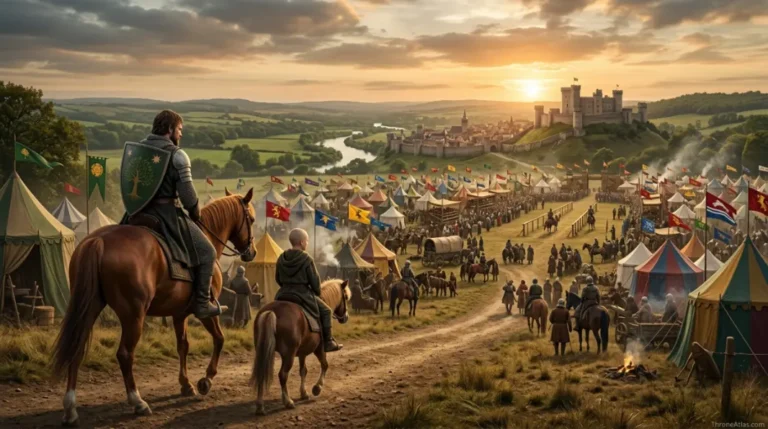
Bitterbridge is where Renly’s campaign becomes easiest to see as a political spectacle. The host gathered around him is vast, full of Reach and Stormlands nobles, knights, tents, banners and competing ambitions. Catelyn Stark’s arrival gives readers an outsider’s view of that confidence.
The location is important because it sits on the broader route between Highgarden and King’s Landing. Renly has advanced far enough to threaten the capital eventually, but he remains in friendly or supportive country with a strong supply base behind him.
At Bitterbridge, Renly can negotiate from apparent strength. He treats his crown as a political fact rather than a desperate claim. The camp itself becomes a temporary moving capital.
Catelyn’s presence introduces another geographic layer. She comes as an envoy from Robb Stark, whose power lies in the North and Riverlands. Their negotiations reveal how difficult it is to combine factions even when they share enemies. Maps show the problem clearly: several anti-Lannister powers control different regions, but they do not share one command structure.
Then news of Stannis changes the camp’s purpose. Storm’s End is under threat. Renly cannot allow his older brother to seize the Baratheon ancestral seat unopposed while also claiming the throne.
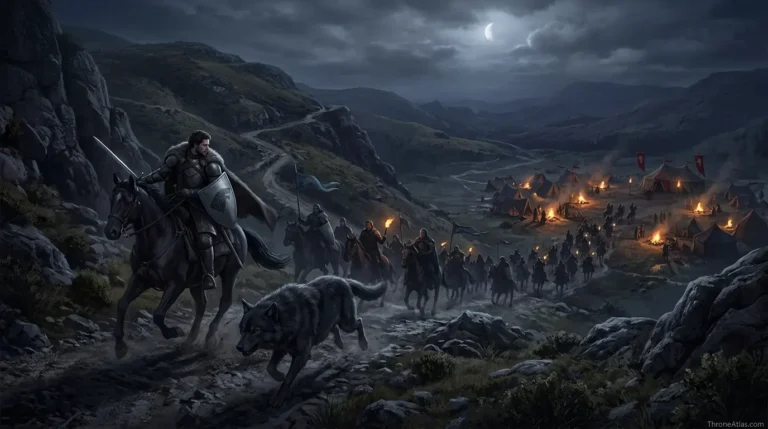
He therefore leaves much of the slower host behind and moves rapidly with cavalry. Bitterbridge becomes a split point on the journey map: the large coalition remains, while the claimant himself rides east.
This split is crucial. Renly’s political strength is enormous, but not all of it is physically present at Storm’s End when his life ends. After his death, the forces left behind become prizes for other claimants.
Storm’s End: The Journey Ends Before the Battle Begins
Storm’s End is more than a strategic castle to Renly and Stannis. It is their family seat, the fortress associated with House Baratheon and the place Robert once granted to Renly. When Stannis besieges it, military strategy and family grievance become inseparable.
Renly rides east to confront his brother, bringing cavalry and leading supporters. The planned battle promises to decide which Baratheon claimant will dominate their shared regional base.
Geography favors drama. Storm’s End stands above Shipbreaker Bay, surrounded by a landscape already associated with storms, massive fortification and dynastic legend. Two brothers meet near the seat that symbolizes their house while both claim a crown won originally by their elder brother.
Yet the battle never occurs in the expected form. Renly is killed by the shadow associated with Melisandre and Stannis. His route ends not with defeat in open battle but with sudden death inside his own camp.
That distinction matters for the map. There is no legitimate “Renly’s final battle formation” to reconstruct as though two armies completed a conventional clash. The key geographic event is the convergence at Storm’s End and the abrupt collapse of Renly’s command.
His death instantly changes the meaning of every marker behind him. Bitterbridge becomes a camp without its king. Highgarden becomes a center whose rulers must choose a new political direction. Many Stormlands lords shift toward Stannis, while the Tyrells eventually make a different alliance.
The journey is therefore unfinished by design. The line stops at Storm’s End because Renly’s political geography is broken there.
After Renly: How the Same Roads Carry New Alliances
Renly’s death does not erase the army he built. It redistributes it. This is one of the most important reasons to keep his journey connected to the wider War of the Five Kings map.
Many Stormlands lords who had followed Renly move toward Stannis, giving the older Baratheon brother new strength. The Tyrell leadership, however, eventually aligns with the Lannisters. Margaery’s royal marriage project survives, but the groom changes.
That new alliance turns the roseroad and Reach supply network toward a different purpose. Instead of carrying Renly’s claim toward King’s Landing, Reach power helps rescue the city from Stannis at the Battle of the Blackwater.
The same geography therefore supports opposite political outcomes within a short period. Highgarden remains where it was. Bitterbridge remains on the road. Storm’s End remains the Baratheon fortress. What changes is who controls armies and where those armies are ordered to go.
This illustrates a core principle of ThroneAtlas mapping: routes do not belong permanently to one character. They are infrastructure used by successive coalitions.
Renly’s campaign leaves behind a ready-made network of mobilized nobles, supplies and marching routes. His death is a political shock, but that network can be repurposed quickly.
For readers, this makes the journey more consequential than a failed claim that ended early. Renly assembled the coalition whose pieces later reshape the war. His route from King’s Landing to Highgarden, Bitterbridge and Storm’s End is therefore also the prehistory of the Lannister-Tyrell order that emerges after Blackwater.
Fast Answers About the Map
He went into the Reach, allied with House Tyrell and married Margaery at Highgarden.
The Tyrell alliance gave his claim enormous political, military and logistical support.
The campaign broadly follows the roseroad axis from the Reach toward King’s Landing.
Bitterbridge is the key camp where his vast coalition is described and where Catelyn Stark meets him.
He rode east with cavalry after learning that Stannis was besieging Storm’s End.
No. Renly was killed before the planned battle took place.
His coalition split, with many Stormlands supporters joining Stannis while the Tyrells later allied with the Lannisters.
No. The major anchors are clear, but the exact day-by-day camp route is not fully specified.
What This Atlas Is Based On
- George R. R. Martin’s A Game of Thrones and A Clash of Kings for Renly’s departure, Tyrell alliance, Bitterbridge camp and Storm’s End confrontation.
- Published maps of the Reach, Crownlands and Stormlands for the roseroad and major route anchors.
- The World of Ice & Fire for broader Baratheon and Tyrell political context.
- The atlas connects secure locations while treating unrecorded daily camps and minor roads as approximate.
Continue Exploring ThroneAtlas Maps
Renly Baratheon Journey Map FAQs
Where does Renly Baratheon travel after Robert dies?
He leaves King’s Landing, builds his power in the Reach around Highgarden and later advances through Bitterbridge before riding to Storm’s End.
Why did House Tyrell support Renly?
Renly’s alliance with the Tyrells included his marriage to Margaery and offered the family a path to royal power.
How large was Renly’s army?
It was described as an exceptionally large coalition, drawing heavily from the populous and wealthy Reach as well as Stormlands supporters.
Why did Renly march slowly?
He had numerical confidence, strong supplies and political reasons to let his coalition grow while rivals fought one another.
Where did Catelyn Stark meet Renly?
She encounters Renly and his enormous host at Bitterbridge.
Why did Stannis attack Storm’s End?
Taking the Baratheon ancestral seat would strengthen Stannis’s regional position and challenge Renly’s authority.
How did Renly die?
He was killed before battle by the supernatural shadow associated with Melisandre and Stannis.
Did Brienne travel with Renly?
Brienne served in Renly’s Rainbow Guard and was present during the final Storm’s End phase of his campaign.
What happened to the Tyrell army afterward?
The Tyrells later allied with the Lannisters and helped relieve King’s Landing at the Battle of the Blackwater.
Is the route line exact?
No. The major campaign locations are established, while unrecorded camps and minor road choices are shown schematically.
Why This Geography Matters
Renly Baratheon’s journey turns escape into coalition. King’s Landing is abandoned, Highgarden supplies a new power base, Bitterbridge displays overwhelming strength and Storm’s End forces a rapid confrontation. His death breaks the route, but the armies and roads he assembled continue shaping the war.