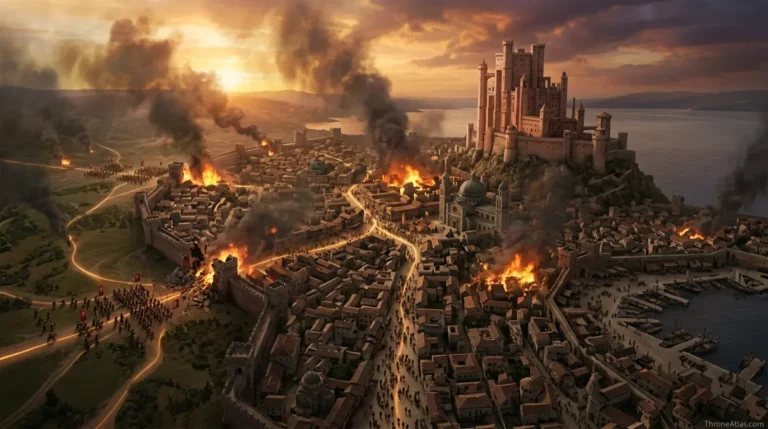
Ramsay Bolton Journey Map: Dreadfort, Winterfell, Moat Cailin & Barrowton
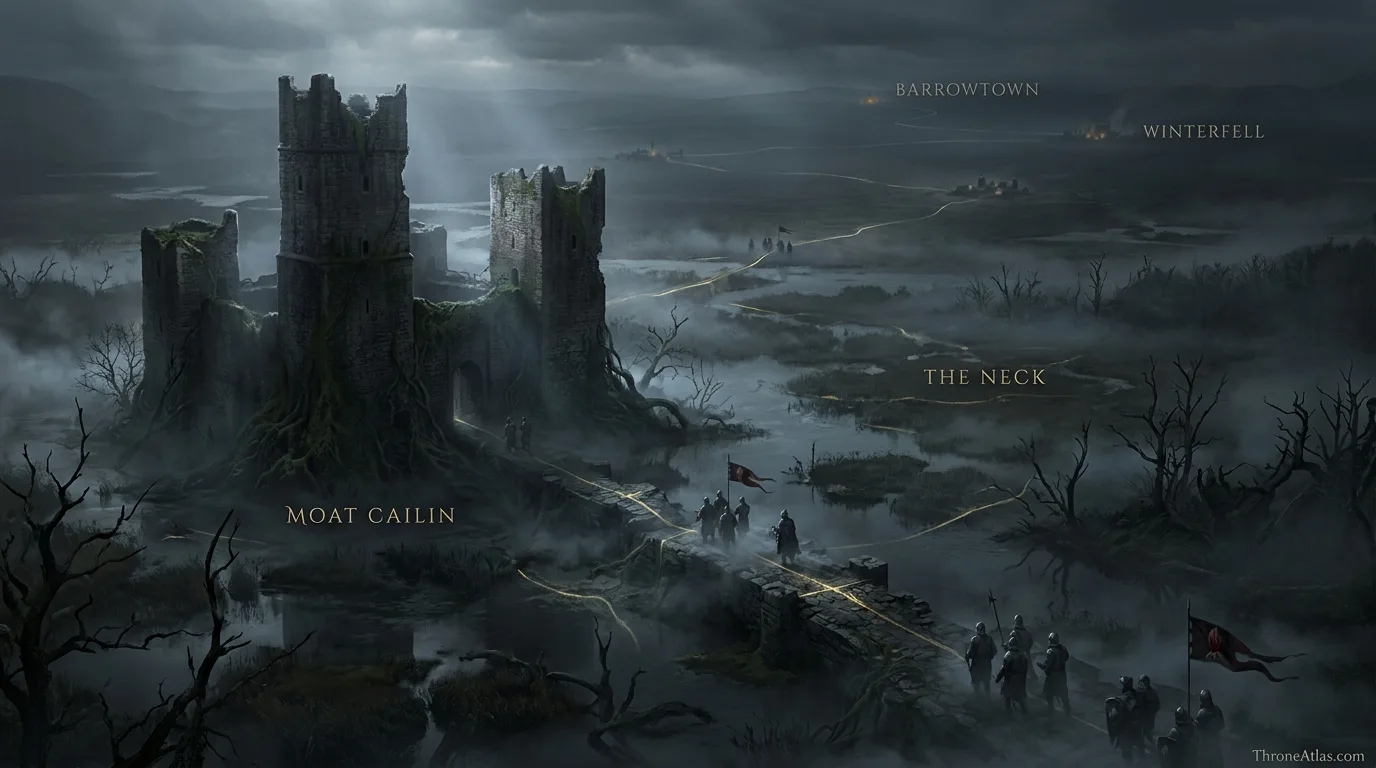
A dark northern campaign map tracing how Ramsay turns local violence around the Dreadfort into control of Winterfell and the strategic gateway at Moat Cailin.
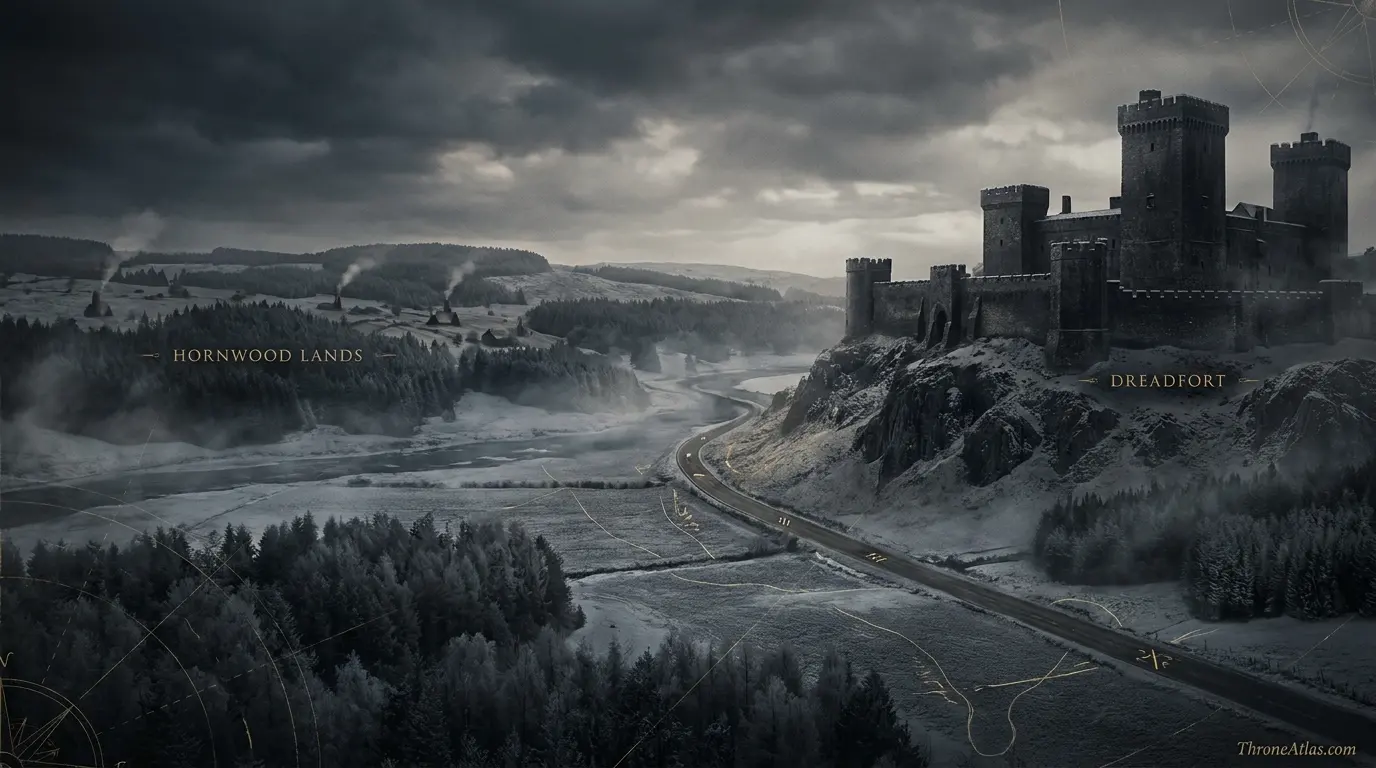
Ramsay Bolton’s northern route begins around the Dreadfort and disputed Hornwood lands, reaches Winterfell through his deception of Theon Greyjoy, later extends south to Moat Cailin through Theon’s forced role in the Ironborn surrender, and finally centers on Bolton-held Winterfell as northern resistance and Stannis Baratheon threaten the regime.
Map Ramsay as an Expansion of Bolton Control
The markers are arranged as a power network rather than a clean personal travel diary. Ramsay moves between these places, but the larger story is how Bolton influence expands from the Dreadfort toward Winterfell and the Neck. Book and HBO sequences diverge in important details, so the map keeps those layers distinct.
Canon Confidence & What This Map Claims
ThroneAtlas separates confirmed geography from useful reconstruction so a clean digital map never appears more certain than the underlying source.
Read the Map From Anchors to Story
- Visual Atlas
- Canon Confidence
- Key Takeaways
- Locations & Route Table
- The Dreadfort: Ramsay’s First Geographic Identity
- The Hornwood Lands: Violence Becomes Territorial Politics
- Winterfell: Deception, Destruction and Occupation
- Moat Cailin: Ramsay Uses Theon to Open the North
- Barrowton, Winterfell and the Uneasy Bolton Coalition
- Book Route vs HBO Route: Where Ramsay’s Geography Changes
- Fast Answers
- Sources & Method
- FAQs
Ramsay’s Map Is a Map of Stolen Places
The Dreadfort is the starting power base
Ramsay’s identity and resources originate in the Bolton sphere.
Hornwood is an early territorial escalation
His abuse of Lady Hornwood turns a succession dispute into personal seizure and terror.
Winterfell changes the scale of his story
The destruction and later occupation of the Stark seat moves Ramsay from local menace to northern power broker.
Theon becomes a geographic tool
Ramsay uses his broken captive not only personally but strategically, especially at Moat Cailin.
Moat Cailin controls north-south access
Its position in the Neck gives the Bolton regime a route advantage that ordinary castle maps can hide.
Barrowton exposes northern politics
Bolton control depends on uneasy alliances with other northern houses, not just fear.
Books and television diverge
Some Ramsay movements and victims differ significantly between the two versions.
The route is not a triumphal journey
The atlas emphasizes coercion, occupation and contested control rather than presenting the path as heroic exploration.
Places, Routes & Strategic Connections
| Map Anchor | Type | Why It Matters |
|---|---|---|
| Dreadfort | Base | The Bolton ancestral seat and Ramsay’s original center of family power in the North. |
| Hornwood Lands | Territory | The disputed lands where Ramsay’s violence and forced marriage to Lady Hornwood expand his local power. |
| Winterfell | Castle | The Stark seat that Ramsay helps destroy and later occupies under Bolton rule. |
| Barrowton | Political | A major northern political gathering point associated with the Bolton regime and Dustin influence. |
| Moat Cailin | Siege | The strategic gateway in the Neck where Theon is used to secure Ironborn surrender. |
| Neck Causeway | Route | The narrow north-south route whose control makes Moat Cailin strategically decisive. |
| Bolton Host | Army | A schematic army position showing the movement of Bolton power between the Neck and northern heartland. |
| Stannis Threat | Front | The western/southwestern pressure that eventually forces the Bolton regime to prepare for battle. |
The Dreadfort: Ramsay’s First Geographic Identity
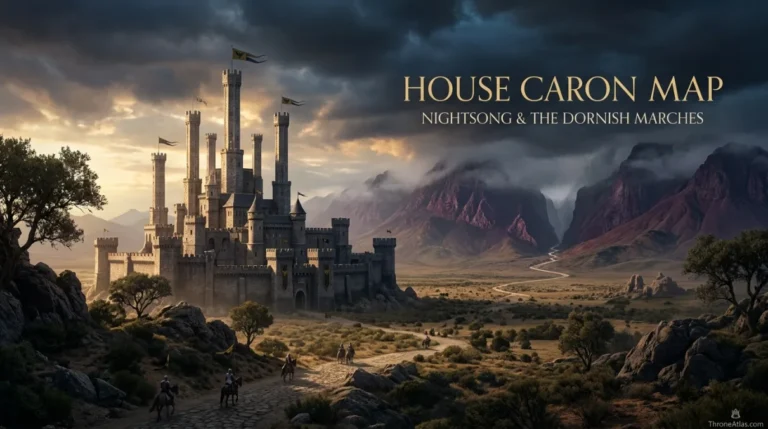
Ramsay is inseparable from the Dreadfort even before he holds the Bolton name openly. The castle is the ancestral seat of House Bolton, east of Winterfell, and represents a rival northern tradition whose history stretches back to the old Red Kings and centuries of conflict with the Starks.
For Ramsay, the Dreadfort is more than home. It is the source of men, fear and legitimacy he can eventually claim through Roose Bolton. His early actions make more sense when viewed from this local base rather than from Winterfell.
The surrounding northeast of the North is not empty. Noble lands, villages and roads connect the Bolton seat to neighboring houses. Ramsay’s ability to terrorize the region depends partly on the fact that he operates close enough to Dreadfort influence to draw on local knowledge and armed support.
The castle also provides a contrast with Winterfell. Winterfell represents the established Stark order and the broad loyalty many northern houses traditionally give that family. The Dreadfort represents a powerful bannerman house with its own darker history and ambitions. Ramsay’s later occupation of Winterfell therefore creates a geographic inversion: power originating from the Bolton seat moves into the Stark center.
This map does not attempt to draw every road Ramsay used around the Dreadfort. The novels establish the places more confidently than the exact tracks. What matters is the direction of expansion.
Starting at the Dreadfort also prevents the character from appearing suddenly at Winterfell without context. He is a product of a specific northern power base, and every later seizure extends that base outward.
The Hornwood Lands: Violence Becomes Territorial Politics
The Hornwood succession crisis is one of the earliest moments when Ramsay’s personal brutality becomes a question of land. After Lord Halys Hornwood and his heir die, competing interests emerge around the future of the house and its territory.
Ramsay forces Lady Donella Hornwood into marriage and takes the Hornwood name and claims for himself. The act is abusive and politically crude, but it reveals his instinct: people and territory are both things to be seized.
On a map, the Hornwood lands matter because they lie within the broader northern environment between major seats. This is not a distant campaign. It is local expansion near the Bolton sphere. Ramsay’s rise begins through exploiting weakness in neighboring noble geography.
The episode also shows how succession can redraw maps without a formal battle. If a house loses heirs, marriage becomes a route to land. That is why noble family trees and maps are inseparable in Westeros.
Ramsay’s treatment of Lady Hornwood destroys any pretense that this is ordinary dynastic negotiation. His methods turn the claim into terror. Northern lords react not simply because he is cruel but because his behavior threatens the rules through which property and inheritance are supposed to operate.
The Hornwood marker therefore represents more than one victim or one castle. It marks the point where Ramsay begins trying to convert violence into recognized territorial status.
That pattern will repeat on a much larger scale at Winterfell. Ramsay does not build legitimacy patiently. He enters weakened spaces, exploits political disorder and relies on fear to make possession look like authority.
Winterfell: Deception, Destruction and Occupation
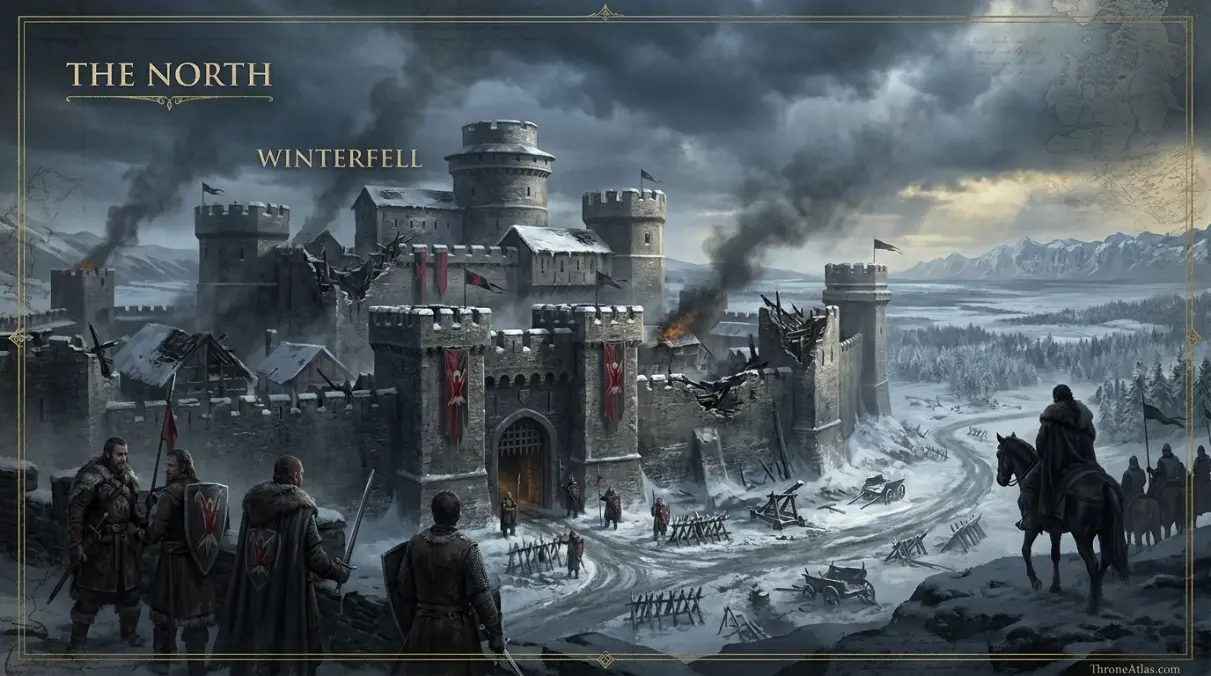
Ramsay’s relationship with Winterfell is central to his map because the Stark seat is the political heart of the North. In the book storyline, he first enters the Winterfell crisis through deception, presenting himself as Reek while Theon Greyjoy struggles to hold the castle.
When northern forces close in, Ramsay returns with Bolton men under the appearance of aid. He then turns on the remaining opposition, sacks Winterfell and captures Theon. This sequence matters geographically because control of the castle changes without a conventional long siege between two clearly identified armies.
Theon’s earlier seizure has already broken the normal Stark order. Ramsay exploits that disruption. The result is physical destruction and a political vacuum that House Bolton later fills after the Red Wedding destroys Robb Stark’s cause.
Winterfell then changes from a captured battlefield objective into the seat from which Bolton authority tries to present itself as the new northern government. Ramsay’s marriage is used to strengthen that claim, although the bride differs between book and television continuity.
In the novels, Jeyne Poole is passed off as Arya Stark. In HBO’s adaptation, Sansa Stark is married to Ramsay. That difference is too important to blur. It changes character routes even though Winterfell remains the geographic center.
The castle’s symbolic value explains why Bolton occupation is never secure in the same way as holding an ordinary fortress. Northern memory remains deeply attached to the Starks.
Ramsay can occupy Winterfell, terrorize people inside it and use its walls. What he cannot easily manufacture is the historic legitimacy the place carries. The map therefore shows Winterfell as both a Bolton base and a contested symbol.
Moat Cailin: Ramsay Uses Theon to Open the North
Moat Cailin is one of the most strategically important positions in Westeros because it controls the causeway through the Neck. Approaching from the south, armies are funneled through swampy terrain toward old towers and narrow routes. A relatively small defending force can make passage extremely difficult.
Ironborn hold Moat Cailin during part of the northern crisis. For the Boltons, clearing that obstruction is essential if men are to move securely between the Riverlands and the North.
Ramsay uses Theon — psychologically broken and renamed Reek — as an instrument. Because Theon is a Greyjoy, he can approach the Ironborn defenders with a credibility Bolton soldiers do not possess. He persuades them to surrender under promised terms.
The aftermath demonstrates the brutality of Ramsay’s politics, but the geographic significance is equally important. Moat Cailin is not conquered because Ramsay wins a grand open battle. It is neutralized through a captive whose identity provides access.
This is why Theon belongs conceptually on Ramsay’s journey map even when he is not a place. He becomes a key that opens geographic obstacles. Ramsay repeatedly uses personal domination to solve political and military problems.
Once the Neck route is safer, Bolton authority can connect more effectively with forces and political developments to the south. The strategic gateway helps make later northern consolidation possible.
The atlas shows the Neck causeway separately so users can see why Moat Cailin matters. On a full Westeros map it is a tiny point. At campaign scale it is the door through which north-south movement must pass.
Barrowton, Winterfell and the Uneasy Bolton Coalition
Bolton power after the Red Wedding is not simply Ramsay ruling through fear from Winterfell. Roose Bolton must manage a network of northern houses whose loyalties are mixed, resentments old and commitment to the new regime uncertain.
Barrowton is valuable on this map because House Dustin and Lady Barbrey Dustin represent that complexity. Her hostility toward some Stark memories does not automatically make every aspect of Bolton rule secure. Northern politics are full of grudges layered over older loyalties.
Assemblies and movements around Barrowton and Winterfell show that a ruling house needs allies, hostages, marriages and military strength. The map of control is social as much as territorial.
Ramsay’s behavior makes coalition management harder. Fear can produce obedience at close range, but it also creates enemies and instability. Roose often operates with a colder political calculation than his son, understanding that the Boltons cannot personally occupy every village in the North.
Winterfell remains the chosen center because of its symbolic value and location. Holding the Stark seat allows the Boltons to claim continuity of rule rather than appearing as an eastern house governing from the Dreadfort.
But the map reveals the fragility. The Dreadfort lies in one direction, Barrowton and Dustin power in another, Moat Cailin guards the south, and Stannis creates pressure from elsewhere. Bolton authority stretches across a huge region with uncertain loyalty between its anchors.
That is why the regime can look dominant inside Winterfell while remaining strategically nervous. A castle can be held more easily than a kingdom-sized political landscape.
Book Route vs HBO Route: Where Ramsay’s Geography Changes
Ramsay’s television storyline uses many of the same major northern anchors but rearranges important character routes and events. A map that merges both versions without labels would create false canon.
The largest difference for many viewers concerns Ramsay’s marriage. In the novels, the Boltons use Jeyne Poole, falsely presented as Arya Stark, to create a supposed Stark connection at Winterfell. In the HBO series, Sansa Stark is brought north and married to Ramsay instead. That change sends Sansa through a route she does not take in the published books.
The television series also compresses travel and alters the timing of battles around Winterfell. Ramsay ultimately fights Jon Snow in the Battle of the Bastards, a major HBO event not present in the published novels to date. The screen version therefore gives Ramsay a final military route and end point that cannot be projected backward into book canon.
Moat Cailin and Theon’s captivity remain important across the broader adaptation, but details of sequence and emphasis differ.
This atlas uses the novels as the primary route basis and treats HBO geography as a separate layer when discussing screen events. That keeps the page useful for users arriving from either version.
The distinction is especially important because Ramsay is a character whose adaptation became culturally dominant. Many people remember the television route first. A trustworthy atlas should help them see where the versions agree without quietly replacing one with the other.
The stable anchors — Dreadfort, Winterfell, Moat Cailin and the North — remain recognizable. The exact people traveling between them can be very different.
Fast Answers About the Map
His power begins around the Dreadfort and the Bolton sphere in the northeast of the North.
Ramsay forced Lady Donella Hornwood into marriage and attempted to seize her lands and title.
He exploited the chaos at Winterfell, turned on the forces there and took Theon prisoner after the castle was sacked.
Holding the Stark seat helps the Boltons claim authority over the North and gives Ramsay enormous symbolic power.
It controls the narrow causeway through the Neck and therefore north-south land movement.
He uses Theon to persuade the Ironborn garrison to surrender.
No. That is an HBO storyline. In the novels he marries Jeyne Poole, who is presented as Arya Stark.
No. Major locations overlap, but several journeys, marriages and battles differ.
What This Atlas Is Based On
- George R. R. Martin’s A Clash of Kings, A Storm of Swords and A Dance with Dragons for Ramsay, Theon, Winterfell, Hornwood and Moat Cailin.
- Published maps of the North for Dreadfort, Winterfell, Barrowton and Neck relationships.
- The World of Ice & Fire for Bolton and Stark regional history.
- HBO adaptation geography is identified separately where it changes characters, sequence or outcomes from the novels.
Continue Exploring ThroneAtlas Maps
Ramsay Bolton Journey Map FAQs
Where is the Dreadfort?
The Dreadfort is the ancestral seat of House Bolton in the northeastern part of the North.
How is Ramsay connected to the Hornwoods?
He forcibly marries Lady Donella Hornwood and attempts to appropriate her lands during the succession crisis.
Did Ramsay burn Winterfell?
In the book storyline, Ramsay and Bolton men are responsible for the sack and burning after exploiting Theon’s vulnerable position.
Why does Ramsay keep Theon alive?
Beyond personal cruelty, Ramsay can use Theon’s Greyjoy identity for political and strategic purposes, including at Moat Cailin.
Where is Moat Cailin?
It lies in the Neck on the narrow causeway connecting the North to the southern kingdoms.
Why do the Boltons want Winterfell?
The castle is the historic Stark seat and a central symbol of legitimate northern rule.
Is Barrowton a Bolton castle?
No. Barrowton is associated with House Dustin; it is included because Dustin politics matter to the Bolton coalition.
Did Ramsay fight Jon Snow in the books?
Not in the published novels to date. The Battle of the Bastards is an HBO storyline.
Does Sansa marry Ramsay in the novels?
No. HBO gives Sansa that storyline; the novels use Jeyne Poole disguised as Arya Stark.
Why is this map not a simple line?
Ramsay’s story is better understood as a network of seized places and Bolton control than as a continuous documented travel diary.
Why This Geography Matters
Ramsay Bolton’s map is a geography of coercion. The Dreadfort supplies the starting power base, Hornwood shows territorial predation, Winterfell becomes the stolen political center and Moat Cailin demonstrates how Ramsay turns personal domination into strategic control. The route expands, but legitimacy never grows as easily as fear.