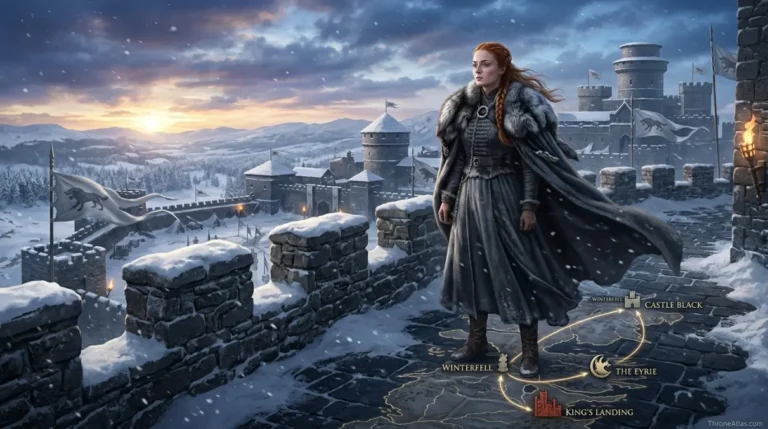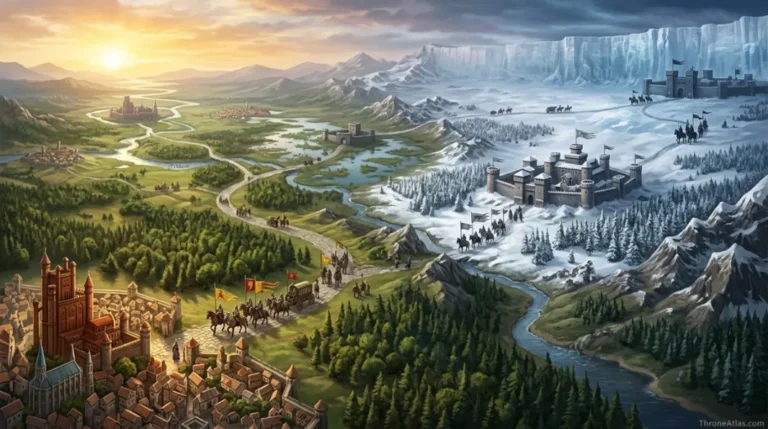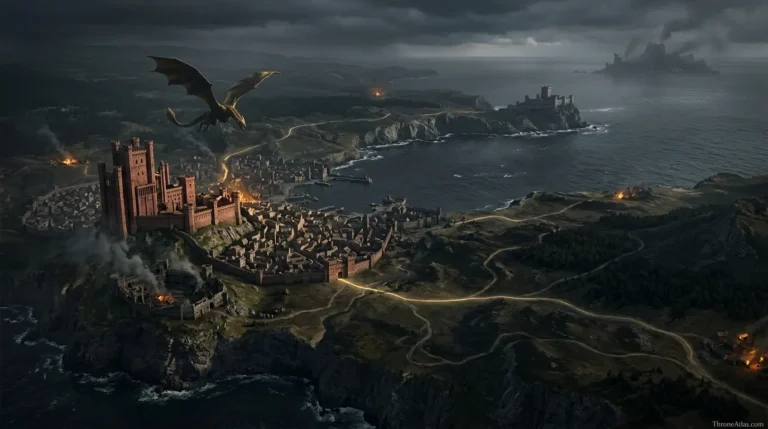
Vhagar Locations Map: Visenya, Laena, Aemond & 181 Years of Dragonflight
Follow Vhagar across nearly two centuries, four principal riders and some of the most consequential dragonflights in Targaryen history—from the Conquest to the Battle Above the Gods Eye.
Read the Map by Place, Route and Confidence
Interactive Vhagar Locations Map: Visenya, Laena, Aemond & 181 Years of Dragonflight
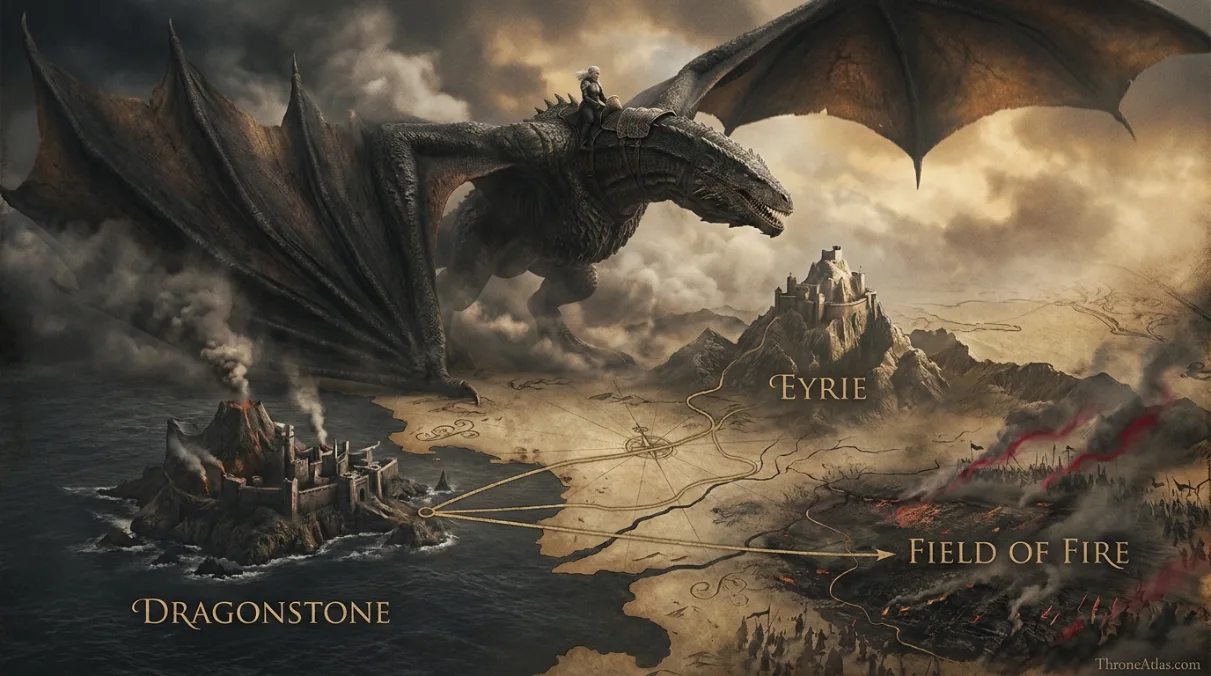
This schematic is a reading aid, not an official cartographic plate. Tap a marker to see why that location matters. The connecting route is intentionally simplified so confirmed geography is not confused with an invented exact path.
Map Navigator
Six Things the Map Makes Clear
1. Map Takeaway
The map is built around multi-rider lifetime dragon map, not a generic Westeros overview.
2. Map Takeaway
Confirmed places are separated from reconstructed corridors so the page does not overstate precision.
3. Map Takeaway
The strongest geographic anchors are Dragonstone, Eyrie and Gods Eye.
4. Map Takeaway
Political, military and environmental geography are explained together instead of being reduced to a pin list.
5. Map Takeaway
Book chronology and adaptation material are kept separate whenever they do not align exactly.
6. Map Takeaway
The map is designed to connect naturally with the surrounding ThroneAtlas location, house, battle and journey pages.
Key Places on the Vhagar Locations Map
| Location | Map confidence | Why it matters |
|---|---|---|
| Dragonstone | Birth / residence | Vhagar hatched here in 52 BC and returned during several riderless periods. |
| Eyrie | Conquest | Visenya secured the Vale and even carried young Ronnel Arryn around the Giant’s Lance. |
| Field of Fire | Conquest battle | Vhagar joined Balerion and Meraxes in the Conquest’s decisive three-dragon battle. |
| King’s Landing / Dragonpit | Royal residence | Vhagar later spent time in the capital and Dragonpit during periods without a rider. |
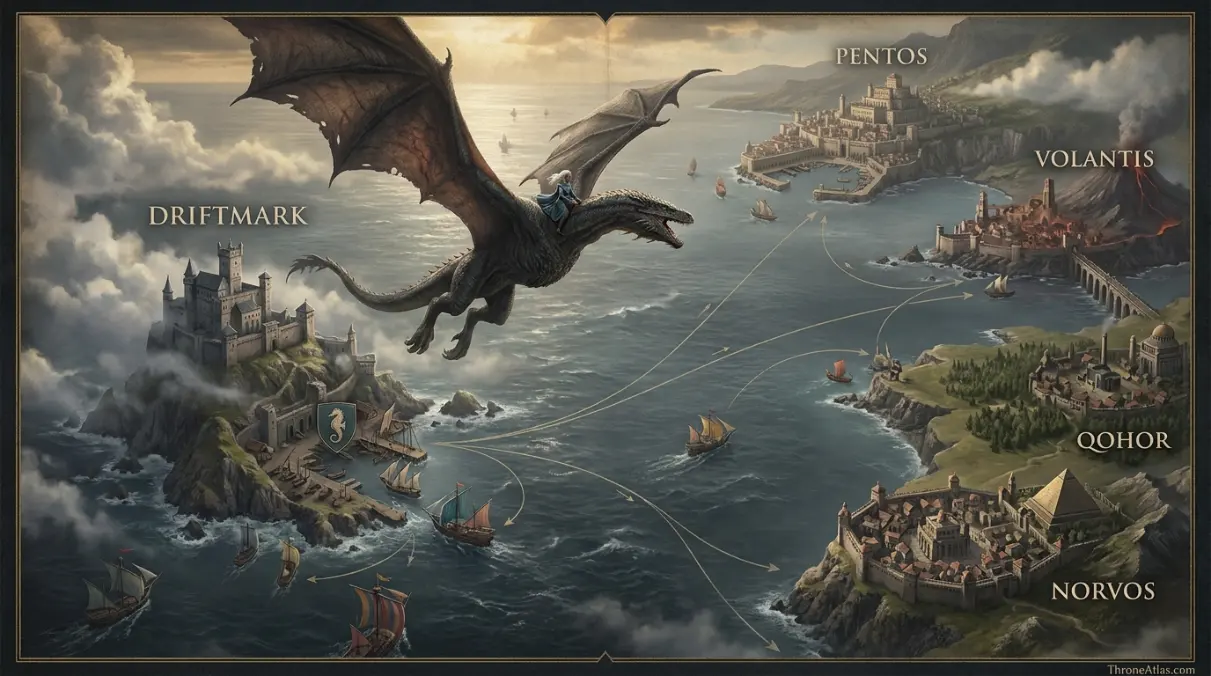
| Pentos & Free Cities | Laena era | Laena and Daemon traveled with Vhagar and Caraxes to Pentos, Volantis, Qohor and Norvos. |
| Driftmark | Laena / Aemond transition | Laena’s funeral was followed by Aemond claiming Vhagar. |
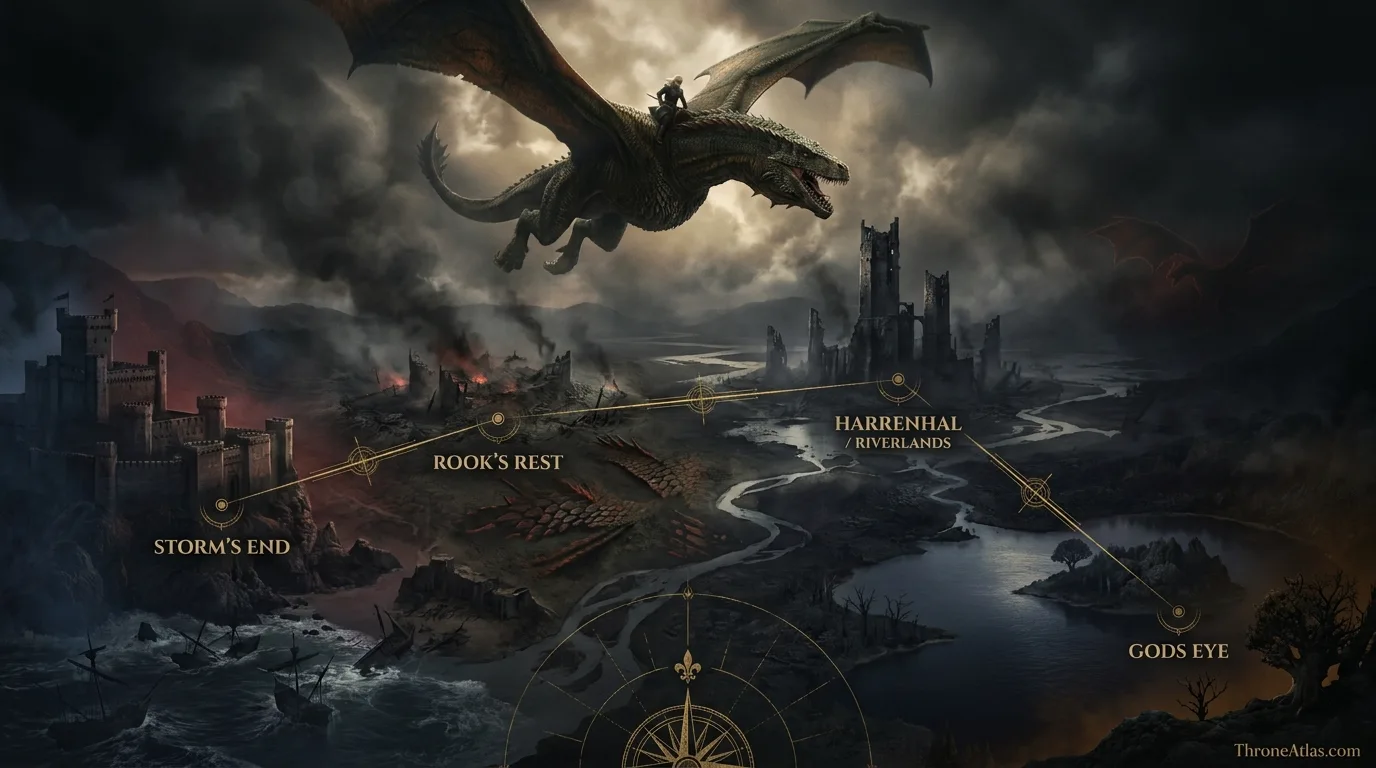
| Storm’s End | Dance | Aemond’s mission brought Vhagar here before the pursuit of Lucerys and Arrax. |
| Rook’s Rest | Dance battle | Vhagar and Sunfyre fought Meleys in one of the war’s defining dragon battles. |
| Harrenhal / Riverlands | Dance campaign | Aemond used Vhagar as a mobile weapon across the riverlands. |
| Gods Eye | Death | Vhagar died fighting Caraxes above the Gods Eye in 130 AC. |
A location marked “reconstructed” is not a guess presented as fact. It means the surrounding event is attested but the surviving narrative does not give enough spatial detail to place a modern-style coordinate. That distinction is especially important for ancient battles, aerial pursuits, siege camps and long sea voyages.
How the Story Moves Across the Map
A dragon born after Valyria, before the Conquest
Vhagar hatches on Dragonstone during the Century of Blood, making her a creature of the Targaryens’ island era rather than a survivor of the Doom itself. That starting point matters. Dragonstone gives the family a defensible base between worlds: Valyrian in culture, geographically close to Westeros and rich in dragon tradition. Vhagar’s life begins there and later returns there during riderless periods, so the island is both origin and recurring home.
From an atlas perspective, this section is best read through the relationship between Dragonstone and Field of Fire. The first anchors the narrative in a named place, while the second shows how the consequences spread into a wider political or military space. That relationship is more useful than forcing the episode into an artificial straight line, because Westerosi history is shaped by roads, seas, fortifications, weather, alliances and the time required to move information as much as by raw distance.
Visenya makes Vhagar a conquest dragon
Under Visenya, Vhagar’s map spreads rapidly across Westeros. She appears at Stokeworth, Gulltown, Crackclaw Point, Stoney Sept, the Field of Fire, the Trident and the Eyrie. She later burns Dornish strongholds during the Dragon’s Wroth. No single interactive map can place every flight without becoming unreadable, so this atlas uses selected campaign anchors and treats the full conquest as a network rather than one continuous line.
From an atlas perspective, this section is best read through the relationship between Eyrie and King’s Landing / Dragonpit. The first anchors the narrative in a named place, while the second shows how the consequences spread into a wider political or military space. That relationship is more useful than forcing the episode into an artificial straight line, because Westerosi history is shaped by roads, seas, fortifications, weather, alliances and the time required to move information as much as by raw distance.
Riderless years and Baelon’s generation
After Visenya’s death, Vhagar spends decades without a rider, much of that time around Dragonstone and later the Dragonpit. Baelon the Brave claims her in 73 AC and rides her in the Fourth Dornish War, where Vhagar joins Caraxes and Vermithor against a Dornish fleet threatening the stormlands. These quieter decades are important because they show dragons as long-lived strategic assets whose history outlasts any one rider.
From an atlas perspective, this section is best read through the relationship between Field of Fire and Pentos & Free Cities. The first anchors the narrative in a named place, while the second shows how the consequences spread into a wider political or military space. That relationship is more useful than forcing the episode into an artificial straight line, because Westerosi history is shaped by roads, seas, fortifications, weather, alliances and the time required to move information as much as by raw distance.
Laena takes Vhagar back across the narrow sea
Laena Velaryon’s years with Vhagar give the dragon a different geography. With Daemon and Caraxes she travels to Pentos, Volantis, Qohor and Norvos, becoming a spectacle across the Free Cities. The route demonstrates how dragonriders can move between elite courts and continents with a speed no conventional army can match. After Laena’s death, Driftmark becomes the pivotal point where Aemond claims the old dragon.
From an atlas perspective, this section is best read through the relationship between King’s Landing / Dragonpit and Driftmark. The first anchors the narrative in a named place, while the second shows how the consequences spread into a wider political or military space. That relationship is more useful than forcing the episode into an artificial straight line, because Westerosi history is shaped by roads, seas, fortifications, weather, alliances and the time required to move information as much as by raw distance.
Aemond turns Vhagar into the Greens’ greatest mobile weapon
During the Dance, Vhagar’s age and size make her a strategic force unlike almost anything else in the war. She flies to Storm’s End, destroys Arrax above Shipbreaker Bay, helps kill Meleys at Rook’s Rest and later accompanies Aemond into the riverlands. Her presence can alter the behavior of armies without a battle occurring. This is why the Aemond-era map includes both battle sites and wider terror zones.
From an atlas perspective, this section is best read through the relationship between Pentos & Free Cities and Storm’s End. The first anchors the narrative in a named place, while the second shows how the consequences spread into a wider political or military space. That relationship is more useful than forcing the episode into an artificial straight line, because Westerosi history is shaped by roads, seas, fortifications, weather, alliances and the time required to move information as much as by raw distance.
The Gods Eye closes the longest arc
Vhagar’s final journey returns the story to Harrenhal and the Gods Eye, where Daemon waits with Caraxes. Their battle ends with both dragons and riders plunging into the lake. Vhagar dies at 181 years old. For a map page, the power of that endpoint comes from contrast: the dragon that helped conquer kingdoms and crossed the Free Cities ends in one lake in the central riverlands. Her life is almost a miniature atlas of Targaryen history.
From an atlas perspective, this section is best read through the relationship between Driftmark and Rook’s Rest. The first anchors the narrative in a named place, while the second shows how the consequences spread into a wider political or military space. That relationship is more useful than forcing the episode into an artificial straight line, because Westerosi history is shaped by roads, seas, fortifications, weather, alliances and the time required to move information as much as by raw distance.
What Changes When You Read the Story Spatially
Read from the first marker to the last and the map becomes a sequence of changing pressures rather than a simple itinerary. Dragonstone establishes the opening context, while Gods Eye shows where the central arc resolves. Between those points, the map distinguishes sites named directly in the histories from zones added only to make the geography legible. That distinction prevents a smooth-looking route from being mistaken for a surveyed road or flight path.
Dragonstone and Eyrie serve different functions on this page. Vhagar hatched here in 52 BC and returned during several riderless periods. Visenya secured the Vale and even carried young Ronnel Arryn around the Giant’s Lance. Seeing them together helps explain why vhagar locations map is best treated as a spatial argument: the story depends on what each place enables, restricts or exposes, not merely on the order in which names appear in a chronology.
Field of Fire and King’s Landing / Dragonpit serve different functions on this page. Vhagar joined Balerion and Meraxes in the Conquest’s decisive three-dragon battle. Vhagar later spent time in the capital and Dragonpit during periods without a rider. Seeing them together helps explain why vhagar locations map is best treated as a spatial argument: the story depends on what each place enables, restricts or exposes, not merely on the order in which names appear in a chronology.
Pentos & Free Cities and Driftmark serve different functions on this page. Laena and Daemon traveled with Vhagar and Caraxes to Pentos, Volantis, Qohor and Norvos. Laena’s funeral was followed by Aemond claiming Vhagar. Seeing them together helps explain why vhagar locations map is best treated as a spatial argument: the story depends on what each place enables, restricts or exposes, not merely on the order in which names appear in a chronology.
The broader value of this atlas is context. A named castle or bay can look isolated in prose, but once it is placed beside nearby regions, rival seats and movement corridors, the choices of rulers and commanders become easier to understand. Distance creates delay. Water creates risk. Fortresses concentrate power. Roads channel armies. Dragons ignore some of those limits while introducing others. The map is useful because it lets those constraints appear together.
That is also why ThroneAtlas avoids false precision. Westerosi sources often preserve destination names while omitting exact road segments, camp positions or mile-by-mile paths. A responsible reconstruction should tell readers where certainty ends. The result may look less absolute than a fictional GPS trace, but it is more faithful to how the geography is actually described.
Canon Confidence & Reconstruction Limits
This page separates firm geographic anchors from interpretive connectors. The goal is to make the map useful without upgrading inference into canon.
Four Details Worth Watching
Dragonstone
Vhagar hatched here in 52 BC and returned during several riderless periods. Its placement on this atlas is intended to clarify the wider story without claiming precision beyond the source record.
Field of Fire
Vhagar joined Balerion and Meraxes in the Conquest’s decisive three-dragon battle. Its placement on this atlas is intended to clarify the wider story without claiming precision beyond the source record.
Pentos & Free Cities
Laena and Daemon traveled with Vhagar and Caraxes to Pentos, Volantis, Qohor and Norvos. Its placement on this atlas is intended to clarify the wider story without claiming precision beyond the source record.
Storm’s End
Aemond’s mission brought Vhagar here before the pursuit of Lucerys and Arrax. Its placement on this atlas is intended to clarify the wider story without claiming precision beyond the source record.
The visual layer should reinforce the text rather than merely decorate it. When you replace these image URLs with final artwork using the same filenames, keep the labels readable on mobile and avoid placing invented borders, distances or roads where the source record is uncertain.
Fast Answers About This Map
Vhagar hatched on Dragonstone in 52 BC and was ridden by Visenya Targaryen, Baelon Targaryen, Laena Velaryon and Aemond Targaryen. Her recorded locations span Aegon’s Conquest, the Eyrie, Dorne, King’s Landing, the Dragonpit, Pentos, Volantis, Qohor, Norvos, Driftmark, Storm’s End, Rook’s Rest, Harrenhal and the riverlands. She died at age 181 in 130 AC during the Battle Above the Gods Eye against Daemon and Caraxes.
Dragonstone is the opening anchor, but Gods Eye is equally important because it shows where the main geographic arc reaches its consequence.
No. Named destinations and major event locations come from the source record, while connecting lines are schematic unless a specific road, river or route is directly established.
Use the confidence labels. They distinguish fixed places from probable regions and explanatory reconstructions, which is especially important for battles, dragonflights and ancient migrations.
What This Atlas Is Based On
- Fire & Blood for Vhagar’s riders, Conquest history, later royal service and Dance of the Dragons campaign.
- The World of Ice & Fire for broader Targaryen and Valyrian chronology.
- Published Westeros and Essos maps for Dragonstone, the Vale, Free Cities, stormlands and riverlands locations.
- Where sources disagree or omit exact coordinates, the page labels the uncertainty rather than silently choosing one version.
Continue Exploring ThroneAtlas
These connected pages expand the same geography from different angles—regional maps for physical context, character routes for movement, house maps for political control and battle maps for moments when the landscape directly shapes the outcome.
Vhagar Locations Map: Visenya, Laena, Aemond & 181 Years of Dragonflight FAQs
Where was Vhagar born?
Vhagar hatched on Dragonstone in 52 BC.
Who were Vhagar’s riders?
Her principal riders were Visenya Targaryen, Baelon Targaryen, Laena Velaryon and Aemond Targaryen.
Did Vhagar fight in Aegon’s Conquest?
Yes. She was Visenya’s dragon and fought in major operations including the Field of Fire.
Did Vhagar visit the Eyrie?
Yes. Visenya flew Vhagar to the Eyrie and secured the Vale’s submission.
Where did Vhagar live when riderless?
She spent long periods around Dragonstone and later the Dragonpit in King’s Landing.
Did Vhagar travel in Essos?
Yes. With Laena, Vhagar traveled with Daemon and Caraxes to Pentos, Volantis, Qohor and Norvos.
Where did Aemond claim Vhagar?
Aemond claimed her after Laena’s funeral on Driftmark.
What happened at Storm’s End?
Aemond departed Storm’s End on Vhagar and pursued Lucerys and Arrax above Shipbreaker Bay.
How did Vhagar die?
She died fighting Caraxes in the Battle Above the Gods Eye in 130 AC.
How old was Vhagar when she died?
She was 181 years old.
These questions focus on the distinctions most likely to matter when reading the vhagar locations map: what is directly named, what is inferred from regional geography, and what should remain uncertain. Where the chronicles preserve competing versions, ThroneAtlas keeps the disagreement visible rather than selecting the most dramatic account simply because it produces a cleaner map.
Why This Geography Matters
Vhagar hatched on Dragonstone in 52 BC and was ridden by Visenya Targaryen, Baelon Targaryen, Laena Velaryon and Aemond Targaryen. Her recorded locations span Aegon’s Conquest, the Eyrie, Dorne, King’s Landing, the Dragonpit, Pentos, Volantis, Qohor, Norvos, Driftmark, Storm’s End, Rook’s Rest, Harrenhal and the riverlands. She died at age 181 in 130 AC during the Battle Above the Gods Eye against Daemon and Caraxes.
Seen as a map rather than a list of names, the story becomes easier to follow because movement, control and consequence share the same frame. That is the purpose of this atlas: not to replace the books or screen adaptation, but to make their geography legible.