Gods Eye Map Sacred Lake, Isle of Faces, Harrenhal, Old Gods, Daemon & Aemond Dragon Lore
The Riverlands lake where old gods mystery and dragon war meet
The Gods Eye is one of Westeros’s most layered map points: a lake, a sacred center, a Riverlands landmark, a Harrenhal neighbor and a legendary dragon-war stage.
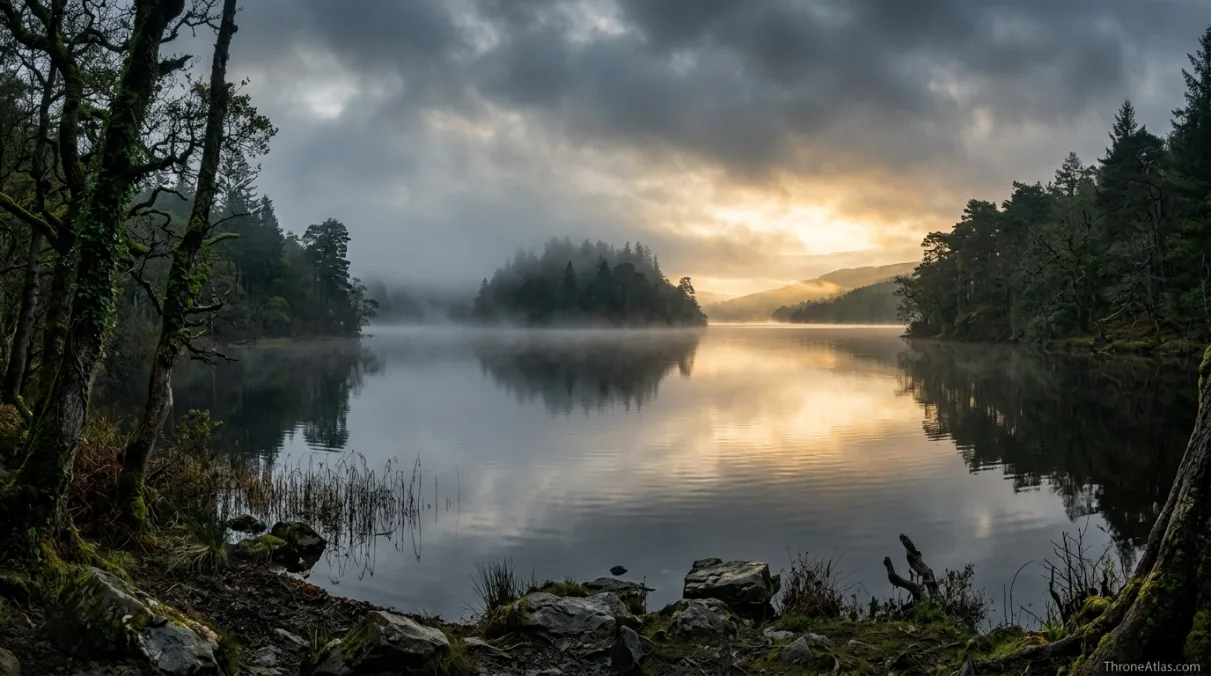
The Gods Eye map shows a large lake in the Riverlands with the Isle of Faces at its center and Harrenhal on its northern shore. The lake matters for old gods lore, the pact between the First Men and the Children of the Forest, weirwood mystery and the Green Men. It also matters to later war geography because Harrenhal dominates the shore and the Dance of the Dragons connects the lake to Daemon Targaryen, Aemond Targaryen, Caraxes, Vhagar and the famous dragon duel above the Gods Eye.
What this Gods Eye Map explains
The cards below give the fast orientation before the deeper route, table and FAQ sections.
Main points on the Gods Eye Map
This simplified graphic is designed for reading flow, not exact geographic scale. Use it to understand order, pressure and consequence.
The castle side brings war, ruin and occupation to the lake.
Harrenhal gives the Gods Eye its most visible human ruin.
The water separates ordinary Riverlands roads from the island’s mystery.
The island is the heart of old gods lore and pact memory.
Carved faces and ancient trees make the island feel outside normal politics.
Routes around the lake shape access, rumor and isolation.
The sky above the lake becomes mythic through Daemon and Aemond.
The lake connects battle, faith and history clusters across the atlas.
Complete Gods Eye Map Guide
A thin map page only lists names. A strong ThroneAtlas page explains how places create pressure, change decisions and connect to the wider atlas. This guide is built to help readers follow the route, understand the stakes at each stop, and continue into connected maps without losing context.
The lake that feels older than the war around it
The Gods Eye is powerful because it feels older than the conflicts around it. Harrenhal, armies and dragon riders come and go, but the lake and island suggest a deeper memory tied to the old gods and the earliest agreements in Westeros.
That oldness makes the lake different from ordinary Riverlands geography. It is not simply a strategic obstacle or water source. It is a symbolic center, especially because the Isle of Faces sits inside it like a hidden heart.
For search intent, readers usually want three answers: where is the Gods Eye, what is the Isle of Faces, and why do Daemon and Aemond connect to the lake. This page is structured around those questions.
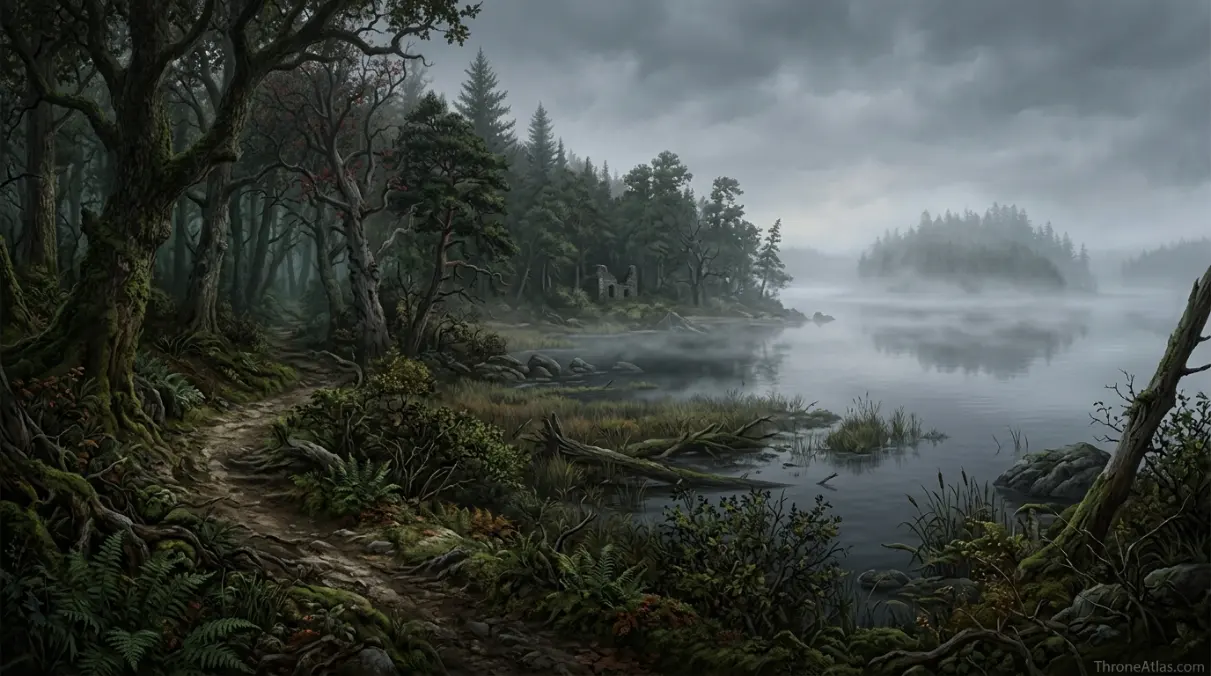
Harrenhal on the northern shore
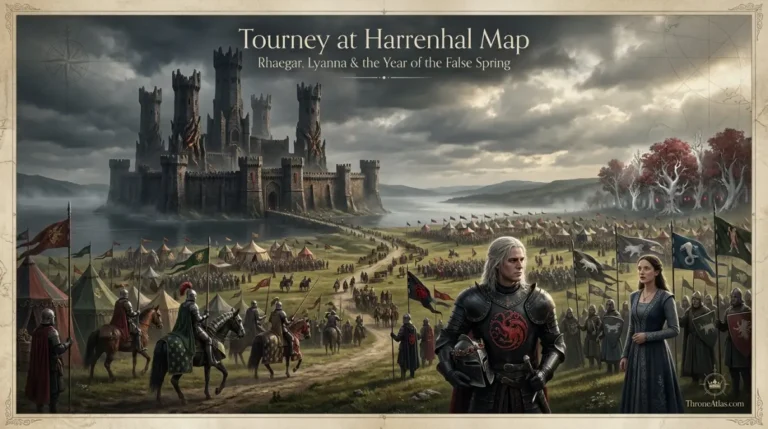
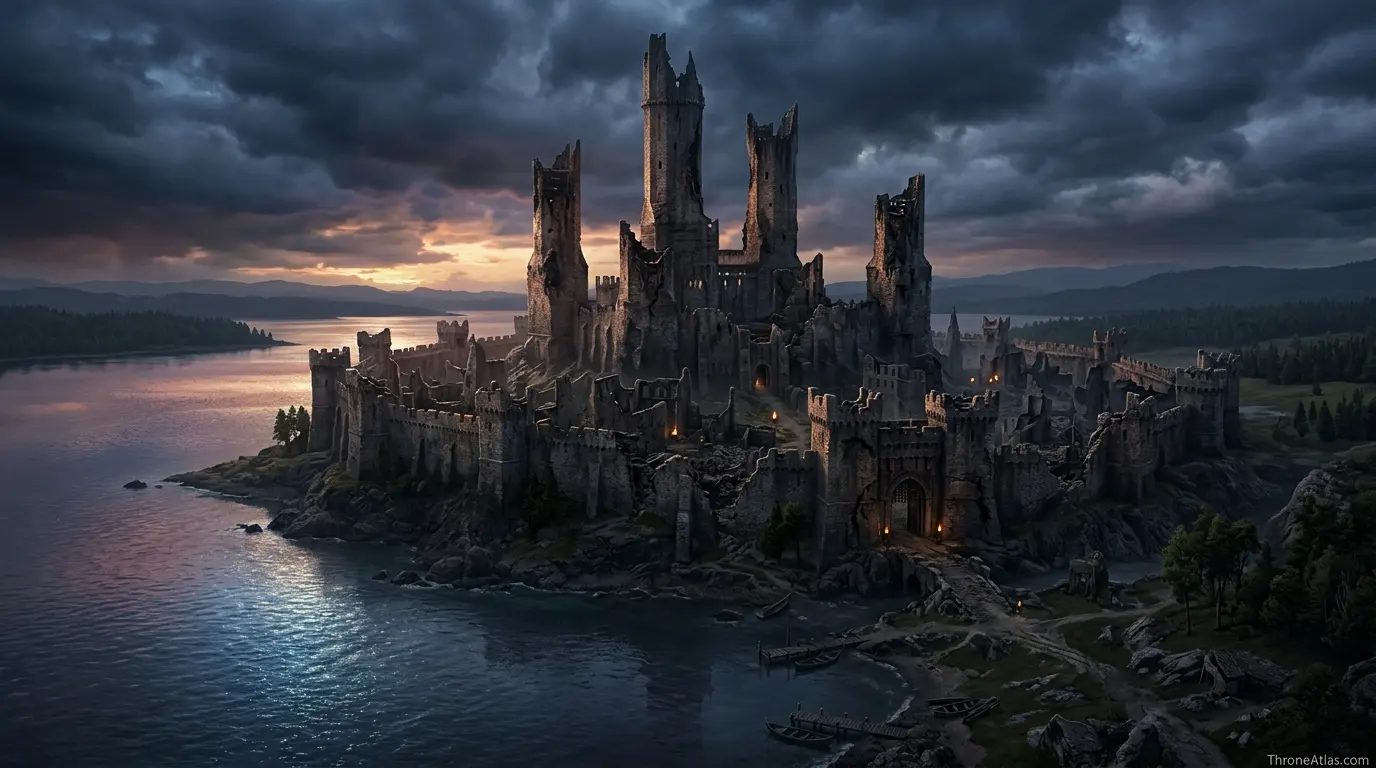
Harrenhal gives the Gods Eye a massive human landmark. The castle’s burned towers create a visual contrast with the sacred lake: ambition and ruin beside old water and hidden trees. This contrast makes the area one of the richest lore maps in Westeros.
The northern shore matters because it turns the lake into more than myth. Armies can gather there. Lords can occupy the castle. Roads can connect campaigns to the water. The Gods Eye is not isolated fantasy scenery; it sits inside contested Riverlands geography.
That is why this page links naturally to Harrenhal and Gods Eye Map, Aegon’s Conquest Map and Dance of the Dragons content.
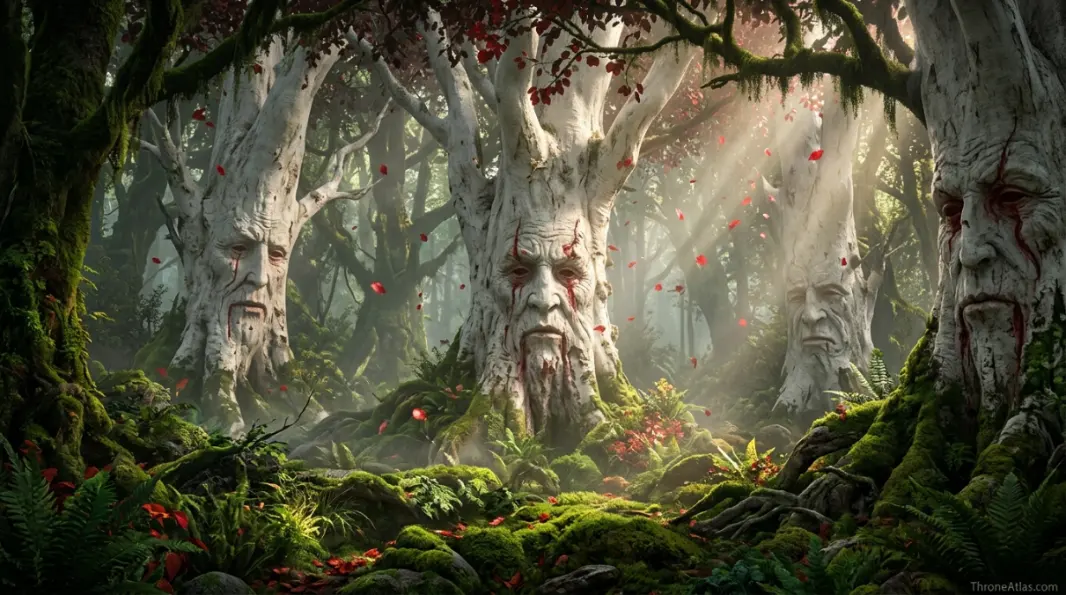
Isle of Faces as the lake’s heart
The Isle of Faces is the reason the Gods Eye has sacred force. Without the island, the lake would still be a major landmark. With the island, it becomes a lore center tied to weirwoods, old gods, pact traditions and mystery.
The island’s isolation is part of its power. Water creates distance from ordinary politics. The trees and faces create a feeling that memory survives there differently than in castles or courts. A map page should preserve that mystery while giving readers enough structure to understand location and relevance.
This section should link to a dedicated Isle of Faces Map page for readers who want the deeper old gods and Children of the Forest angle.
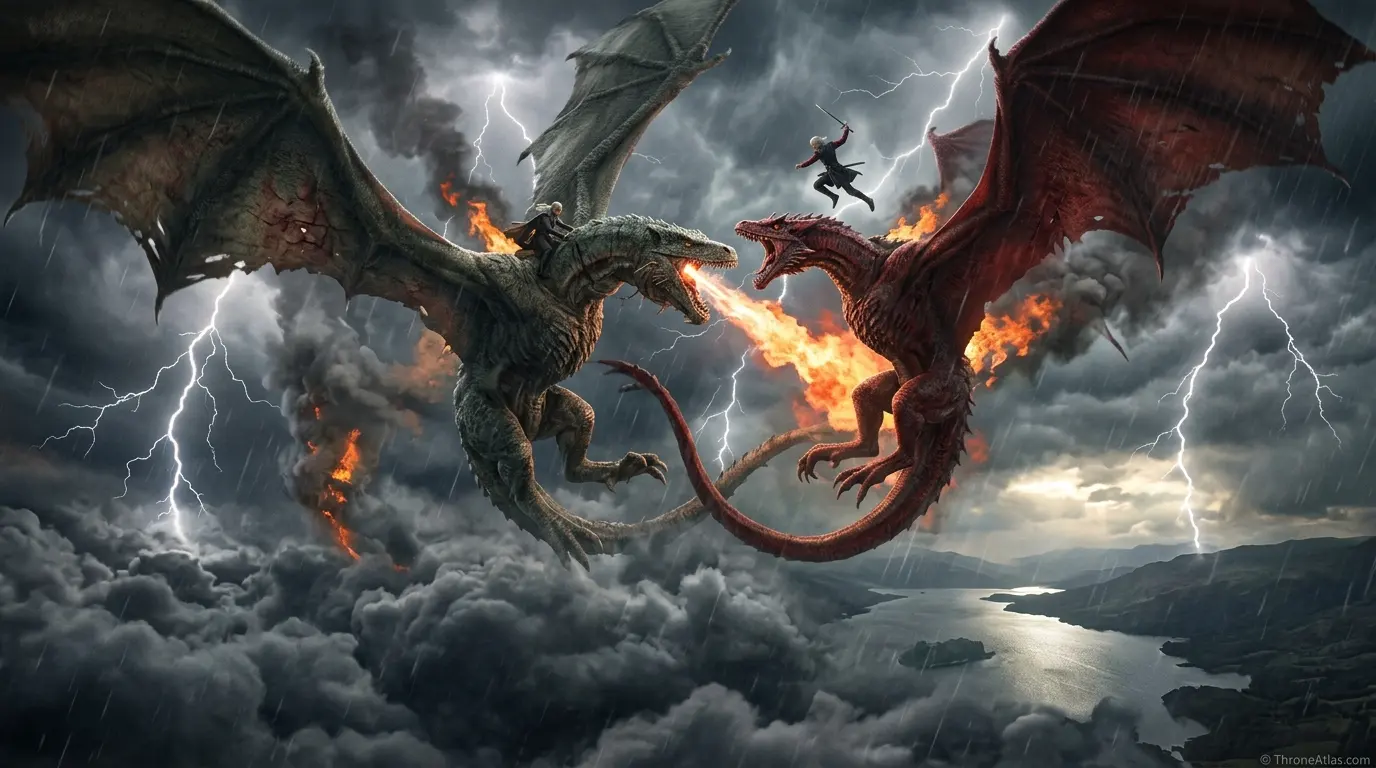
The dragon duel layer
The Gods Eye becomes even more famous through the Dance of the Dragons because the lake is associated with Daemon, Aemond, Caraxes and Vhagar. The event turns sacred geography into battle myth.
The lake matters visually and thematically. A dragon duel over the Gods Eye is not just a fight above water; it is a confrontation above one of Westeros’s oldest symbolic locations. That makes the scene feel larger than military strategy.
A 10/10 page should therefore treat the Gods Eye as three maps at once: physical lake, sacred island system and Dance battle memory.
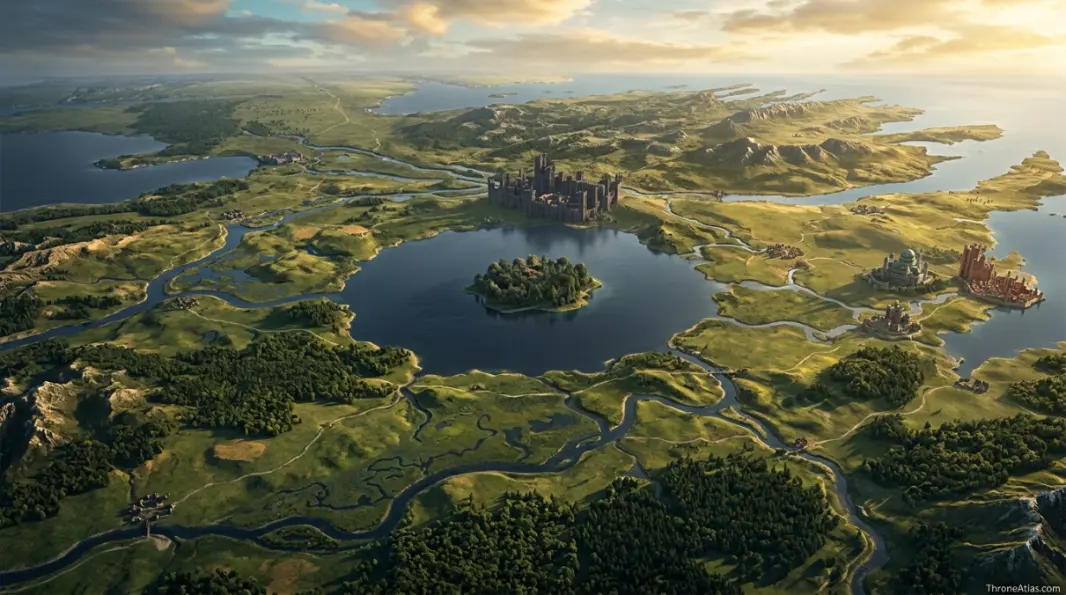
Detailed map reading for Gods Eye Map
The quick route above gives the order, but the real value of this page is the cause-and-consequence logic between map points. A normal recap tells you what happened. A ThroneAtlas map explains why the location made that outcome possible, why the next route opened, and why some choices became almost impossible once characters entered the wrong room, road, crossing or battlefield.
For Gods Eye Map, each stop should be read as a pressure point. Roads control timing, castles control access, rivers control movement, halls control sightlines, islands control isolation, and sacred places control memory. That is why this page is structured as an atlas guide instead of a thin summary.
1. Northern Shore — Harrenhal side
The castle side brings war, ruin and occupation to the lake. In map terms, this point belongs to Riverlands, but its function is larger than place-labeling. It changes leverage, visibility, safety or legitimacy. From here the reader naturally moves toward Harrenhal, carrying the previous consequence forward instead of treating the event as a disconnected scene.
2. Harrenhal — Cursed landmark
Harrenhal gives the Gods Eye its most visible human ruin. In map terms, this point belongs to Riverlands, but its function is larger than place-labeling. It changes leverage, visibility, safety or legitimacy. From here the reader naturally moves toward Lake Surface, carrying the previous consequence forward instead of treating the event as a disconnected scene.
3. Lake Surface — Sacred water
The water separates ordinary Riverlands roads from the island’s mystery. In map terms, this point belongs to Gods Eye, but its function is larger than place-labeling. It changes leverage, visibility, safety or legitimacy. From here the reader naturally moves toward Isle of Faces, carrying the previous consequence forward instead of treating the event as a disconnected scene.
4. Isle of Faces — Spiritual center
The island is the heart of old gods lore and pact memory. In map terms, this point belongs to Gods Eye, but its function is larger than place-labeling. It changes leverage, visibility, safety or legitimacy. From here the reader naturally moves toward Weirwood Groves, carrying the previous consequence forward instead of treating the event as a disconnected scene.
5. Weirwood Groves — Memory landscape
Carved faces and ancient trees make the island feel outside normal politics. In map terms, this point belongs to Isle of Faces, but its function is larger than place-labeling. It changes leverage, visibility, safety or legitimacy. From here the reader naturally moves toward Southern Approaches, carrying the previous consequence forward instead of treating the event as a disconnected scene.
6. Southern Approaches — Hidden boundary
Routes around the lake shape access, rumor and isolation. In map terms, this point belongs to Riverlands, but its function is larger than place-labeling. It changes leverage, visibility, safety or legitimacy. From here the reader naturally moves toward Dragon Duel Airspace, carrying the previous consequence forward instead of treating the event as a disconnected scene.
7. Dragon Duel Airspace — Dance legend
The sky above the lake becomes mythic through Daemon and Aemond. In map terms, this point belongs to Gods Eye, but its function is larger than place-labeling. It changes leverage, visibility, safety or legitimacy. From here the reader naturally moves toward Riverlands Network, carrying the previous consequence forward instead of treating the event as a disconnected scene.
8. Riverlands Network — Lore hub
The lake connects battle, faith and history clusters across the atlas. In map terms, this point belongs to Central Westeros, but its function is larger than place-labeling. It changes leverage, visibility, safety or legitimacy. From here the reader naturally moves toward Northern Shore, carrying the previous consequence forward instead of treating the event as a disconnected scene.
Why this page is built for search intent
People searching for Gods Eye Map usually want a fast answer first: the main location, the correct order, the central turning point and the final consequence. After that, they want context that a short wiki paragraph cannot provide. This page supports both needs with a quick answer, fact cards, route schematic, location cards, deep explanations, table and FAQ.
The stronger SEO angle is topical completeness rather than repetition. The content uses natural entity coverage: region names, castles, houses, battles, characters, terrain and route logic. That helps the page work as a map hub and not just an isolated article.
How to use this Gods Eye Map on ThroneAtlas
Use this page as the orientation layer before opening the deeper location pages. Start with the quick answer to confirm the place, then use the route schematic to understand order, then scan the table if you only need the map role of each point. If you are building a full reading path, follow the related links into the houses, regional maps and battle or lore pages connected to this event.
The page is intentionally written for map-first readers. That means it avoids treating geography as decoration. Every location is included because it changes the balance of power, the available route, the safety of a character, the meaning of a battle, or the historical memory of Westeros. This is the difference between a normal recap and a useful atlas entry.
For best internal SEO, publish this page with a short URL, descriptive image alt text, one H1, and related links using exact but natural anchors such as “Gods Eye Map,” “Riverlands map,” “King’s Landing map,” “Dragonstone map,” “House Targaryen map,” or the specific battle/location phrase that matches the page topic.
Topical authority notes for Gods Eye Map
The page is also designed to answer the follow-up questions readers usually ask after the first map answer. They want to know how the event connects to nearby regions, which houses gain or lose power, which characters move because of the event, and which later routes are changed by the outcome. For Gods Eye Map, that means the map should not stop at Northern Shore or Riverlands Network. It should show how the consequence travels through surrounding castles, roads, rivers, courts, islands or sacred places.
This is especially important for ThroneAtlas because map pages work best as clusters. A reader who lands on this page should be able to continue naturally into a regional guide, a house guide, a battle guide, a character route or a lore explanation. That internal path increases usefulness for humans and gives search engines clearer entity relationships around Westeros geography.
The content also avoids the common thin-page mistake of repeating the title in every sentence. Instead, it uses supporting entities: the relevant kingdom, controlling house, nearby castle, route pressure, battlefield condition, political consequence and memory layer. These supporting terms make the page feel complete without sounding forced.
For final publication, keep the hero image near the top, retain the round compass card, and do not remove the boxed quick answer. That combination gives the page the same visual identity as the master Westeros page while still allowing each event or lore location to have its own voice. The design rhythm should feel familiar across the site, but the analysis should feel unique to the map.
If this page is being used for programmatic publishing, pair it with two to four exact internal links in the first half of the article and several broader atlas links near the end. The safest anchor style is descriptive rather than generic: “Gods Eye Map route,” “Northern Shore location,” “Riverlands Network consequence,” and the specific region or house name. That keeps the page helpful and prevents the internal link block from feeling pasted on.
Before publishing, compare the page against the surrounding cluster and make sure the opening answer, the first image alt text, the first two H2s, and the related-link anchors all reinforce the same search intent. That final pass is what makes the page feel handcrafted rather than generated in bulk. For Gods Eye Map, the reader should leave with a clear route, a clear consequence, and a clear next page to open.
Location order and story function
The table below condenses the event into a scanner-friendly format for readers who want quick orientation before moving into related maps.
| Location | Map role | Region / route | Story function |
|---|---|---|---|
| Northern Shore | Harrenhal side | Riverlands | The castle side brings war, ruin and occupation to the lake. |
| Harrenhal | Cursed landmark | Riverlands | Harrenhal gives the Gods Eye its most visible human ruin. |
| Lake Surface | Sacred water | Gods Eye | The water separates ordinary Riverlands roads from the island’s mystery. |
| Isle of Faces | Spiritual center | Gods Eye | The island is the heart of old gods lore and pact memory. |
| Weirwood Groves | Memory landscape | Isle of Faces | Carved faces and ancient trees make the island feel outside normal politics. |
| Southern Approaches | Hidden boundary | Riverlands | Routes around the lake shape access, rumor and isolation. |
| Dragon Duel Airspace | Dance legend | Gods Eye | The sky above the lake becomes mythic through Daemon and Aemond. |
| Riverlands Network | Lore hub | Central Westeros | The lake connects battle, faith and history clusters across the atlas. |
Gods Eye Map Questions
The Gods Eye is in the Riverlands of Westeros.
The Isle of Faces sits at the center of the lake.
Harrenhal is on the northern shore.
Its sacred importance comes from the Isle of Faces, weirwoods and old gods/pact lore.
It is tied to the legendary Daemon and Aemond dragon confrontation.
Related maps, houses, battles and lore routes
ThroneAtlas is an independent fan-made atlas. Game of Thrones, House of the Dragon and related names belong to their respective rights holders. This page is for educational, lore-navigation and fan-reference purposes.